

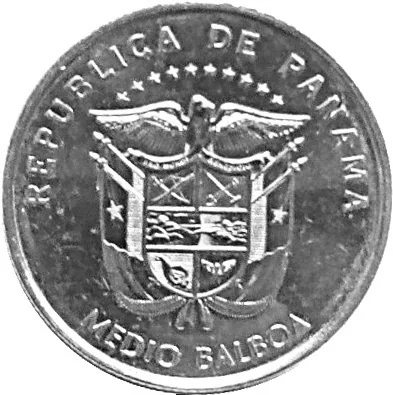
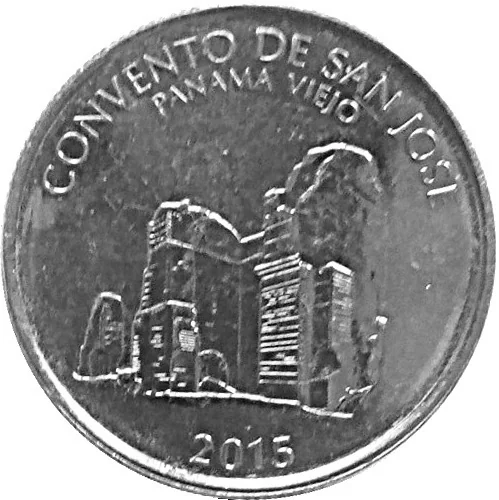
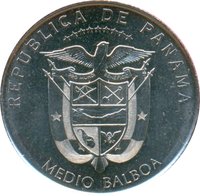
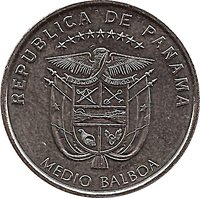
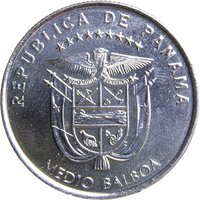
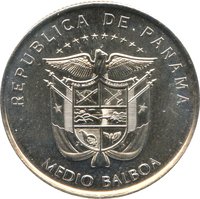
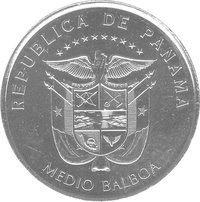
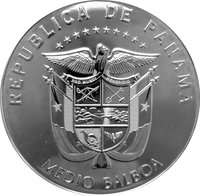
Obverse
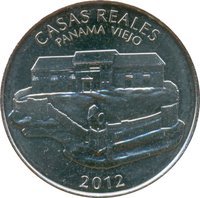
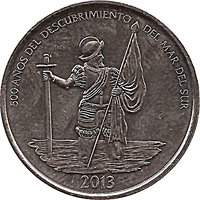
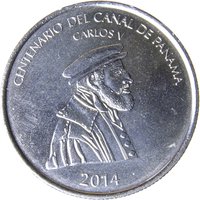
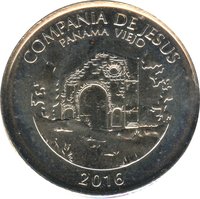
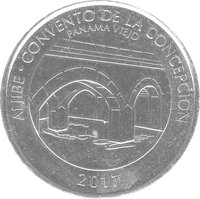
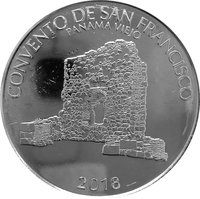
Reverse
Edge
Reeded
Categories
| Building> Religious building |
| Symbols> Coat of Arms |
Mints
| Name | Mark |
|---|---|
| Royal Canadian Mint of Winnipeg | — |
Mintings
| Year | Mint Mark | Mintage | Quality | Collection |
|---|---|---|---|---|
| 2015 | — | 3,000,000 |
Historical background
Panama's currency situation in 2015 was defined by its unique and long-standing monetary framework, which remained a cornerstone of economic stability. The country is officially "dollarized," meaning the US dollar is the legal tender and circulates as the sole paper currency. This system, in place since 1904, eliminates Panama's own monetary policy and central bank control over currency issuance, but in return, it provides low inflation, reduces exchange rate risk, and fosters confidence for international trade and investment, which is vital for its service-based economy, particularly the Panama Canal.
Alongside the US dollar, Panama also mints its own fractional coinage, the Panamanian balboa, which is pegged at a 1:1 parity with the dollar. In 2015, these coins (such as the 1, 5, 10, 25, and 50 centésimos pieces) circulated interchangeably with US coins for everyday transactions. This dual-coinage system functioned seamlessly, with no distinction made between a US quarter and a 25-centésimo coin in practical use. The country's financial stability was further supported by a robust banking center and fiscal discipline.
The primary economic challenges in 2015 were not related to currency volatility but to external factors and fiscal management. As a dollarized economy, Panama was susceptible to the monetary policy decisions of the US Federal Reserve, with expectations of rising US interest rates posing a potential future risk for borrowing costs. Domestically, concerns centered on maintaining fiscal deficit targets and public debt levels amidst major infrastructure spending, including the ambitious expansion of the Panama Canal, which was nearing completion. Thus, the currency itself was a source of stability, while policymakers focused on navigating broader economic pressures.
Alongside the US dollar, Panama also mints its own fractional coinage, the Panamanian balboa, which is pegged at a 1:1 parity with the dollar. In 2015, these coins (such as the 1, 5, 10, 25, and 50 centésimos pieces) circulated interchangeably with US coins for everyday transactions. This dual-coinage system functioned seamlessly, with no distinction made between a US quarter and a 25-centésimo coin in practical use. The country's financial stability was further supported by a robust banking center and fiscal discipline.
The primary economic challenges in 2015 were not related to currency volatility but to external factors and fiscal management. As a dollarized economy, Panama was susceptible to the monetary policy decisions of the US Federal Reserve, with expectations of rising US interest rates posing a potential future risk for borrowing costs. Domestically, concerns centered on maintaining fiscal deficit targets and public debt levels amidst major infrastructure spending, including the ambitious expansion of the Panama Canal, which was nearing completion. Thus, the currency itself was a source of stability, while policymakers focused on navigating broader economic pressures.
Series: Panama Viejo
🌱 Fairly Common