

2 Euro (Easter Rising) – Ireland
Circulating commemorative coins
Commemoration: 100th Anniversary of the Easter Rising
Ireland
Context
Year: 2016
Issuer: Ireland 
Issuing organization: Central bank of Ireland
Period:
(since 1937)
Currency:
(since 2002)
Total mintage: 4,524,000
Material
References
KM: #Click to copy to clipboard88
Numista: #80921
Value
Exchange value: 2 EUR = $2.36
Inflation-adjusted value: 2.51 EUR
Obverse
Description:
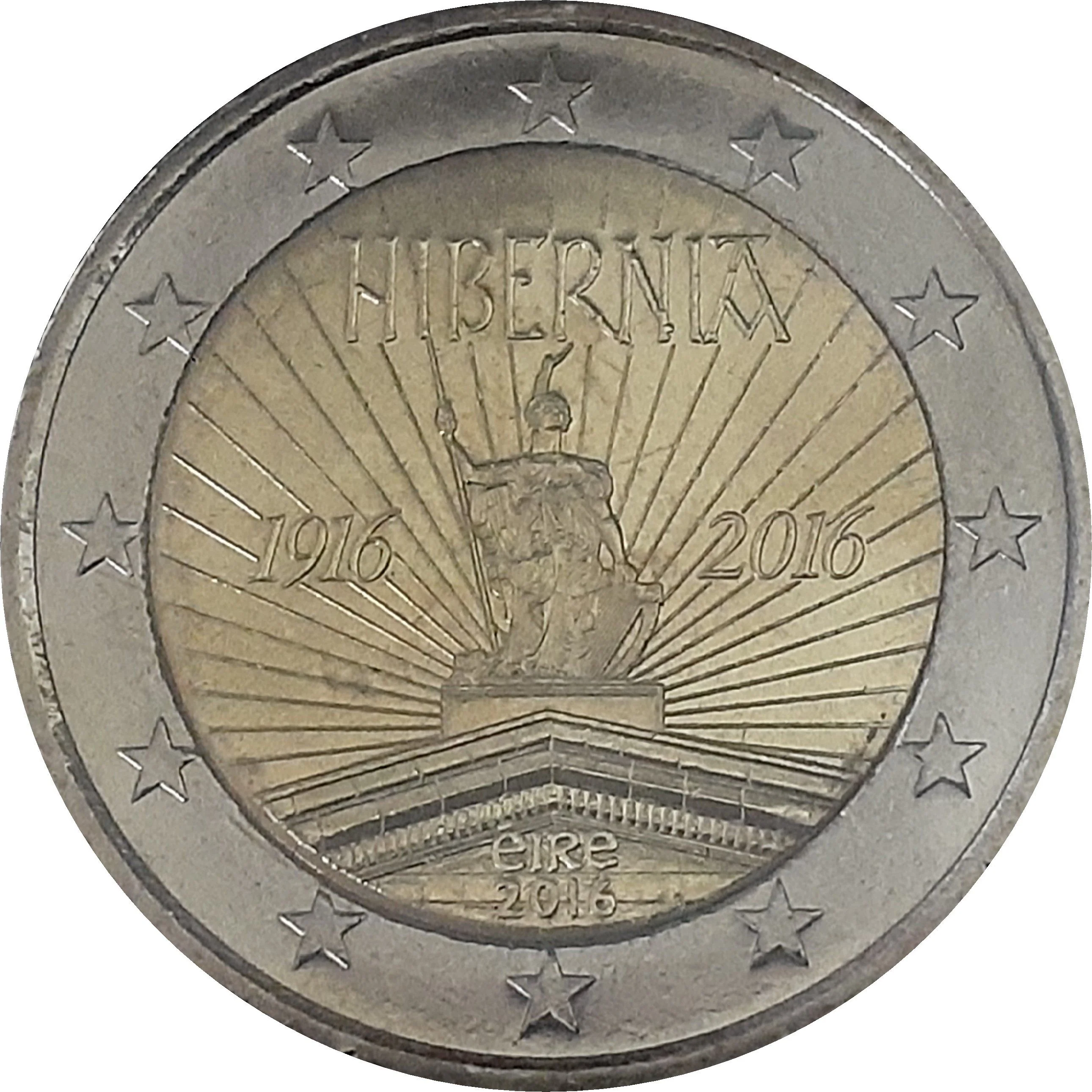
The design features Hibernia, the statue atop Dublin's General Post Office—a building seized during the 1916 Easter Rising. A national symbol sculpted by John Smyth, she witnesses Ireland's century of growth since the Proclamation. She gazes forward, representing Ireland's past, present, and future. 'HIBERNIA' is inscribed in Book of Kells-inspired lettering. Sunrays symbolize the nation's dawn, flanked by '1916' and '2016'. 'éire' and '2016' appear below. The outer ring bears the 12 stars of the EU.
Inscription:
HIBERNIA
1916 2016
éire
2016
1916 2016
éire
2016
Translation:
IRELAND
1916 2016
IRELAND
2016
1916 2016
IRELAND
2016
Scripts: Latin (Gaelic), Latin
Engraver: Emmet Mullins
Reverse
Edge
Legend:
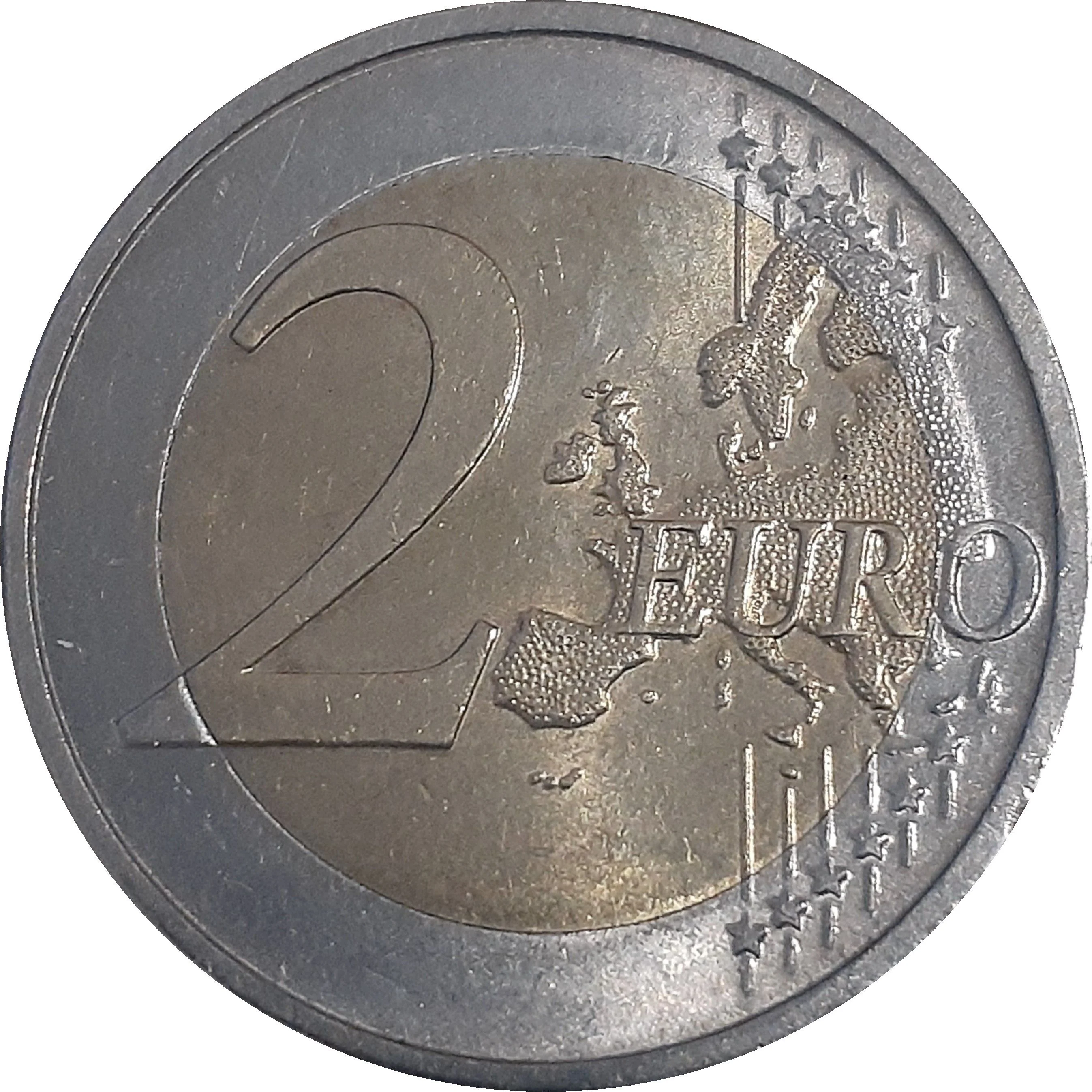
2 ** 2 ** 2 ** 2 ** 2 ** 2 **
Mints
| Name | Mark |
|---|---|
| Irish Mint | — |
Mintings
| Year | Mint Mark | Mintage | Quality | Collection |
|---|---|---|---|---|
| 2016 | — | 4,500,000 | ||
| 2016 | — | 24,000 | Proof |
Historical background
In 2016, Ireland remained a full member of the Eurozone, using the euro (€) as its official and sole currency since its adoption in 2002. The country's monetary policy was therefore set by the European Central Bank (ECB) in Frankfurt, with a primary focus on price stability across the entire currency bloc. This period followed the tumultuous aftermath of the 2008 financial crisis, during which Ireland had exited its EU-IMF bailout programme in 2013. By 2016, the economy was in a phase of strong recovery, dubbed the "Celtic Phoenix," with GDP growth among the highest in the EU, which bolstered confidence in the euro's stability within the country.
A significant currency-related issue in 2016 was the persistent volatility and depreciation of the pound sterling following the UK's Brexit referendum in June. As Ireland's largest trading partner, the UK's decision created immediate economic uncertainty. The sharp fall in sterling's value posed a serious challenge to Irish exporters, making their goods and services more expensive in the vital British market, while also increasing the risk of cheaper UK imports undermining Irish domestic producers. This exchange rate shock highlighted the unique complexities of sharing a currency with Europe while being so deeply economically intertwined with a non-euro neighbour.
Domestically, there was little political appetite or serious public debate about leaving the euro, which was broadly seen as a source of stability during the previous crisis. However, the year was not without currency-focused discussions. These primarily centred on housing and banking, as the recovering economy faced issues of rising mortgage rates (influenced by ECB policy) and the legacy of non-performing loans from the crash. Furthermore, the continued use of sterling in cash transactions along the border with Northern Ireland was a practical reality, a reminder of the island's complex economic geography that would become a central focus in the post-Brexit negotiations that lay ahead.
A significant currency-related issue in 2016 was the persistent volatility and depreciation of the pound sterling following the UK's Brexit referendum in June. As Ireland's largest trading partner, the UK's decision created immediate economic uncertainty. The sharp fall in sterling's value posed a serious challenge to Irish exporters, making their goods and services more expensive in the vital British market, while also increasing the risk of cheaper UK imports undermining Irish domestic producers. This exchange rate shock highlighted the unique complexities of sharing a currency with Europe while being so deeply economically intertwined with a non-euro neighbour.
Domestically, there was little political appetite or serious public debate about leaving the euro, which was broadly seen as a source of stability during the previous crisis. However, the year was not without currency-focused discussions. These primarily centred on housing and banking, as the recovering economy faced issues of rising mortgage rates (influenced by ECB policy) and the legacy of non-performing loans from the crash. Furthermore, the continued use of sterling in cash transactions along the border with Northern Ireland was a practical reality, a reminder of the island's complex economic geography that would become a central focus in the post-Brexit negotiations that lay ahead.
Series: Ireland 2 euro commemoratives

🌱 Very Common