

2 Euro (European Union membership) – Ireland
Circulating commemorative coins
Commemoration: 50 Years of European Union Membership
Ireland
Context
Year: 2023
Issuer: Ireland 
Issuing organization: Central bank of Ireland
Period:
(since 1937)
Currency:
(since 2002)
Total mintage: 501,000
Material
References
KM: #Click to copy to clipboard106
Numista: #368762
Value
Exchange value: 2 EUR = $2.36
Inflation-adjusted value: 2.24 EUR
Obverse
Description:
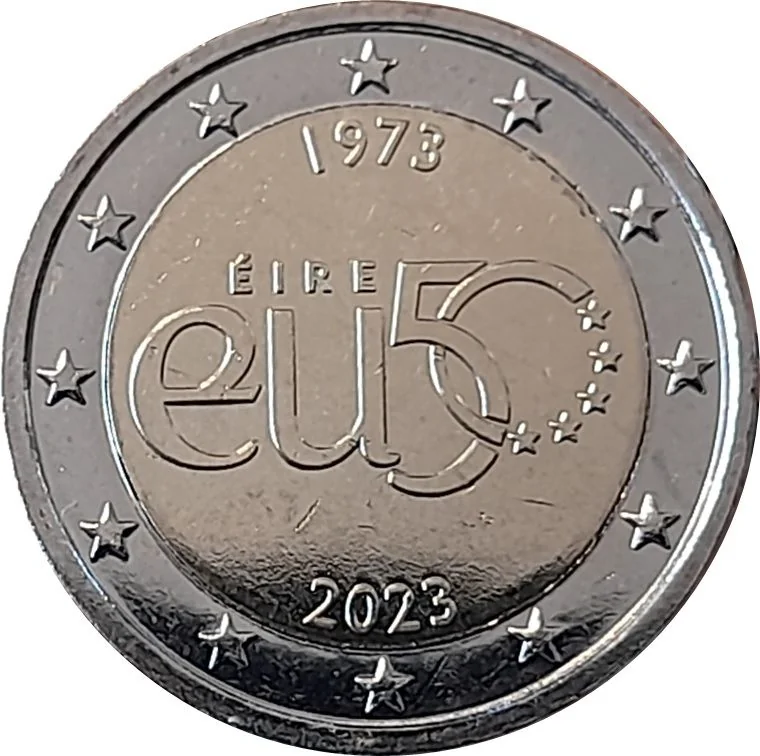
This coin modifies the ‘EU50’ logo marking Ireland’s 50th anniversary of EU membership. ‘ÉIRE’ is placed above the logo, with ‘1973’ and ‘2023’ noting the year of accession and issue. The outer ring features the 12 stars of the European flag.
Inscription:
1973
ÉIRE
eu50
2023
ÉIRE
eu50
2023
Translation:
IRELAND
50 years
50 years
Scripts: Latin (Gaelic), Latin
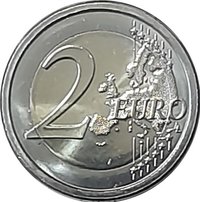
Reverse
Edge
The sequence "2 ★ ★" repeated six times alternately upright and inverted
Legend:
2 ★ ★ 2 ★ ★2 ★ ★2 ★ ★2 ★ ★2 ★ ★
Categories
| Map |
Mints
| Name | Mark |
|---|---|
| Irish Mint | — |
Mintings
| Year | Mint Mark | Mintage | Quality | Collection |
|---|---|---|---|---|
| 2023 | — | 500,000 | ||
| 2023 | — | 1,000 | Proof |
Historical background
In 2023, Ireland, as a committed member of the Eurozone, continued to use the euro (€) as its sole legal tender. This provided significant stability and eliminated currency risk for trade, given that the majority of its exports and imports are with other EU nations, particularly the UK and mainland Europe. The common currency, managed by the European Central Bank (ECB), insulated Ireland from the direct exchange rate volatility seen in non-Eurozone neighbours like the United Kingdom, which proved advantageous during a year of global economic uncertainty.
Domestically, the primary monetary policy focus was on the ECB's aggressive interest rate hikes throughout the year, aimed at tackling high inflation across the Eurozone. While Irish inflation began to moderate from its 2022 peak, it remained a concern, driven by persistent high costs in services, energy, and food. These rising ECB rates directly increased mortgage costs for a large number of Irish households on tracker or variable rates, squeezing disposable income and cooling housing market activity, even as employment remained robust.
A significant ongoing discussion, though not a crisis in 2023, centred on the continued use of physical cash. The trend towards digital payments accelerated, with a notable decline in ATM withdrawals and a growing retail preference for card and contactless payments. This prompted government commitments to legislate for the protection of cash access, ensuring it remained a viable payment option for all citizens, particularly the elderly and those in rural communities. Thus, the year was marked by the challenges of Eurozone monetary tightening and the societal shift towards a digital economy, all within the stable framework of the single currency.
Domestically, the primary monetary policy focus was on the ECB's aggressive interest rate hikes throughout the year, aimed at tackling high inflation across the Eurozone. While Irish inflation began to moderate from its 2022 peak, it remained a concern, driven by persistent high costs in services, energy, and food. These rising ECB rates directly increased mortgage costs for a large number of Irish households on tracker or variable rates, squeezing disposable income and cooling housing market activity, even as employment remained robust.
A significant ongoing discussion, though not a crisis in 2023, centred on the continued use of physical cash. The trend towards digital payments accelerated, with a notable decline in ATM withdrawals and a growing retail preference for card and contactless payments. This prompted government commitments to legislate for the protection of cash access, ensuring it remained a viable payment option for all citizens, particularly the elderly and those in rural communities. Thus, the year was marked by the challenges of Eurozone monetary tightening and the societal shift towards a digital economy, all within the stable framework of the single currency.
Series: Ireland 2 euro commemoratives

🌱 Common