

1 escudo (Establishment of the Republic) – Portugal
Add to wishlist
Circulating commemorative coins
Commemoration: Establishment of the Republic in 1910
Series: System 1912-1916
Portugal
Obverse
Description:
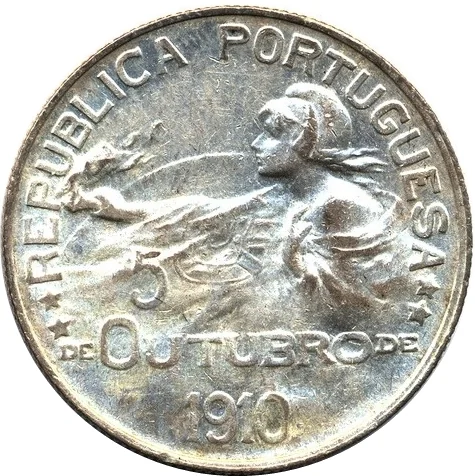
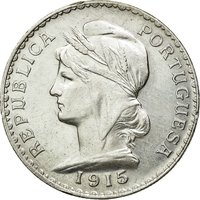
Liberty, torch raised, lighting her path. Words encircle the top; the republic's birth date below.
Inscription:
REPUBLICA PORTUGUESA
5
DE OUTUBRO DE
1910
5
DE OUTUBRO DE
1910
Translation:
Portuguese Republic
5th of October
1910
5th of October
1910
Script: Latin
Language: Portuguese
Engraver: Domingos Alves do Rego
Reverse
Description:
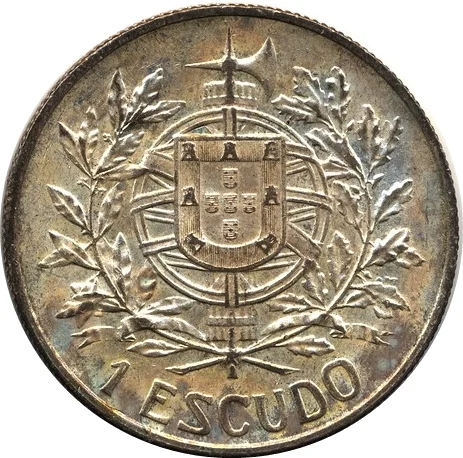
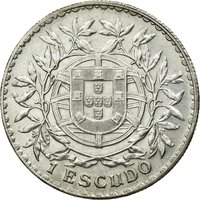
Portuguese crest on globe, encircled by wreath and fasces. Value below.
Inscription:
1 ESCUDO
Script: Latin
Engraver: Domingos Alves do Rego
Edge
Reeded
Mints
| Name | Mark |
|---|---|
| Imprensa Nacional - Casa da Moeda | — |
Mintings
| Year | Mint Mark | Mintage | Quality | Collection |
|---|---|---|---|---|
| 1914 | — | 1,000,000 |
Historical background
In 1914, Portugal's currency situation was defined by its adherence to the gold standard, a system it had officially joined in 1854. The Portuguese currency, the real (plural réis), was backed by gold reserves, with the value of the milréis (1,000 réis) fixed against the British pound sterling. This linkage provided stability for international trade and investment, which was crucial for a nation with a significant colonial empire and close financial ties to Britain. However, the system's rigidity also meant that the money supply was directly constrained by the country's limited gold holdings, restricting the government's ability to respond to economic shocks.
Domestically, Portugal's economy was relatively underdeveloped and heavily reliant on agriculture, with a growing but fragile industrial sector. Public finances were chronically strained due to decades of political instability, royal extravagance, and high external debt. The gold standard required fiscal discipline that successive governments struggled to maintain. By the eve of World War I, Portugal's gold reserves were already under pressure, and the economy was vulnerable to external disruptions, with a significant portion of state revenue dedicated to servicing foreign loans.
The outbreak of war in August 1914 triggered an immediate crisis. Fearing capital flight and a run on gold, Portugal, like many other European nations, swiftly suspended the convertibility of its currency into gold. This emergency measure severed the milréis from its gold anchor, allowing the government greater flexibility to finance its eventual entry into the war but opening the door to inflation and currency depreciation. Thus, 1914 marked the decisive end of the classical gold standard era in Portugal, setting the stage for the severe financial instability and monetary experiments that would characterize the following decades.
Domestically, Portugal's economy was relatively underdeveloped and heavily reliant on agriculture, with a growing but fragile industrial sector. Public finances were chronically strained due to decades of political instability, royal extravagance, and high external debt. The gold standard required fiscal discipline that successive governments struggled to maintain. By the eve of World War I, Portugal's gold reserves were already under pressure, and the economy was vulnerable to external disruptions, with a significant portion of state revenue dedicated to servicing foreign loans.
The outbreak of war in August 1914 triggered an immediate crisis. Fearing capital flight and a run on gold, Portugal, like many other European nations, swiftly suspended the convertibility of its currency into gold. This emergency measure severed the milréis from its gold anchor, allowing the government greater flexibility to finance its eventual entry into the war but opening the door to inflation and currency depreciation. Thus, 1914 marked the decisive end of the classical gold standard era in Portugal, setting the stage for the severe financial instability and monetary experiments that would characterize the following decades.
Series: System 1912-1916
🌱 Fairly Common