

Obverse
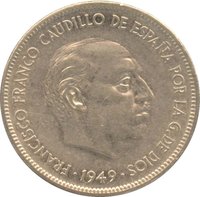
Description:
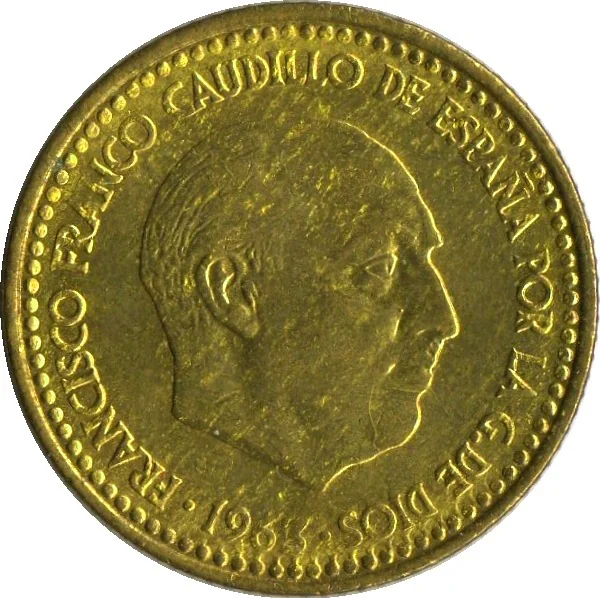
Franco facing right.
Inscription:
FRANCISCO FRANCO CAUDILLO DE ESPAÑA POR LA G. DE DIOS
· 1963 ·
· 1963 ·
Translation:
Francisco Franco, Leader of Spain by the Grace of God
· 1963 ·
· 1963 ·
Script: Latin
Language: Spanish
Engraver: Manuel Marín Jimeno
Designer: Mariano Benlliure Gil
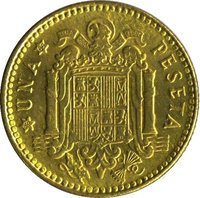
Reverse
Description:
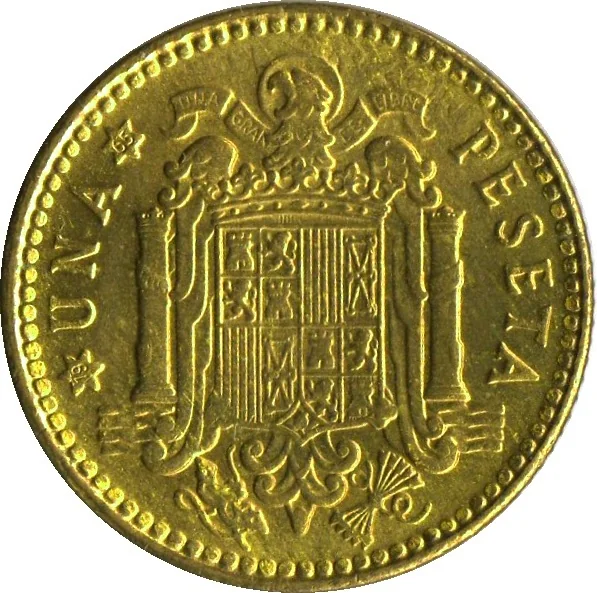
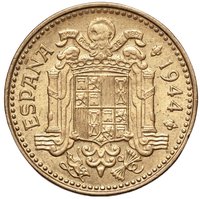
Coat of arms with yoke and arrows.
Inscription:
🟌 UNA 🟌 PESETA
UNA GRANDE LIBRE
PLUS ULTRA
UNA GRANDE LIBRE
PLUS ULTRA
Translation:
One Peseta
One Great Free
Further Beyond
One Great Free
Further Beyond
Script: Latin
Engraver: Manuel Marín Jimeno
Edge
Reeded
Categories
| Person> Military leader |
| Person> Politician |
| Symbols> Coat of Arms |
Mints
| Name | Mark |
|---|---|
| Royal Mint of Madrid | (🟌) |
Mintings
| Year | Mint Mark | Mintage | Quality | Collection |
|---|---|---|---|---|
| 1948 | — | 5,000 | ||
| 1948 | — | 15,000,000 | ||
| 1949 | — | 27,600,000 | ||
| 1950 | — | 4,000,000 | ||
| 1951 | — | 9,185,000 | ||
| 1952 | — | 5,000 | ||
| 1953 | — | 34,000,000 | ||
| 1954 | — | 37,000,000 | ||
| 1954 | — | 6,000,000 | ||
| 1956 | — | 13,000,000 | ||
| 1956 | — | 108,000,000 | ||
| 1960 | — | 45,160,000 | ||
| 1961 | — | 25,830,000 | ||
| 1962 | — | 66,252,000 | ||
| 1963 | — | 37,000,000 | ||
| 1963 | 🟌 | 36,000,000 | ||
| 1964 | — | 80,000,000 | ||
| 1965 | 🟌 | — | ||
| 1965 | — | 70,000,000 | ||
| 1966 | — | 63,000,000 | ||
| 1967 | — | 11,300,000 |
Historical background
In 1948, Spain's currency situation was defined by the severe economic isolation and autarkic policies of the early Franco regime. The devastation of the Civil War (1936-1939) and the subsequent exclusion from the post-war Marshall Plan had crippled the economy, leading to chronic shortages, a vast black market (estraperlo), and rampant inflation. The official currency, the peseta, was grossly overvalued at multiple artificial exchange rates set by the government, which stifled legitimate foreign trade and investment. This created a complex and inefficient system where the real value of the peseta was determined on the thriving black market, often at a fraction of its official rate.
Recognizing the unsustainable crisis, the regime initiated a cautious and partial shift away from strict autarky in the late 1940s. The key development was the 1959 Stabilization Plan, but its groundwork began with earlier measures. In 1948, Spain signed bilateral trade agreements with the United States and took initial steps to liberalize its foreign exchange regime. Most significantly, a new, more realistic fixed exchange rate was established for certain commercial transactions, creating a "preferential" rate that moved the peseta closer to its black-market value. This was a tentative first move to attract vital foreign currency and goods.
Consequently, 1948 represents a transitional year from the peak of post-war economic desperation toward the managed, state-capitalist model that would characterize the 1950s. The currency measures of that year did not immediately end hardship—rationing and controls persisted—but they marked the regime's pragmatic acknowledgment that some economic liberalization was necessary for survival. These steps began the slow process of reintegrating Spain into the world economy, a path that would ultimately lead to the decisive reforms of the 1959 Stabilization Plan.
Recognizing the unsustainable crisis, the regime initiated a cautious and partial shift away from strict autarky in the late 1940s. The key development was the 1959 Stabilization Plan, but its groundwork began with earlier measures. In 1948, Spain signed bilateral trade agreements with the United States and took initial steps to liberalize its foreign exchange regime. Most significantly, a new, more realistic fixed exchange rate was established for certain commercial transactions, creating a "preferential" rate that moved the peseta closer to its black-market value. This was a tentative first move to attract vital foreign currency and goods.
Consequently, 1948 represents a transitional year from the peak of post-war economic desperation toward the managed, state-capitalist model that would characterize the 1950s. The currency measures of that year did not immediately end hardship—rationing and controls persisted—but they marked the regime's pragmatic acknowledgment that some economic liberalization was necessary for survival. These steps began the slow process of reintegrating Spain into the world economy, a path that would ultimately lead to the decisive reforms of the 1959 Stabilization Plan.
🌱 Very Common