

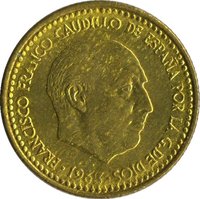
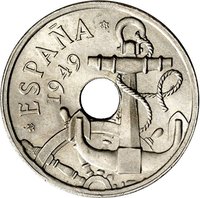
Obverse
Description:
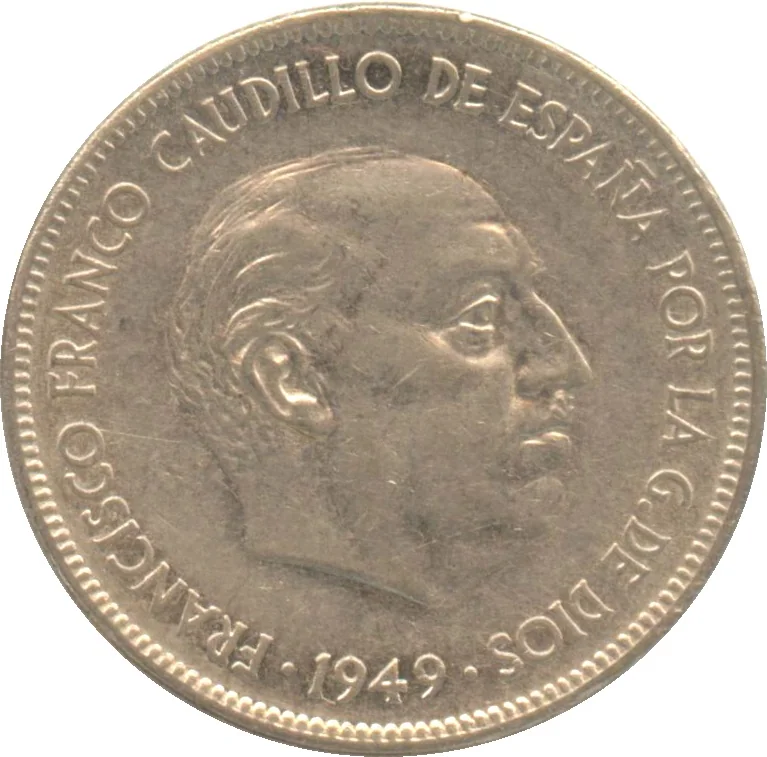
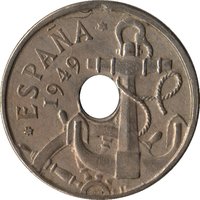
Franco facing right.
Inscription:
FRANCISCO FRANCO CAUDILLO DE ESPAÑA POR LA G. DE DIOS
· 1949 ·
· 1949 ·
Translation:
Francisco Franco, Caudillo of Spain by the Grace of God
· 1949 ·
· 1949 ·
Script: Latin
Language: Spanish
Engraver: Manuel Marín Jimeno
Designer: Mariano Benlliure Gil
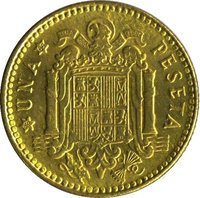
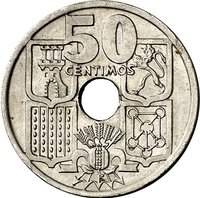
Reverse
Description:
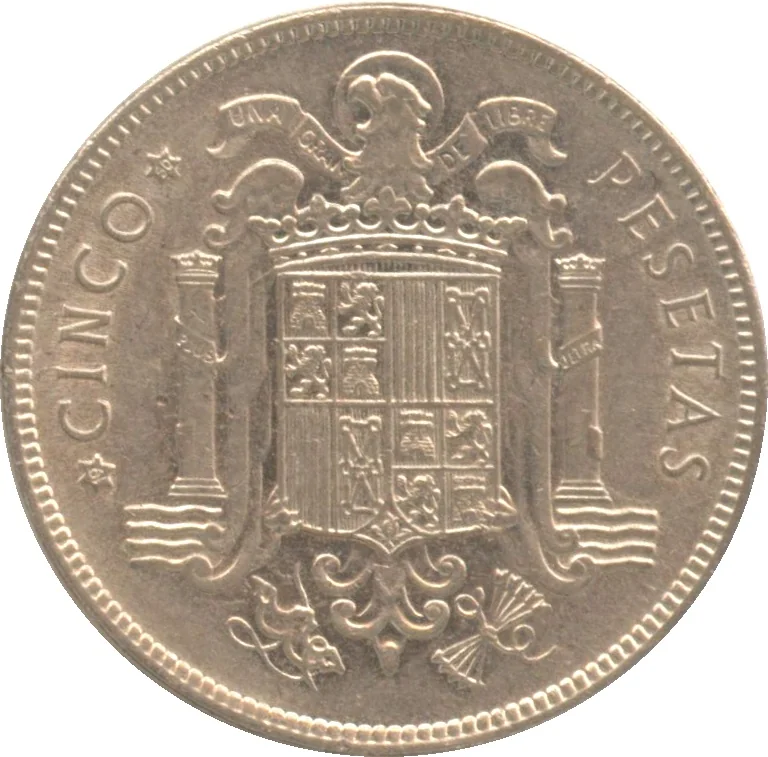
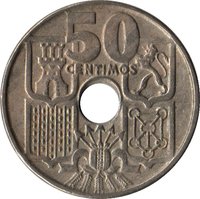
Coat of arms with yoke and arrows.
Inscription:
🟌 CINCO 🟌 PESETAS
UNA GRANDE LIBRE
PLUS ULTRA
UNA GRANDE LIBRE
PLUS ULTRA
Translation:
Five Pesetas
One Great Free
Further Beyond
One Great Free
Further Beyond
Script: Latin
Engraver: Manuel Marín Jimeno
Edge
Reeded
Categories
| Person> Politician |
| Person> Military leader |
| Symbols> Coat of Arms |
Mints
| Name | Mark |
|---|---|
| Royal Mint of Madrid | (🟌) |
Mintings
| Year | Mint Mark | Mintage | Quality | Collection |
|---|---|---|---|---|
| 1949 | 🟌 | — | ||
| 1950 | 🟌 | — | ||
| 1950 | — | 21,000,000 | ||
| 1951 | — | 145,000 | ||
| 1952 | — | 6,000 |
Historical background
In 1949, Spain's currency situation was defined by the severe economic isolation and autarkic policies of the early Franco dictatorship. The country was still recovering from the devastation of the Civil War (1936-1939) and was largely excluded from the post-World War II Marshall Plan due to its fascist associations. The regime's policy of economic self-sufficiency had crippled industrial and agricultural output, leading to widespread poverty, rationing (cartillas), and a thriving black market. The official currency, the Spanish peseta, was rigidly controlled by the government, but its internal purchasing power was low and its external value was artificially maintained at an unrealistic official exchange rate.
Internationally, the peseta was a non-convertible currency, meaning it could not be freely exchanged for other currencies like the US dollar or British pound. This created a complex system of multiple exchange rates for different types of transactions, overseen by the Instituto Español de Moneda. The most critical divide was between the strong, overvalued official rate and the much weaker black-market rate, which reflected the peseta's true lack of confidence and scarcity of hard currency reserves. This duality distorted trade and encouraged rampant smuggling and capital flight, as those who could access foreign currency at the official rate gained significant advantage.
The year 1949, however, marked a tentative turning point. Under pressure from crippling inflation and economic stagnation, the Franco regime began a cautious shift away from pure autarky. In a significant move, the peseta was devalued in October 1949, following the devaluation of the British pound. This adjustment, which changed the rate from 10.95 to 16.60 pesetas per US dollar for some official transactions, was a reluctant admission that the previous rate was unsustainable. It represented the first step toward a slow and managed reintegration into the world economy, a process that would gradually accelerate throughout the 1950s as the policy of autarky was incrementally abandoned.
Internationally, the peseta was a non-convertible currency, meaning it could not be freely exchanged for other currencies like the US dollar or British pound. This created a complex system of multiple exchange rates for different types of transactions, overseen by the Instituto Español de Moneda. The most critical divide was between the strong, overvalued official rate and the much weaker black-market rate, which reflected the peseta's true lack of confidence and scarcity of hard currency reserves. This duality distorted trade and encouraged rampant smuggling and capital flight, as those who could access foreign currency at the official rate gained significant advantage.
The year 1949, however, marked a tentative turning point. Under pressure from crippling inflation and economic stagnation, the Franco regime began a cautious shift away from pure autarky. In a significant move, the peseta was devalued in October 1949, following the devaluation of the British pound. This adjustment, which changed the rate from 10.95 to 16.60 pesetas per US dollar for some official transactions, was a reluctant admission that the previous rate was unsustainable. It represented the first step toward a slow and managed reintegration into the world economy, a process that would gradually accelerate throughout the 1950s as the policy of autarky was incrementally abandoned.
🌱 Very Common