

50 centimos – Spain
Add to wishlist
Spain
Context
Material
Diameter: 20 mm
Weight: 4 g
Thickness: 1.4 mm
Shape: Round with a round hole
Technique: Milled
Alignment: Coin alignment
flip
References
KM: #
Numista: #671
Value
Exchange value: 0.50 ESP
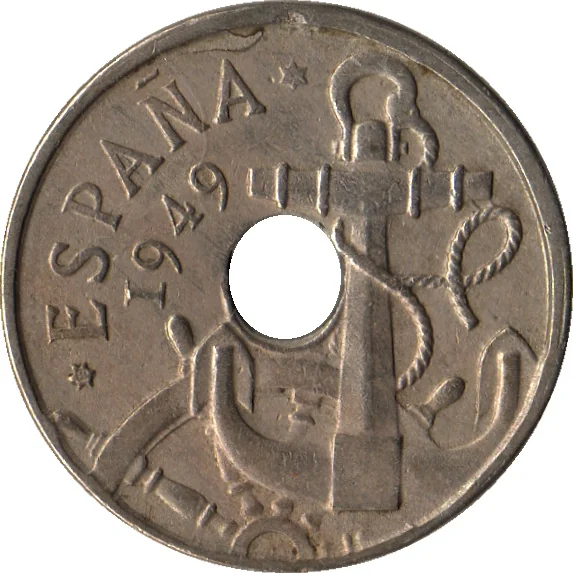
Obverse
Description:
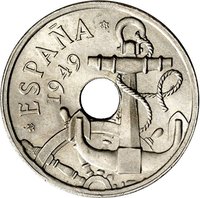
Anchor left of center hole, rudder below.
Inscription:
🟌 ESPAÑA 🟌
1949
1949
Translation:
Spain 1949
Script: Latin
Language: Spanish
Engraver: Carlos Mingo López
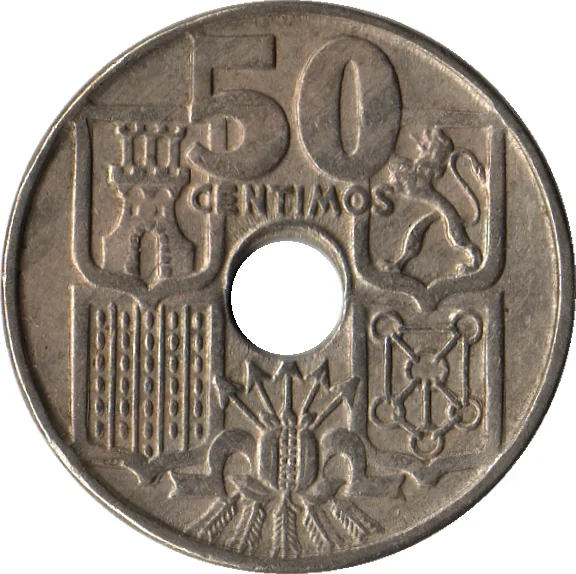
Reverse
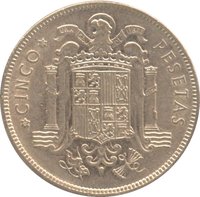
Description:
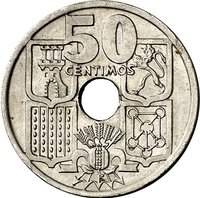
Spain's coat of arms features symbols for its historic regions: a castle for Castile, a lion for León, four red stripes for Aragon, a chain design for Navarre, and a pomegranate for Granada, along with the external yoke and bundle of arrows.
Inscription:
50
CENTIMOS
CENTIMOS
Script: Latin
Engraver: Carlos Mingo López
Edge
Plain
Categories
| Symbol> Anchor |
| Symbols> Coat of Arms |
Mints
| Name | Mark |
|---|---|
| Royal Mint of Madrid | (🟌) |
Mintings
| Year | Mint Mark | Mintage | Quality | Collection |
|---|---|---|---|---|
| 1951 | — | 8,010,000 | ||
| 1952 | — | 5,000 | ||
| 1953 | — | 17,500,000 | ||
| 1954 | — | 37,000,000 | ||
| 1956 | — | 38,000,000 | ||
| 1962 | — | 31,000,000 | ||
| 1963 | 🟌 | 4,000,000 | ||
| 1964 | — | 20,000,000 | ||
| 1965 | — | 14,000,000 |
Historical background
In 1951, Spain's currency situation was defined by the severe economic isolation and autarkic policies of the early Franco regime. The country was still recovering from the devastation of the Civil War (1936-1939) and was largely excluded from the Marshall Plan and post-war international financial institutions due to its fascist associations. The national currency, the peseta, was artificially overvalued by government decree, but this official rate bore little relation to its actual worth. A thriving black market for currency and goods existed, where the peseta traded at a fraction of its official value, reflecting the scarcity of basic commodities and the weakness of the domestic economy.
The system was characterized by strict exchange controls and multiple, complex exchange rates for different types of transactions, a typical feature of a closed, state-controlled economy. The government maintained a fixed official rate (around 11 pesetas to the US dollar) for essential imports and official accounts, while a much more depreciated "free market" rate (closer to 40 pesetas to the dollar) operated for other transactions. This dual system created significant distortions, encouraged corruption, and hindered foreign investment. The economic reality was one of persistent inflation, stagnant production, and widespread poverty, with the currency regime acting as a barrier to recovery rather than a tool for stability.
However, 1951 marked a tentative turning point. The worsening economic crisis and social unrest led to a cabinet reshuffle, bringing in more technocratic ministers. This year saw the beginning of a slow, pragmatic shift away from pure autarky. While the rigid currency controls remained, the government initiated limited economic liberalization, including slight relaxations in trade and the first approaches to the United States. These negotiations would culminate in the 1953 Pact of Madrid, which provided crucial financial aid in exchange for military bases and began Spain’s gradual, albeit limited, reintegration into the Western economic sphere, setting the stage for future monetary and economic reforms in the late 1950s.
The system was characterized by strict exchange controls and multiple, complex exchange rates for different types of transactions, a typical feature of a closed, state-controlled economy. The government maintained a fixed official rate (around 11 pesetas to the US dollar) for essential imports and official accounts, while a much more depreciated "free market" rate (closer to 40 pesetas to the dollar) operated for other transactions. This dual system created significant distortions, encouraged corruption, and hindered foreign investment. The economic reality was one of persistent inflation, stagnant production, and widespread poverty, with the currency regime acting as a barrier to recovery rather than a tool for stability.
However, 1951 marked a tentative turning point. The worsening economic crisis and social unrest led to a cabinet reshuffle, bringing in more technocratic ministers. This year saw the beginning of a slow, pragmatic shift away from pure autarky. While the rigid currency controls remained, the government initiated limited economic liberalization, including slight relaxations in trade and the first approaches to the United States. These negotiations would culminate in the 1953 Pact of Madrid, which provided crucial financial aid in exchange for military bases and began Spain’s gradual, albeit limited, reintegration into the Western economic sphere, setting the stage for future monetary and economic reforms in the late 1950s.
🌱 Very Common