

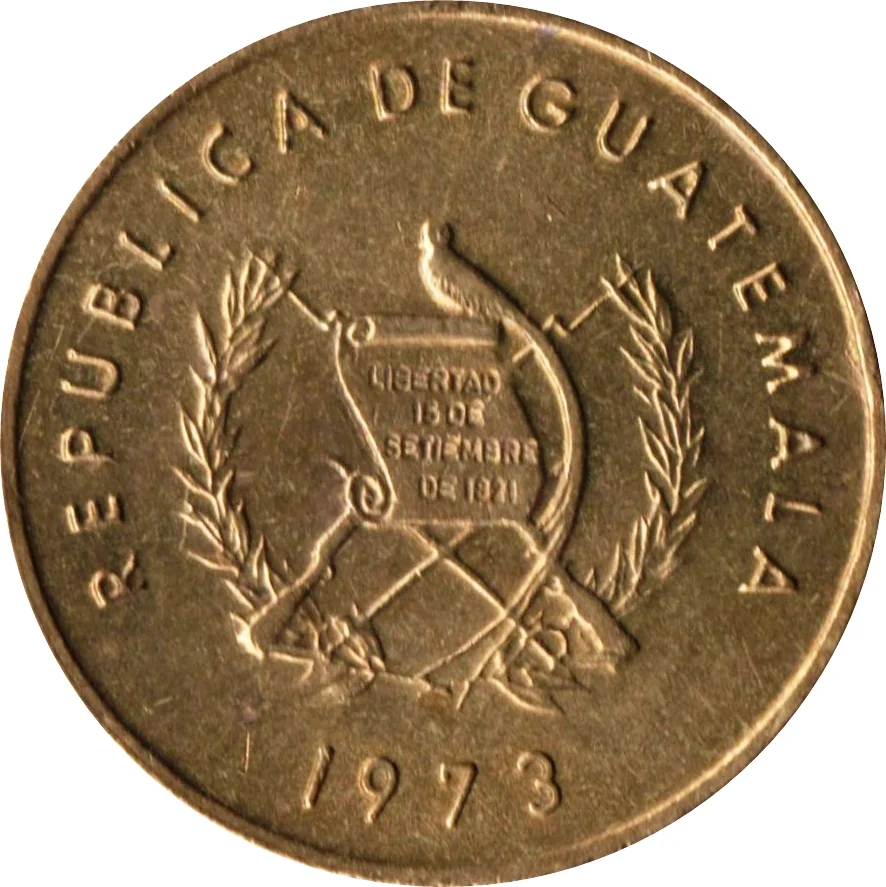
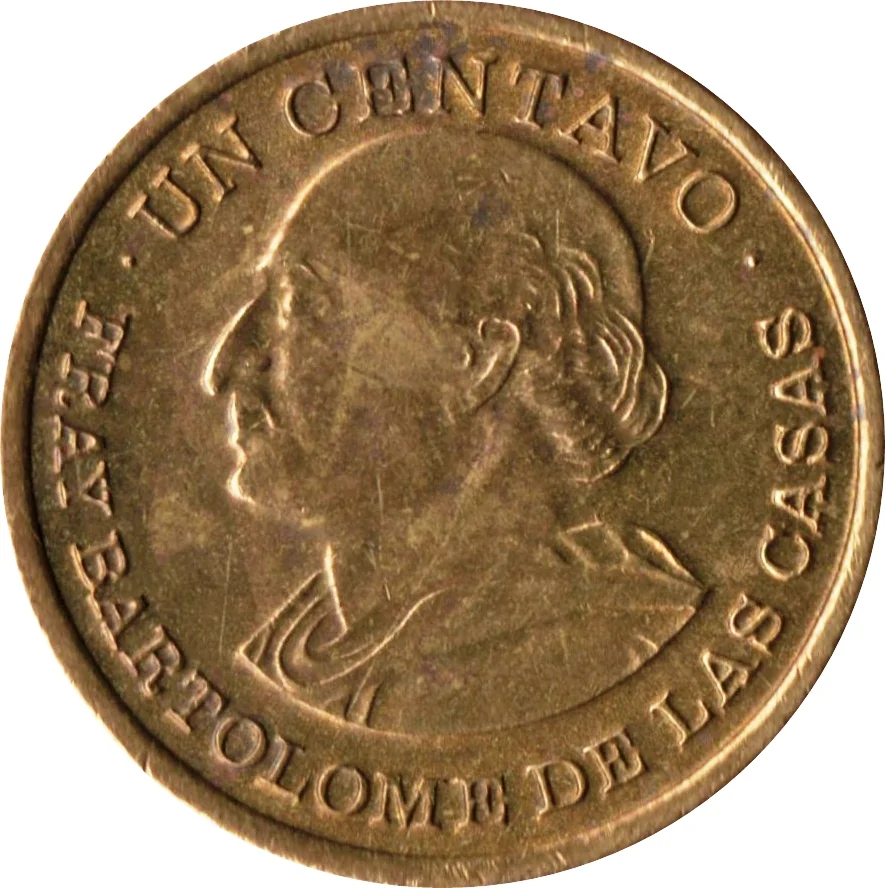
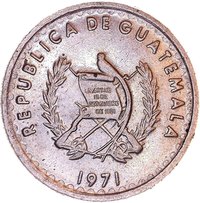
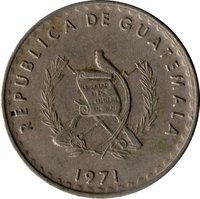
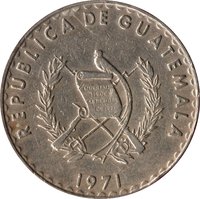
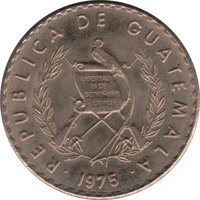
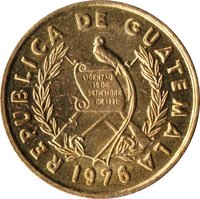
Obverse
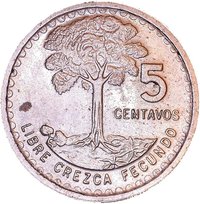
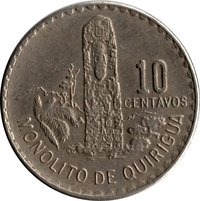
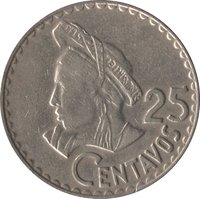
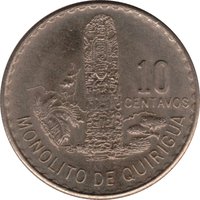
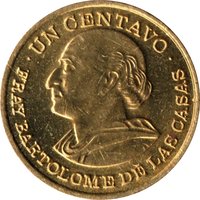
Reverse
Edge
Plain
Categories
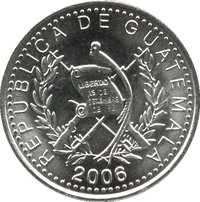
| Symbols> Coat of Arms |
| Person> Religious figure |
Mints
| Name | Mark |
|---|---|
| Casa de Moneda de Guatemala | — |
Mintings
| Year | Mint Mark | Mintage | Quality | Collection |
|---|---|---|---|---|
| 1972 | — | 11,500,000 | ||
| 1973 | — | 12,000,000 |
Historical background
In 1972, Guatemala operated under a fixed exchange rate system, with the Quetzal (GTQ) pegged to the United States dollar at a rate of 1:1, a parity established in 1925. This system was managed by the Bank of Guatemala and was a cornerstone of the country's financial stability, particularly during the post-World War II era of export-led growth. The peg fostered confidence in the national currency, facilitated international trade—especially for key exports like coffee, cotton, and sugar—and provided a predictable environment for foreign investment. The stability of the Quetzal was a point of national pride and a key element of the economic policy of the authoritarian governments that characterized the period.
However, beneath this surface stability, underlying pressures were mounting. The global economic environment of the early 1970s, marked by the collapse of the Bretton Woods system and the 1971 Nixon Shock, introduced new volatility. While the Quetzal's direct peg to the dollar was maintained, the dollar's own fluctuations on international markets indirectly affected Guatemala. More critically, the country faced persistent fiscal deficits and a growing reliance on external borrowing. Inflationary pressures, though moderate compared to later decades, began to erode the real value of the currency, creating a disparity between the official fixed rate and its implicit market value.
Consequently, 1972 represented the final year of the classic, unwavering 1:1 peg. The pressures would culminate the following year, in 1973, when the Bank of Guatemala was forced to adjust the exchange rate, ending the decades-long absolute parity. While not a year of dramatic crisis itself, 1972 was the calm before a significant monetary adjustment. It marked the end of an era for Guatemala's currency management, setting the stage for the gradual devaluations and increased exchange rate interventions that would characterize the latter half of the 1970s amid ongoing political conflict and economic challenges.
However, beneath this surface stability, underlying pressures were mounting. The global economic environment of the early 1970s, marked by the collapse of the Bretton Woods system and the 1971 Nixon Shock, introduced new volatility. While the Quetzal's direct peg to the dollar was maintained, the dollar's own fluctuations on international markets indirectly affected Guatemala. More critically, the country faced persistent fiscal deficits and a growing reliance on external borrowing. Inflationary pressures, though moderate compared to later decades, began to erode the real value of the currency, creating a disparity between the official fixed rate and its implicit market value.
Consequently, 1972 represented the final year of the classic, unwavering 1:1 peg. The pressures would culminate the following year, in 1973, when the Bank of Guatemala was forced to adjust the exchange rate, ending the decades-long absolute parity. While not a year of dramatic crisis itself, 1972 was the calm before a significant monetary adjustment. It marked the end of an era for Guatemala's currency management, setting the stage for the gradual devaluations and increased exchange rate interventions that would characterize the latter half of the 1970s amid ongoing political conflict and economic challenges.
Series: System: 1965-1997
🌱 Common