

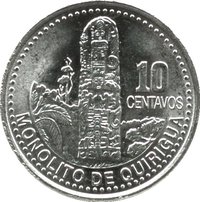
10 Centavos – Guatemala
Guatemala
Context
Material
References
KM: #Click to copy to clipboard277
Numista: #2259
Value
Exchange value: 0.10 GTQ
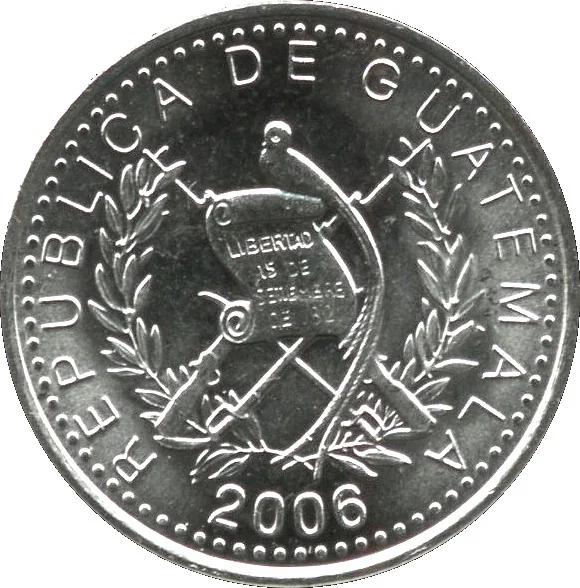
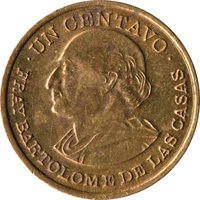
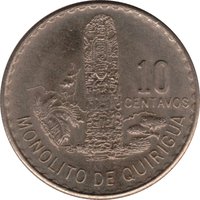
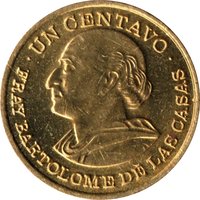
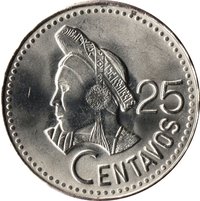
Obverse
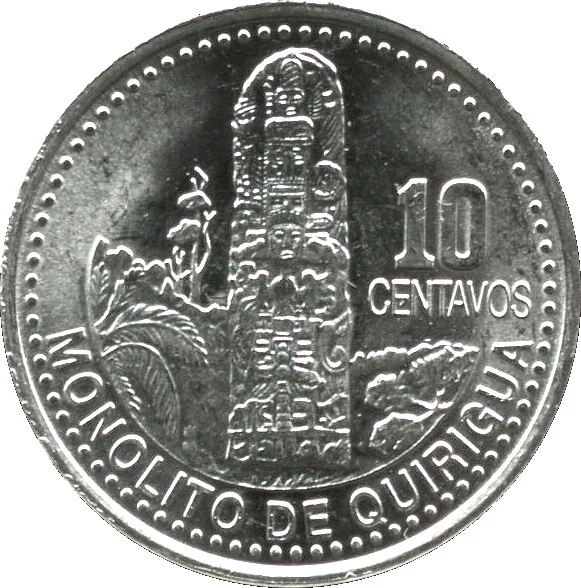
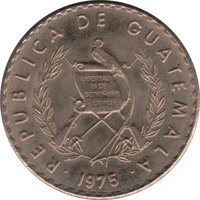
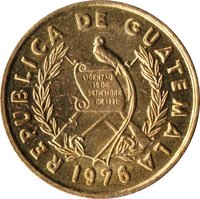
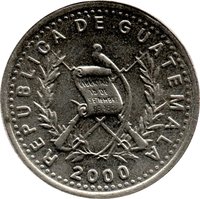
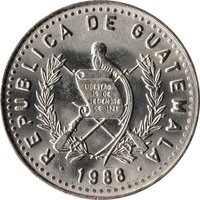
Reverse
Edge
Reeded
Categories
| Art> Sculpture |
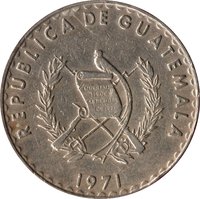
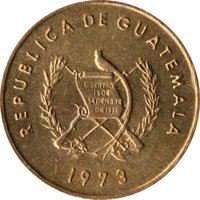
| Symbols> Coat of Arms |
Mints
| Name | Mark |
|---|---|
| Casa de Moneda de Guatemala | — |
Mintings
| Year | Mint Mark | Mintage | Quality | Collection |
|---|---|---|---|---|
| 1976 | — | 2,000,000 | ||
| 1977 | — | 5,000,000 | ||
| 1978 | — | 8,500,000 | ||
| 1979 | — | 11,000,000 | ||
| 1980 | — | 5,000,000 | ||
| 1981 | — | 4,000,000 | ||
| 1983 | — | 20,000,000 | ||
| 1986 | — | — | ||
| 1987 | — | 17,000,000 | ||
| 1988 | — | 13,250,000 | ||
| 1989 | — | 15,750,000 | ||
| 1990 | — | 20,000,000 | ||
| 1991 | — | — | ||
| 1992 | — | — | ||
| 1993 | — | — | ||
| 1994 | — | — | ||
| 1995 | — | — | ||
| 1996 | — | — | ||
| 1997 | — | — | ||
| 1998 | — | — | ||
| 2000 | — | — | ||
| 2006 | — | 350,500 | ||
| 2007 | — | 3,450,000 | ||
| 2008 | — | 3,757,000 | ||
| 2009 | — | — |
Historical background
In 1976, Guatemala's currency situation was characterized by relative stability under the long-standing fixed exchange rate regime of the Quetzal, which was pegged to the United States dollar at a 1:1 ratio. This parity, established in 1925, was a point of national pride and symbolic of monetary sovereignty. The Banco de Guatemala managed this peg through conservative fiscal and monetary policies, maintaining substantial foreign exchange reserves. The economy was primarily driven by agricultural exports like coffee, cotton, and sugar, and the fixed rate provided predictability for these vital sectors and for foreign investment.
However, this apparent stability existed against a backdrop of profound social inequality and the devastating impact of the 7.5 magnitude earthquake that struck on February 4, 1976. The catastrophe killed approximately 23,000 people, left over a million homeless, and caused immense damage to infrastructure. The immediate economic effect was a severe shock, disrupting production and exports, while creating massive unforeseen demands on government resources for reconstruction. This placed significant, though not immediately catastrophic, pressure on the state's finances.
Despite the earthquake's destruction, the currency peg itself was not abandoned in 1976. The government, under President Kjell Laugerud García, prioritized maintaining the quetzal's value, viewing it as a cornerstone of economic order. International aid and loans flowed in to assist with reconstruction, which helped bolster foreign reserves and temporarily alleviated balance of payments pressures. Thus, the primary story of 1976 is not one of a currency crisis, but of a rigid and symbolic exchange rate regime weathering an enormous external shock through a combination of conservative management and international assistance, even as the underlying vulnerabilities of the economy were laid bare.
However, this apparent stability existed against a backdrop of profound social inequality and the devastating impact of the 7.5 magnitude earthquake that struck on February 4, 1976. The catastrophe killed approximately 23,000 people, left over a million homeless, and caused immense damage to infrastructure. The immediate economic effect was a severe shock, disrupting production and exports, while creating massive unforeseen demands on government resources for reconstruction. This placed significant, though not immediately catastrophic, pressure on the state's finances.
Despite the earthquake's destruction, the currency peg itself was not abandoned in 1976. The government, under President Kjell Laugerud García, prioritized maintaining the quetzal's value, viewing it as a cornerstone of economic order. International aid and loans flowed in to assist with reconstruction, which helped bolster foreign reserves and temporarily alleviated balance of payments pressures. Thus, the primary story of 1976 is not one of a currency crisis, but of a rigid and symbolic exchange rate regime weathering an enormous external shock through a combination of conservative management and international assistance, even as the underlying vulnerabilities of the economy were laid bare.
Series: System: 1965-1997
🌱 Very Common