

Obverse
Description:
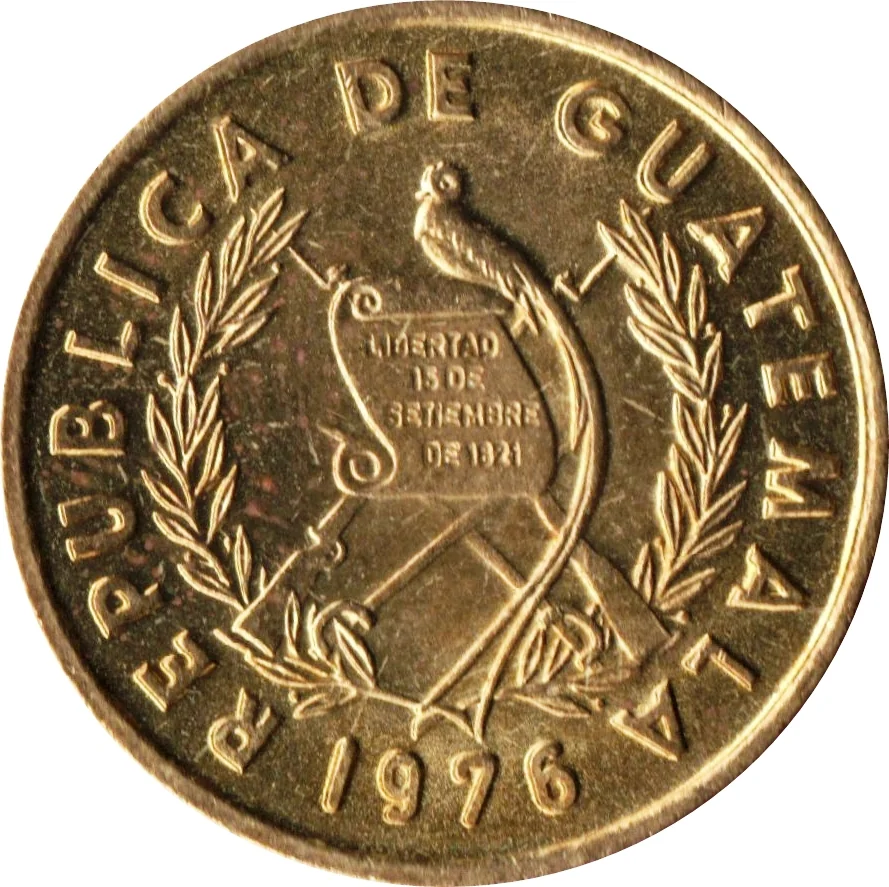
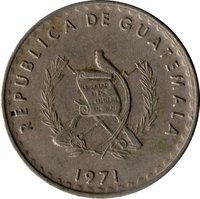
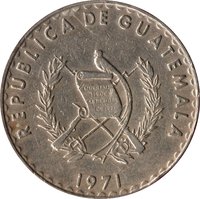
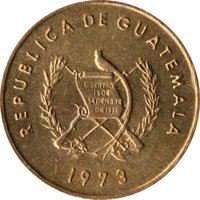
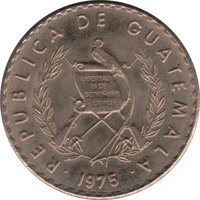
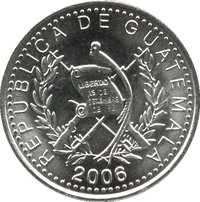
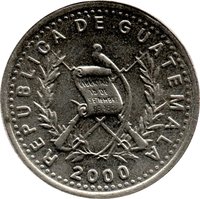
The Guatemalan emblem features crossed rifles and swords encircled by laurel, a scroll reading "Liberty 15 of September, 1821," and the national bird, the Quetzal, above.
Inscription:
REPUBLICA DE GUATEMALA
LIBERTAD
15 DE
SETIEMBRE
DE 1821
1976
LIBERTAD
15 DE
SETIEMBRE
DE 1821
1976
Translation:
REPUBLIC OF GUATEMALA
LIBERTY
15TH OF
SEPTEMBER
OF 1821
1976
LIBERTY
15TH OF
SEPTEMBER
OF 1821
1976
Script: Latin
Language: Spanish
Reverse
Edge
Plain
Categories
| Animal> Bird |
| Symbols> Coat of Arms |
| Person> Religious figure |
| Object> Firearms |
Mints
| Name | Mark |
|---|---|
| Casa de Moneda de Guatemala | — |
Mintings
| Year | Mint Mark | Mintage | Quality | Collection |
|---|---|---|---|---|
| 1974 | — | 10,000,000 | ||
| 1975 | — | 15,000,000 | ||
| 1976 | — | 15,230,000 | ||
| 1977 | — | 30,000,000 | ||
| 1978 | — | 30,000,000 | ||
| 1979 | — | 30,000,000 | ||
| 1980 | — | 20,000,000 | ||
| 1981 | — | 30,000,000 | ||
| 1982 | — | 30,000,000 | ||
| 1984 | — | 20,000,000 | ||
| 1985 | — | 10,000,000 | ||
| 1986 | — | 40,000,000 | ||
| 1987 | — | 50,000,000 | ||
| 1988 | — | 51,400,000 | ||
| 1989 | — | 60,000,000 | ||
| 1990 | — | 76,000,000 | ||
| 1991 | — | — | ||
| 1992 | — | — | ||
| 1993 | — | — | ||
| 1994 | — | — | ||
| 1995 | — | — |
Historical background
In 1974, Guatemala's currency situation was characterized by relative stability under the long-standing fixed exchange rate regime of the Quetzal (GTQ). Since 1925, the quetzal had been pegged to the United States dollar at a rate of 1:1, a policy managed by the Banco de Guatemala. This parity was a point of national pride and a symbol of monetary discipline, supported by conservative fiscal management and a legal requirement for the central bank to hold foreign reserves covering at least 70% of the monetary base. The system fostered confidence and low inflation, which averaged around 2-3% annually in the early 1970s.
However, this apparent stability existed alongside underlying economic pressures and structural inequalities. The economy was heavily dependent on agricultural exports—primarily coffee, cotton, and sugar—making it vulnerable to international commodity price swings. Furthermore, the benefits of growth were concentrated among a small elite, while a large portion of the population, particularly the indigenous rural majority, lived in poverty with limited access to financial services. The fixed exchange rate, while stabilizing prices, also masked competitiveness issues and did little to address the fundamental need for diversified economic development and broader social inclusion.
Politically, the country was under the authoritarian rule of President Kjell Laugerud García, who had taken power that same year following a contested election. His government, like its predecessors, prioritized maintaining the quetzal's parity as a cornerstone of economic policy. Consequently, in 1974 there were no dramatic devaluations or currency crises; the primary focus was on managing foreign reserves and export revenues to defend the peg. The significant challenges to this monetary model would emerge later in the decade, as global inflation, rising oil prices, and internal conflict began to erode the foundations of Guatemala's traditional currency stability.
However, this apparent stability existed alongside underlying economic pressures and structural inequalities. The economy was heavily dependent on agricultural exports—primarily coffee, cotton, and sugar—making it vulnerable to international commodity price swings. Furthermore, the benefits of growth were concentrated among a small elite, while a large portion of the population, particularly the indigenous rural majority, lived in poverty with limited access to financial services. The fixed exchange rate, while stabilizing prices, also masked competitiveness issues and did little to address the fundamental need for diversified economic development and broader social inclusion.
Politically, the country was under the authoritarian rule of President Kjell Laugerud García, who had taken power that same year following a contested election. His government, like its predecessors, prioritized maintaining the quetzal's parity as a cornerstone of economic policy. Consequently, in 1974 there were no dramatic devaluations or currency crises; the primary focus was on managing foreign reserves and export revenues to defend the peg. The significant challenges to this monetary model would emerge later in the decade, as global inflation, rising oil prices, and internal conflict began to erode the foundations of Guatemala's traditional currency stability.
Series: System: 1965-1997
🌱 Very Common