

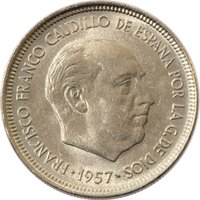
Obverse
Description:
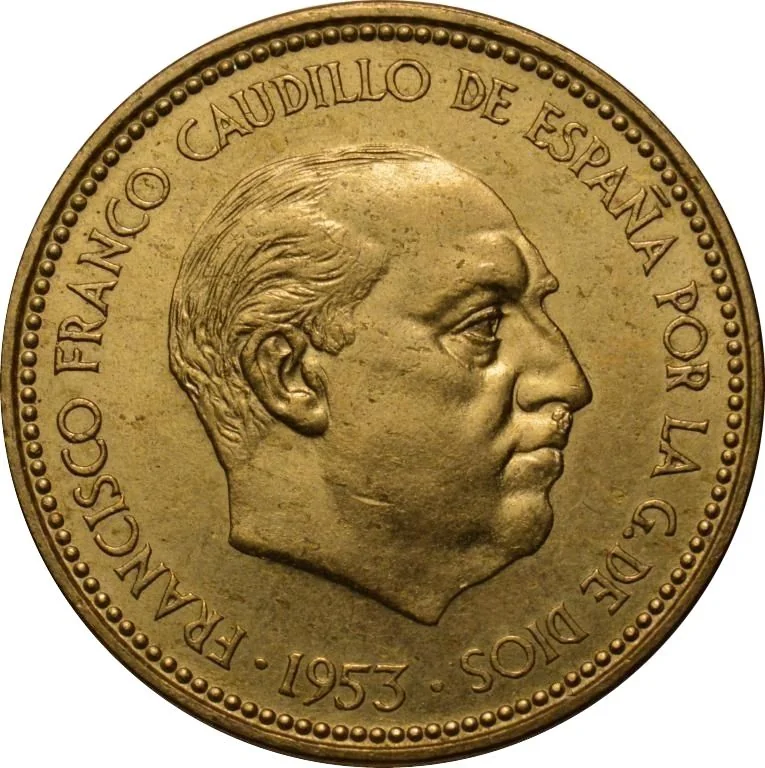
Franco facing right.
Inscription:
FRANCISCO FRANCO CAUDILLO DE ESPAÑA POR LA G. DE DIOS
· 1953 ·
· 1953 ·
Translation:
Francisco Franco, Caudillo of Spain by the Grace of God
· 1953 ·
· 1953 ·
Script: Latin
Language: Spanish
Engraver: Manuel Marín Jimeno
Designer: Mariano Benlliure Gil
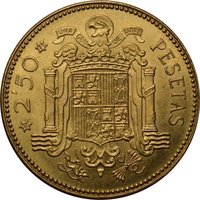
Reverse
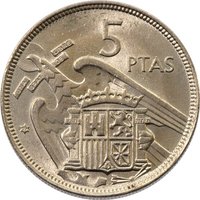
Description:
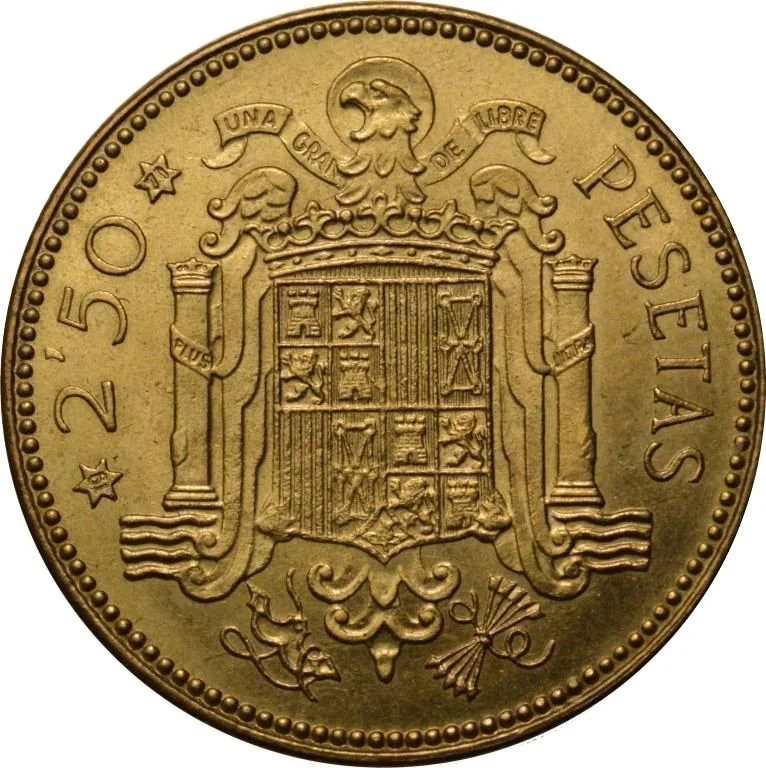
Coat of arms with yoke and arrows.
Inscription:
🟌 2'50 🟌 PESETAS
UNA GRANDE LIBRE
PLUS ULTRA
UNA GRANDE LIBRE
PLUS ULTRA
Translation:
Two Pesetas
One Large Libre
Further Beyond
One Large Libre
Further Beyond
Script: Latin
Engraver: Manuel Marín Jimeno
Edge
Reeded
Categories
| Person> Military leader |
| Person> Politician |
| Symbols> Coat of Arms |
Mints
| Name | Mark |
|---|---|
| Royal Mint of Madrid | (🟌) |
Mintings
| Year | Mint Mark | Mintage | Quality | Collection |
|---|---|---|---|---|
| 1954 | — | 22,729,000 | ||
| 1956 | 🟌 | — | ||
| 1956 | — | 30,322,000 | ||
| 1968 | — | 1,000 | ||
| 1969 | — | 2,000 | ||
| 1970 | — | 6,000 | ||
| 1971 | — | 10,000 |
Historical background
In 1954, Spain’s currency situation was defined by the rigid controls and economic isolation of the early Francoist autarky. The national currency, the peseta, was not freely convertible and existed with multiple, artificially set exchange rates for different types of transactions. This complex system included an official rate for government accounting and essential imports, and a far less favorable "free" market rate for most other foreign trade and tourism, creating a significant gap that encouraged a pervasive black market for foreign currency, especially US dollars.
Economically, the year fell within a period of severe stagnation and scarcity, preceding the limited reforms and stabilization plans of the late 1950s. The government's insistence on a strong overvalued official peseta rate, combined with strict import substitution policies, led to persistent balance of payments difficulties and inflation. Foreign exchange reserves were critically low, limiting Spain's ability to purchase vital goods and machinery from abroad, thereby hampering industrial recovery and contributing to widespread poverty.
However, 1954 also saw early, tentative signs of the pressure for change that would eventually dismantle this system. The signing of a pivotal defense agreement with the United States in 1953 began to inject much-needed dollars into the economy through aid and the establishment of military bases. This influx, alongside growing revenue from a nascent tourism sector, started to alleviate the dire reserve shortage and demonstrated the unsustainable nature of autarky, setting the stage for the technocratic reforms and devaluation of the peseta that would follow later in the decade.
Economically, the year fell within a period of severe stagnation and scarcity, preceding the limited reforms and stabilization plans of the late 1950s. The government's insistence on a strong overvalued official peseta rate, combined with strict import substitution policies, led to persistent balance of payments difficulties and inflation. Foreign exchange reserves were critically low, limiting Spain's ability to purchase vital goods and machinery from abroad, thereby hampering industrial recovery and contributing to widespread poverty.
However, 1954 also saw early, tentative signs of the pressure for change that would eventually dismantle this system. The signing of a pivotal defense agreement with the United States in 1953 began to inject much-needed dollars into the economy through aid and the establishment of military bases. This influx, alongside growing revenue from a nascent tourism sector, started to alleviate the dire reserve shortage and demonstrated the unsustainable nature of autarky, setting the stage for the technocratic reforms and devaluation of the peseta that would follow later in the decade.
🌱 Very Common