

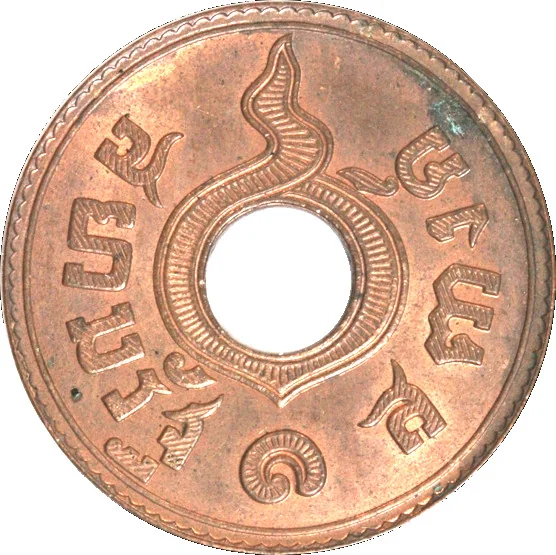
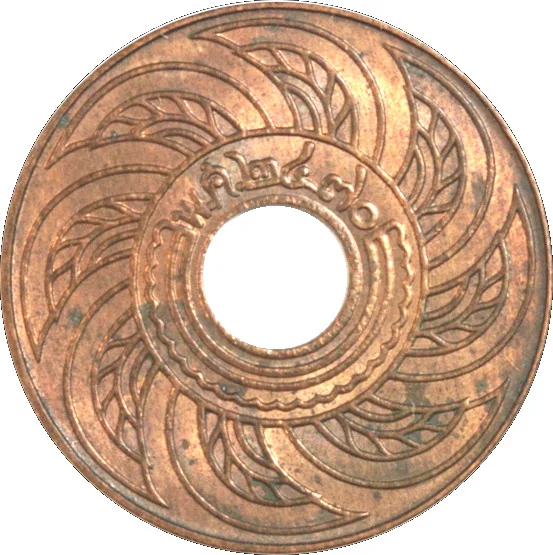
1 satang – Thailand
Add to wishlist
Thailand
Context
Years: 1908–1937
Issuer: Thailand
Ruler: Phra Chula Chom Klao
Currency:
(since 1897)
Demonetized: Yes
Total mintage: 285,327,065
Material
References
Y: #
Numista: #6582
Value
Exchange value: 0.01 THB
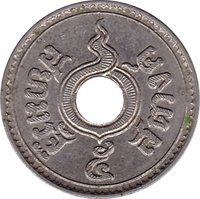
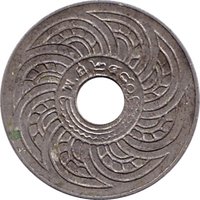
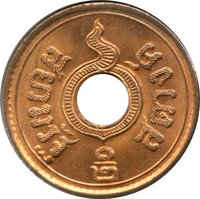
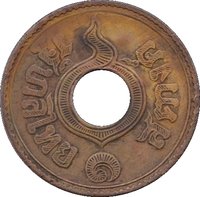
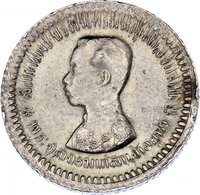
Obverse
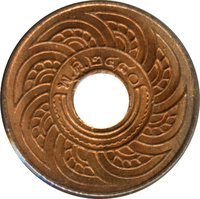
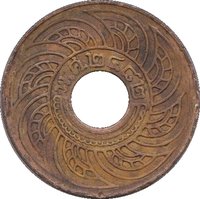
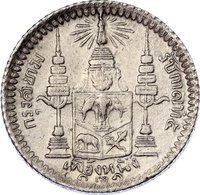
Reverse
Edge
Plain
Mints
| Name | Mark |
|---|---|
| Bangkok | — |
| Heaton and Sons / The Mint Birmingham | — |
| Japan Mint | — |
| Royal Mint of Belgium | — |
| United States Mint of Philadelphia | — |
Mintings
| Year | Mint Mark | Mintage | Quality | Collection |
|---|---|---|---|---|
| 1908 | — | 5,000,000 | ||
| 1909 | — | 30,000,000 | ||
| 1910 | — | 38,000,000 | ||
| 1911 | — | 30,000,000 | ||
| 1913 | — | 10,000,000 | ||
| 1914 | — | 10,000,000 | ||
| 1915 | — | 5,000,000 | ||
| 1918 | — | 10,000,000 | ||
| 1919 | — | 10,000,000 | ||
| 1920 | — | 20,000,000 | ||
| 1921 | — | 5,005,000 | ||
| 1923 | — | 3,100,000 | ||
| 1924 | — | — | ||
| 1926 | — | 20,000,000 | ||
| 1927 | — | 30,000,000 | ||
| 1929 | — | 50,000,000 | ||
| 1935 | — | — | ||
| 1937 | — | 9,222,065 |
Historical background
In 1908, Thailand, then known as Siam, operated under a complex and transitional monetary system. The nation was modernizing under King Chulalongkorn (Rama V), but its currency landscape reflected a blend of traditional Siamese units, foreign trade coins, and a move toward a standardized national currency. The basic unit was the baht, which was both a unit of weight (for silver) and of currency. However, the actual money in circulation was highly varied, including bullet coins (photduang), flat silver pieces with a distinctive bent shape, as well as Mexican and Spanish silver dollars, Indian rupees, and British Straits Settlements dollars, all crucial for international trade.
This multiplicity caused significant practical problems for commerce and state finance. Exchange rates between these different forms of money fluctuated, creating inefficiency and confusion. Recognizing this as an obstacle to both administrative centralization and economic development, King Chulalongkorn's government had already taken a major step toward reform with the Coinage Act of 1902. This act established a decimal system, defining the baht as a unit of currency with 100 satang, and began the minting of modern, machine-struck coins in denominations of satang, baht, and ticals to replace the old bullet coinage.
Therefore, by 1908, Siam was in the midst of a deliberate and state-driven currency unification. The old system was still present but actively being phased out in favor of the new national coinage. This transition was a critical component of Siam's broader legal and financial reforms, which aimed to strengthen sovereignty, streamline taxation, and integrate the kingdom more effectively into the global economy while avoiding formal colonization. The process would culminate in the Paper Currency Act of 1902 (which took several years to implement fully), leading to the first series of Thai banknotes issued by the Treasury in 1902 and later by the newly established Ministry of Finance in 1908 itself.
This multiplicity caused significant practical problems for commerce and state finance. Exchange rates between these different forms of money fluctuated, creating inefficiency and confusion. Recognizing this as an obstacle to both administrative centralization and economic development, King Chulalongkorn's government had already taken a major step toward reform with the Coinage Act of 1902. This act established a decimal system, defining the baht as a unit of currency with 100 satang, and began the minting of modern, machine-struck coins in denominations of satang, baht, and ticals to replace the old bullet coinage.
Therefore, by 1908, Siam was in the midst of a deliberate and state-driven currency unification. The old system was still present but actively being phased out in favor of the new national coinage. This transition was a critical component of Siam's broader legal and financial reforms, which aimed to strengthen sovereignty, streamline taxation, and integrate the kingdom more effectively into the global economy while avoiding formal colonization. The process would culminate in the Paper Currency Act of 1902 (which took several years to implement fully), leading to the first series of Thai banknotes issued by the Treasury in 1902 and later by the newly established Ministry of Finance in 1908 itself.
Series: Unalom - Chakra series
🌱 Common