

1 Lats – Latvia
Non-circulating coins
Series: Hansa Cities
Latvia
Context

Material
Diameter: 38.61 mm
Weight: 31.47 g
Silver weight: 29.11 g
Shape: Round
Composition: 92.5% Silver
Standard: Silver ounce
Magnetic: No
Technique: Milled
Alignment: Medal alignment
flip
References
KM: #Click to copy to clipboard75
Numista: #51688
Value
Exchange value: 1 LVL
Bullion value: $83.04
Inflation-adjusted value: 2.55 LVL
Obverse
Description:
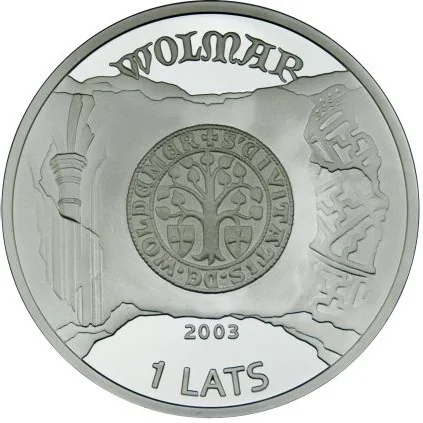
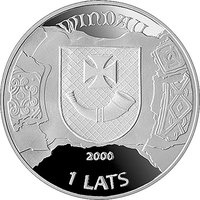
The coin's obverse centers on Valmiera's Hanseatic city seal. To its left is an element from St. Simanis' Church interior, and to its right, details from the Vidzeme brooch. The year 2003 is below the seal, with "WOLMAR" above and "1 LATS" below, each in a semicircle.
Inscription:
WOLMAR
2003
1 LATS
2003
1 LATS
Script: Latin
Engraver: Jānis Strupulis
Designer: Gunārs Krollis
Reverse
Description:
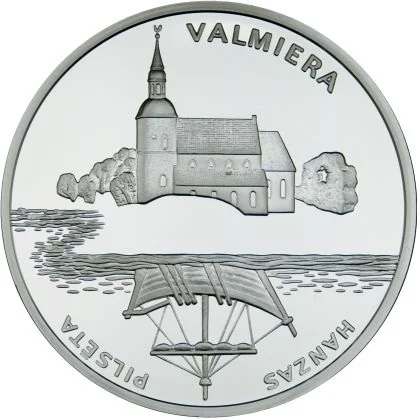
The reverse features a waterway dividing the design. Above is the silhouette of St. Simanis' Church with "VALMIERA" arched to its right. Below, a reflected Hanseatic ship appears with the arched inscription "HANSEATIC CITY."
Inscription:
VALMIERA
HANZAS PILSĒTA
HANZAS PILSĒTA
Translation:
Valmiera
Hansa City
Hansa City
Script: Latin
Language: Latvian
Engraver: Jānis Strupulis
Designer: Gunārs Krollis
Edge
Legend:
LATVIJAS REPUBLIKA ● LATVIJAS BANKA ●
Translation:
REPUBLIC OF LATVIA ● BANK OF LATVIA ●
Language: Latvian
Categories
| Building> Religious building |
| Transportation> Watercraft |
Mints
| Name | Mark |
|---|---|
| Mint of Finland | — |
Mintings
| Year | Mint Mark | Mintage | Quality | Collection |
|---|---|---|---|---|
| 2003 | — | 15,000 | Proof |
Historical background
In 2003, Latvia was in a period of significant economic transition, firmly on the path to European Union membership, which it would achieve in May 2004. The country's currency regime was a cornerstone of its macroeconomic stability. Since 1994, Latvia had maintained a fixed exchange rate, pegging the Latvian lats (LVL) first to the IMF's Special Drawing Rights (SDR) and then, in early 2005, solely to the euro. However, in 2003, the peg was still formally to the SDR, though it effectively shadowed the euro, which was the anchor currency for its future integration.
This fixed regime provided crucial stability, taming the high inflation of the early post-Soviet years and fostering foreign investment. It was managed by the Bank of Latvia, which committed to buying or selling foreign exchange to maintain the peg. The policy was largely successful, contributing to strong economic growth, but it also required strict fiscal discipline to avoid devaluation pressures. Latvia's current account deficit was widening in 2003, fueled by a consumer and credit boom, which presented an underlying challenge to the sustainability of the fixed rate.
Consequently, the dominant monetary policy discussion in 2003 revolved around the eventual adoption of the euro. With EU accession treaties signed, Latvia was obligated to join the European Exchange Rate Mechanism (ERM II), the "waiting room" for the euro, which required maintaining exchange rate stability for two years. Therefore, the fixed peg was seen not just as a tool for domestic stability but as a direct preparatory step for eurozone entry. The focus was on meeting the Maastricht convergence criteria, particularly controlling inflation and budget deficits, to ensure a smooth transition from the lats to the euro in the coming years.
This fixed regime provided crucial stability, taming the high inflation of the early post-Soviet years and fostering foreign investment. It was managed by the Bank of Latvia, which committed to buying or selling foreign exchange to maintain the peg. The policy was largely successful, contributing to strong economic growth, but it also required strict fiscal discipline to avoid devaluation pressures. Latvia's current account deficit was widening in 2003, fueled by a consumer and credit boom, which presented an underlying challenge to the sustainability of the fixed rate.
Consequently, the dominant monetary policy discussion in 2003 revolved around the eventual adoption of the euro. With EU accession treaties signed, Latvia was obligated to join the European Exchange Rate Mechanism (ERM II), the "waiting room" for the euro, which required maintaining exchange rate stability for two years. Therefore, the fixed peg was seen not just as a tool for domestic stability but as a direct preparatory step for eurozone entry. The focus was on meeting the Maastricht convergence criteria, particularly controlling inflation and budget deficits, to ensure a smooth transition from the lats to the euro in the coming years.
Series: Hansa Cities
💎 Extremely Rare