

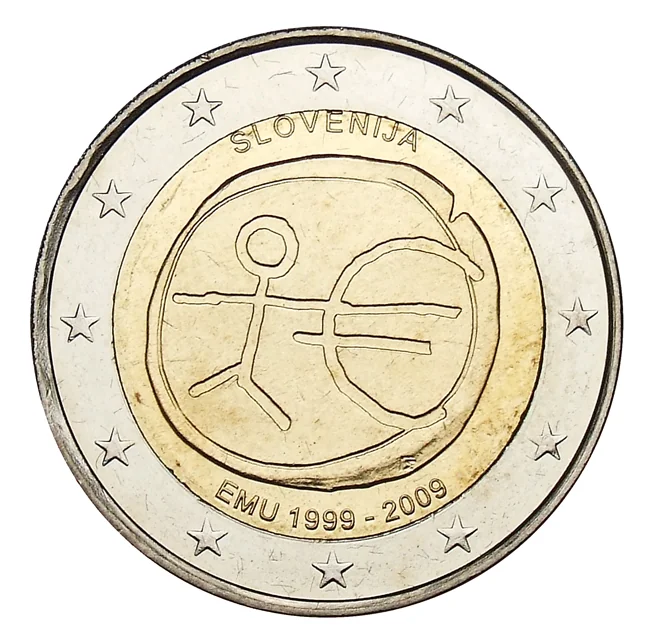
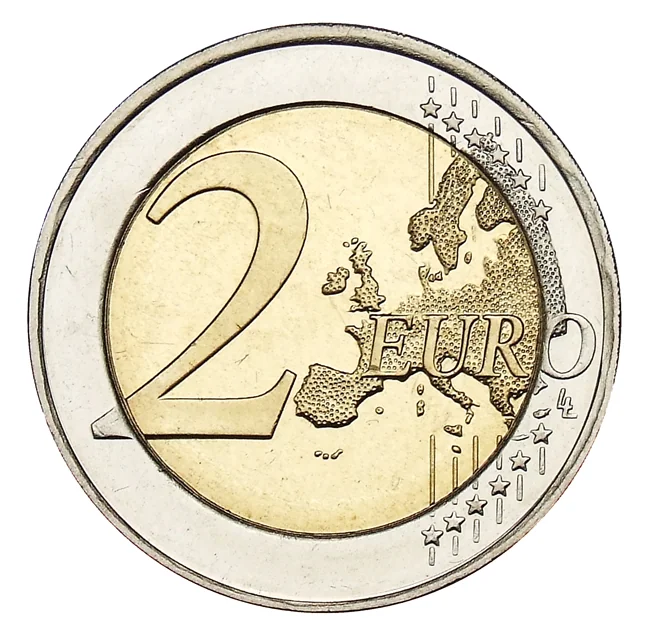
2 euro (Economic and Monetary Union) – Slovenia
Add to wishlist
Circulating commemorative coins
Commemoration: 10th anniversary of Economic and Monetary Union
Slovenia
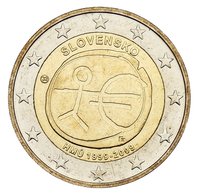
Obverse
Description:
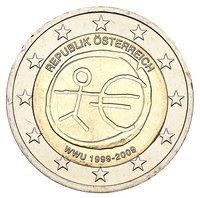
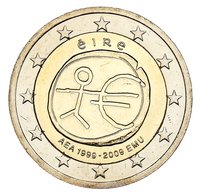
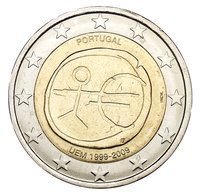
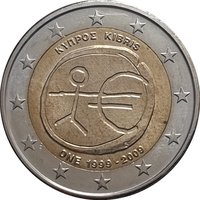
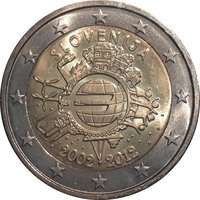
Stick figure merging into a €, surrounded by the EU's twelve stars.
Inscription:
SLOVENIJA
ΓΣ
EMU 1999-2009
ΓΣ
EMU 1999-2009
Translation:
SLOVENIA
200 S
EMU 1999-2009
200 S
EMU 1999-2009
Engraver: Geórgios Stamatópoulos
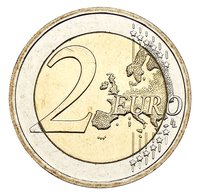
Reverse
Edge
Mints
| Name | Mark |
|---|---|
| Mint of Finland | — |
Mintings
| Year | Mint Mark | Mintage | Quality | Collection |
|---|---|---|---|---|
| 2009 | — | 1,000,000 |
Historical background
In 2009, Slovenia’s currency situation was defined by its membership in the Eurozone, which it had joined on 1 January 2007. As such, the country used the euro as its official currency, having replaced the Slovenian tolar. This membership provided significant stability during the turbulent global financial crisis, shielding Slovenia from the speculative currency attacks and volatility that afflicted neighboring non-euro countries in Central and Eastern Europe. The euro offered a safe haven, ensuring stable exchange rates for trade and finance, which was crucial for an economy heavily reliant on exports to the Eurozone.
However, the euro did not inoculate Slovenia from the economic crisis itself. In 2009, the country faced a severe recession, with GDP contracting by 7.9%, one of the sharpest declines in the EU. The crisis exposed deep vulnerabilities in the domestic banking sector, which was heavily burdened by non-performing loans primarily extended to state-owned and large private companies. While the currency itself was stable, the macroeconomic situation deteriorated rapidly, leading to a credit crunch and rising public debt.
Consequently, the primary financial challenges in 2009 were not about currency devaluation or exchange rate mechanisms but about fiscal sustainability and banking sector solvency within the euro framework. The government was forced to implement austerity measures and began discussions on the need for a potential bank bailout, setting the stage for a deeper economic and political crisis in the years that followed. The euro's stability thus presented a double-edged sword: it prevented a currency crisis but also removed the tool of independent monetary policy, forcing all adjustment onto fiscal policy and internal devaluation during a severe downturn.
However, the euro did not inoculate Slovenia from the economic crisis itself. In 2009, the country faced a severe recession, with GDP contracting by 7.9%, one of the sharpest declines in the EU. The crisis exposed deep vulnerabilities in the domestic banking sector, which was heavily burdened by non-performing loans primarily extended to state-owned and large private companies. While the currency itself was stable, the macroeconomic situation deteriorated rapidly, leading to a credit crunch and rising public debt.
Consequently, the primary financial challenges in 2009 were not about currency devaluation or exchange rate mechanisms but about fiscal sustainability and banking sector solvency within the euro framework. The government was forced to implement austerity measures and began discussions on the need for a potential bank bailout, setting the stage for a deeper economic and political crisis in the years that followed. The euro's stability thus presented a double-edged sword: it prevented a currency crisis but also removed the tool of independent monetary policy, forcing all adjustment onto fiscal policy and internal devaluation during a severe downturn.
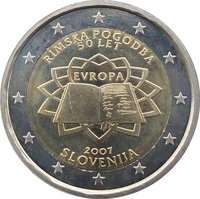
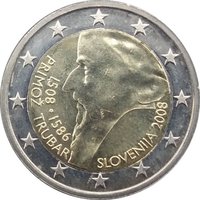
Series: Slovenia 2 euro commemoratives
🌱 Very Common