

2 euro (Primož Trubar) – Slovenia
Add to wishlist
Circulating commemorative coins
Commemoration: 500th Anniversary of Birth of Primož Trubar
Slovenia
Obverse
Description:
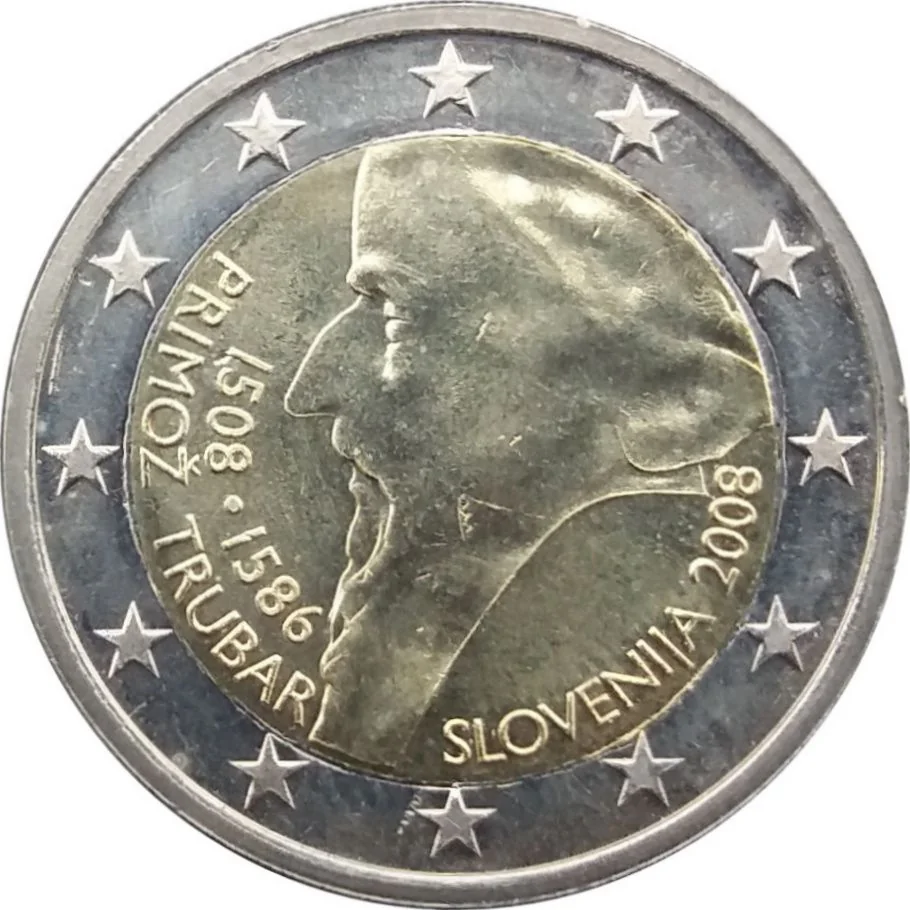
The obverse features Primož Trubar in profile, with his name and dates left, 'SLOVENIJA 2008' bottom right. The EU stars are on the outer ring.
Inscription:
SLOVENIJA 2008
1508·1586
PRIMOŽ TRUBAR
1508·1586
PRIMOŽ TRUBAR
Translation:
Slovenia 2008
1508-1586
Primož Trubar
1508-1586
Primož Trubar
Script: Latin
Reverse
Edge
Categories
| Art> Literature |
| Map |
| Event> Birth anniversary |
| Person> Religious figure |
Mints
| Name | Mark |
|---|---|
| Royal Dutch Mint | — |
Mintings
| Year | Mint Mark | Mintage | Quality | Collection |
|---|---|---|---|---|
| 2008 | — | 950,000 | ||
| 2008 | — | 10,000 | BU | |
| 2008 | — | 40,000 | Proof |
Historical background
In 2008, Slovenia's currency situation was defined by its membership in the Eurozone, a status it had acquired just four years earlier on 1 January 2007. As a small, open, and export-oriented economy, the adoption of the euro had provided significant stability, eliminating exchange rate risk with its main trading partners in the Eurozone and fostering lower interest rates. This pre-crisis period was characterized by robust economic growth, driven by strong credit expansion and investment, largely facilitated by the favourable monetary conditions of the single currency.
However, the global financial crisis of 2008 exposed critical vulnerabilities that had built up during the boom years. The crisis hit Slovenia's economy hard, triggering a severe domestic banking crisis that emerged fully in 2012-2013 but had its roots in 2008. The euro membership meant Slovenia had no independent monetary policy tools—such as devaluing a national currency—to stimulate exports or adjust interest rates unilaterally. The European Central Bank's one-size-fits-all policy was not tailored to Slovenia's specific overheating economy, which had experienced a credit-fuelled construction bubble.
Consequently, while the euro provided a stable external framework and prevented a currency collapse, it also constrained Slovenia's crisis response options. The government was forced to address the mounting problems within its banking sector, heavily exposed to non-performing corporate loans, solely through fiscal measures and eventual state-funded bailouts. Thus, in 2008, Slovenia's currency situation was a double-edged sword: the euro acted as a shield against external currency turmoil but also removed key adjustment mechanisms, setting the stage for a prolonged and painful domestic financial consolidation in the years immediately following the global shock.
However, the global financial crisis of 2008 exposed critical vulnerabilities that had built up during the boom years. The crisis hit Slovenia's economy hard, triggering a severe domestic banking crisis that emerged fully in 2012-2013 but had its roots in 2008. The euro membership meant Slovenia had no independent monetary policy tools—such as devaluing a national currency—to stimulate exports or adjust interest rates unilaterally. The European Central Bank's one-size-fits-all policy was not tailored to Slovenia's specific overheating economy, which had experienced a credit-fuelled construction bubble.
Consequently, while the euro provided a stable external framework and prevented a currency collapse, it also constrained Slovenia's crisis response options. The government was forced to address the mounting problems within its banking sector, heavily exposed to non-performing corporate loans, solely through fiscal measures and eventual state-funded bailouts. Thus, in 2008, Slovenia's currency situation was a double-edged sword: the euro acted as a shield against external currency turmoil but also removed key adjustment mechanisms, setting the stage for a prolonged and painful domestic financial consolidation in the years immediately following the global shock.
Series: Slovenia 2 euro commemoratives
🌱 Very Common