

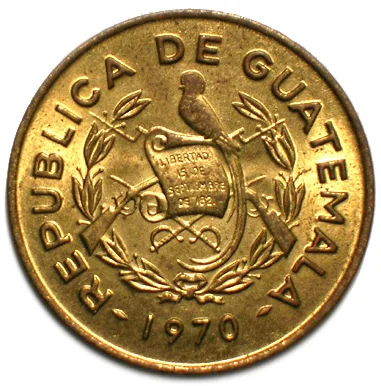
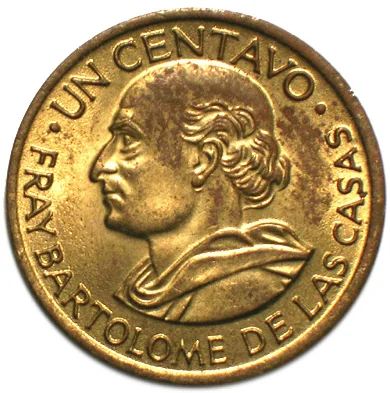
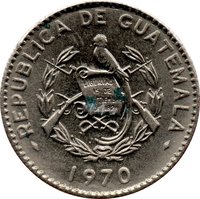
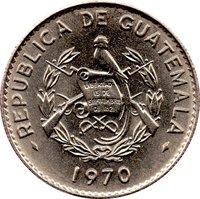
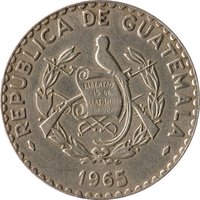
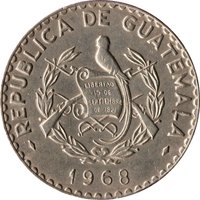
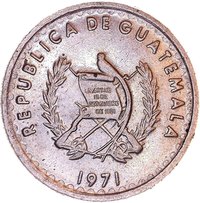
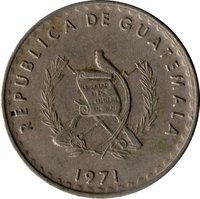
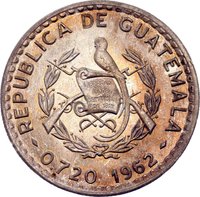
Obverse
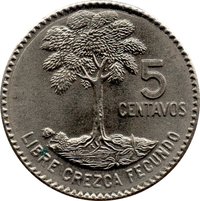
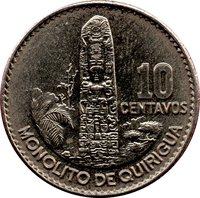
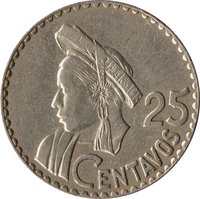
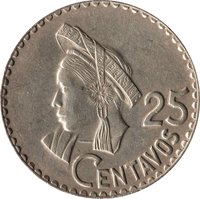
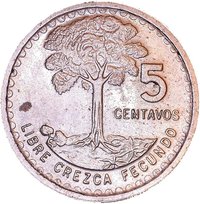
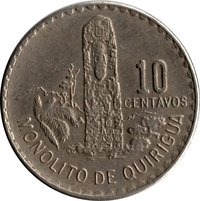
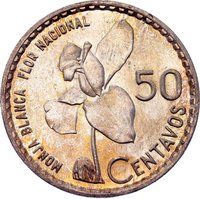
Reverse
Edge
Plain
Categories
| Person> Religious figure |
| Symbols> Coat of Arms |
Mints
| Name | Mark |
|---|---|
| Casa de Moneda de Guatemala | — |
Mintings
| Year | Mint Mark | Mintage | Quality | Collection |
|---|---|---|---|---|
| 1965 | — | 3,845,000 | ||
| 1966 | — | 6,100,000 | ||
| 1967 | — | 6,400,000 | ||
| 1968 | — | 2,590,000 | ||
| 1969 | — | 13,780,000 | ||
| 1970 | — | 10,511,000 |
Historical background
In 1965, Guatemala's currency situation was characterized by relative stability under the Quetzal (GTQ), which had been established as the national currency in 1925, replacing the Guatemalan peso. The quetzal was uniquely and proudly pegged to the United States dollar at a fixed rate of 1:1, a parity it had maintained since its inception. This peg was a cornerstone of monetary policy, managed by the Bank of Guatemala (founded in 1946), and provided a strong anchor for both domestic prices and international trade, fostering a period of low inflation and predictability for the export-oriented agricultural economy, which relied heavily on coffee, bananas, and sugar.
This stability, however, existed within a context of significant political and social tension. The country was under the authoritarian rule of Colonel Enrique Peralta Azurdia (1963-1966), following a 1963 coup that ended a brief democratic experiment. While the fixed exchange rate benefited the traditional agrarian elite and foreign investors, it also reflected and reinforced a deeply unequal economic structure. The monetary policy was conservative, prioritizing the defense of the peg over expansive developmental spending, which limited the government's fiscal flexibility to address widespread poverty and underinvestment in infrastructure and social services.
Looking forward, the rigidity of the fixed exchange rate would eventually come under pressure. While the 1:1 parity held firmly throughout 1965 and for over a decade more, the model's sustainability depended on consistent export earnings and disciplined fiscal management. The eventual breakdown of the Bretton Woods international monetary system in the early 1970s and Guatemala's own internal conflicts and economic shifts would later challenge this decades-old parity, leading to a managed devaluation in the 1980s. Thus, 1965 represents a point of apparent calm in the quetzal's history, underpinned by a political order that ensured stability for some at the cost of broader economic development.
This stability, however, existed within a context of significant political and social tension. The country was under the authoritarian rule of Colonel Enrique Peralta Azurdia (1963-1966), following a 1963 coup that ended a brief democratic experiment. While the fixed exchange rate benefited the traditional agrarian elite and foreign investors, it also reflected and reinforced a deeply unequal economic structure. The monetary policy was conservative, prioritizing the defense of the peg over expansive developmental spending, which limited the government's fiscal flexibility to address widespread poverty and underinvestment in infrastructure and social services.
Looking forward, the rigidity of the fixed exchange rate would eventually come under pressure. While the 1:1 parity held firmly throughout 1965 and for over a decade more, the model's sustainability depended on consistent export earnings and disciplined fiscal management. The eventual breakdown of the Bretton Woods international monetary system in the early 1970s and Guatemala's own internal conflicts and economic shifts would later challenge this decades-old parity, leading to a managed devaluation in the 1980s. Thus, 1965 represents a point of apparent calm in the quetzal's history, underpinned by a political order that ensured stability for some at the cost of broader economic development.
Series: System: 1965-1997
🌱 Very Common