

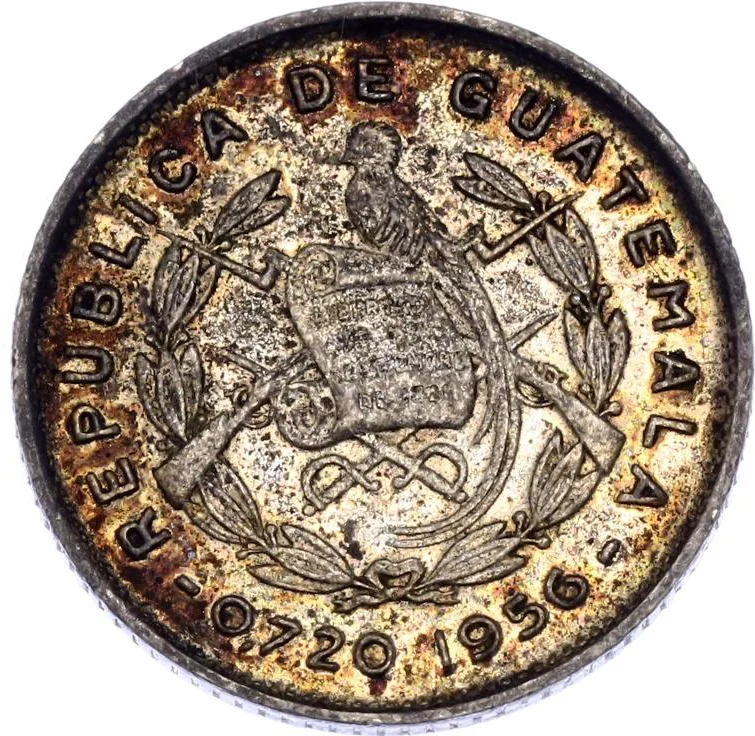
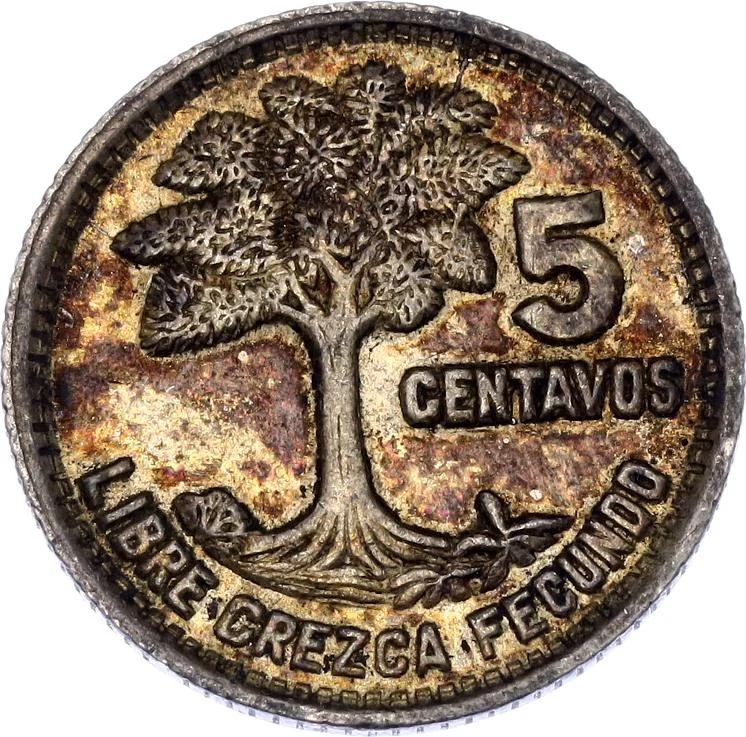
5 centavos – Guatemala
Add to wishlist
Guatemala
Context
Material
References
KM: #
Numista: #4246
Value
Exchange value: 0.05 GTQ
Bullion value: $2.99
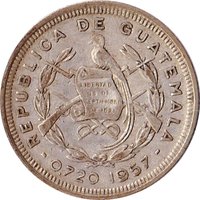
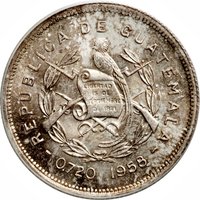
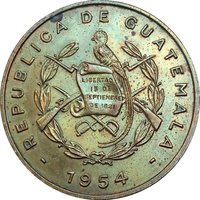
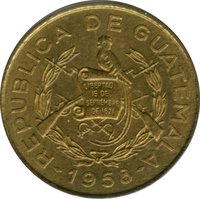
Obverse
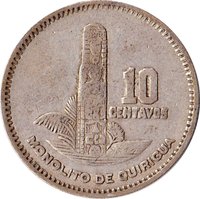
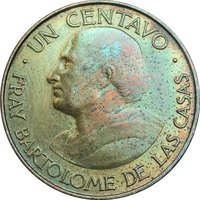
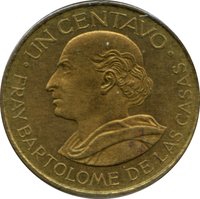
Reverse
Edge
Reeded
Categories
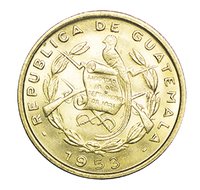
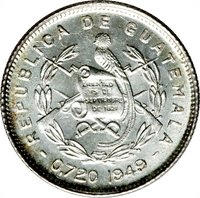
| Symbols> Coat of Arms |
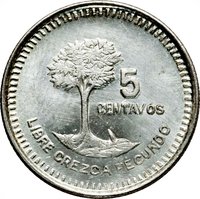
| Plant> Tree |
Mints
| Name | Mark |
|---|---|
| Casa de Moneda de Guatemala | — |
Mintings
| Year | Mint Mark | Mintage | Quality | Collection |
|---|---|---|---|---|
| 1950 | — | 453,422 | ||
| 1951 | — | 1,031,500 | ||
| 1952 | — | 913,000 | ||
| 1953 | — | 446,514 | ||
| 1954 | — | 519,592 | ||
| 1955 | — | 2,062,306 | ||
| 1956 | — | 1,300,666 | ||
| 1957 | — | 2,941,154 | ||
| 1958 | — | 3,025,333 | ||
| 1959 | — | 232,000 |
Historical background
In 1950, Guatemala's currency, the quetzal, was a notable exception to the monetary instability common in Latin America, functioning as a symbol of conservative fiscal policy. Established in 1925 during a period of economic modernization, the quetzal was created to replace the peso and was uniquely pegged at par to the United States dollar. This peg was backed by a legal requirement for 100% gold and foreign exchange reserves, a discipline enforced by the independent Bank of Guatemala, founded in 1946. Consequently, the quetzal enjoyed immense domestic and international confidence, with minimal inflation and no parallel black market for dollars—a rarity in the region.
This monetary stability existed within a complex and shifting economic landscape. The country's economy was overwhelmingly agrarian, dominated by the production and export of coffee, bananas, and later cotton, largely controlled by foreign corporations like the United Fruit Company and a small domestic elite. The governments of Juan José Arévalo (1945-1951) and his successor Jacobo Árbenz (inaugurated in 1951) were pursuing a reformist agenda known as the "Ten Years of Spring," which included social welfare programs and, most controversially, an ambitious land reform. These policies, funded in part by monetary emissions, began to create tensions with the orthodox financial model.
Thus, by 1950, the currency itself was rock-solid, but the economic and political foundations supporting it were entering a period of profound stress. The reformist government's spending priorities and the looming confrontation with powerful landed interests created underlying pressures that would challenge the country's fiscal discipline. The stable quetzal, therefore, stood as a pillar of an old economic order just as the Guatemalan state began to actively attempt to transform that very order, setting the stage for the political and economic upheavals that would culminate in the CIA-backed coup of 1954.
This monetary stability existed within a complex and shifting economic landscape. The country's economy was overwhelmingly agrarian, dominated by the production and export of coffee, bananas, and later cotton, largely controlled by foreign corporations like the United Fruit Company and a small domestic elite. The governments of Juan José Arévalo (1945-1951) and his successor Jacobo Árbenz (inaugurated in 1951) were pursuing a reformist agenda known as the "Ten Years of Spring," which included social welfare programs and, most controversially, an ambitious land reform. These policies, funded in part by monetary emissions, began to create tensions with the orthodox financial model.
Thus, by 1950, the currency itself was rock-solid, but the economic and political foundations supporting it were entering a period of profound stress. The reformist government's spending priorities and the looming confrontation with powerful landed interests created underlying pressures that would challenge the country's fiscal discipline. The stable quetzal, therefore, stood as a pillar of an old economic order just as the Guatemalan state began to actively attempt to transform that very order, setting the stage for the political and economic upheavals that would culminate in the CIA-backed coup of 1954.
Series: System: 1949-1964
🌱 Common