

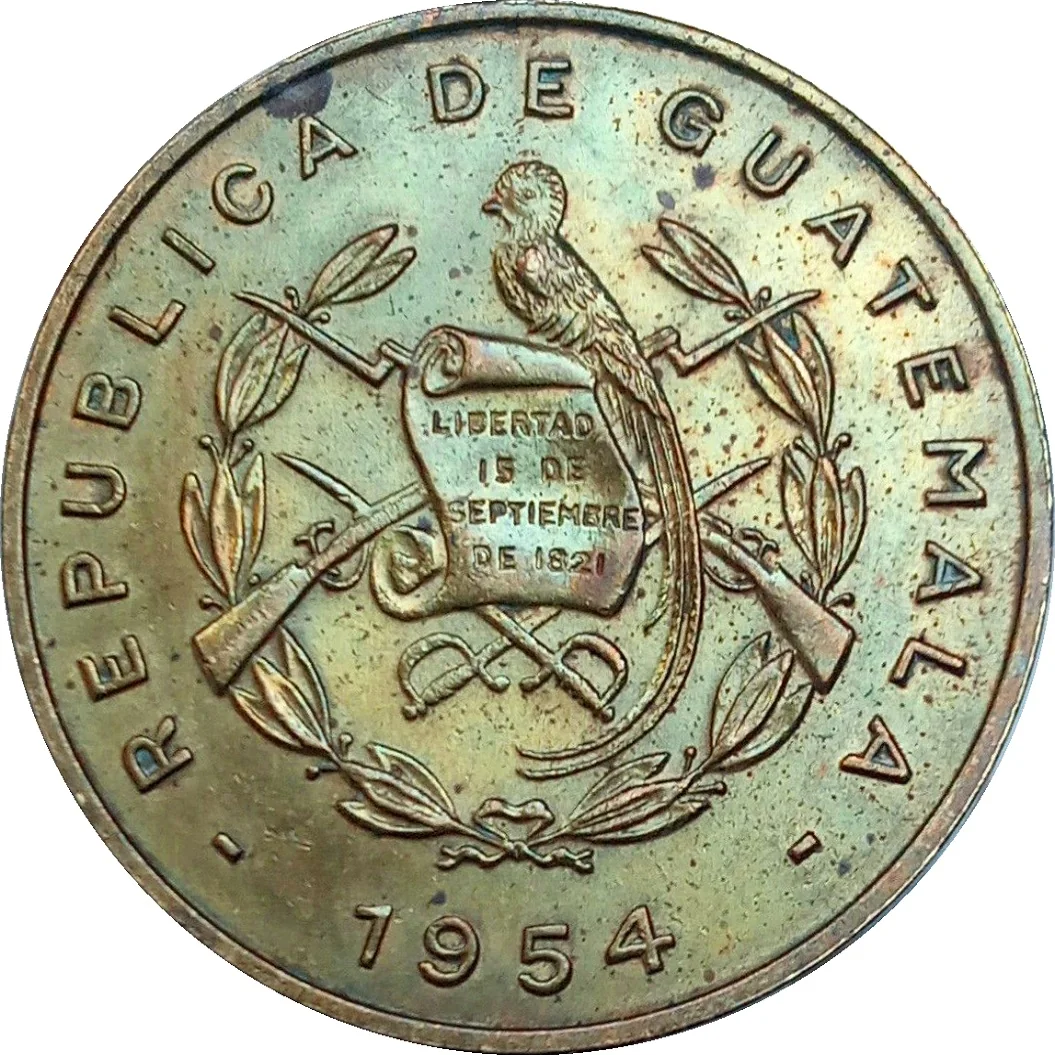
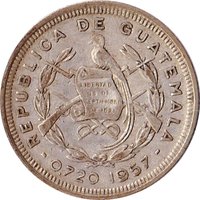
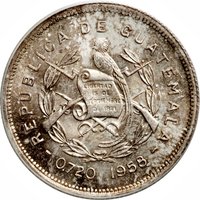
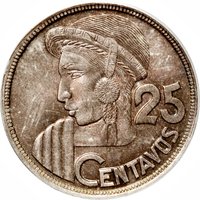
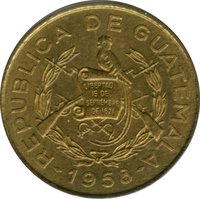
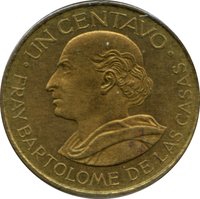
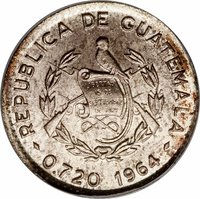
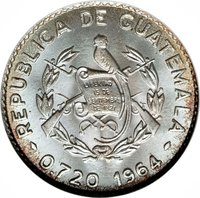
Obverse
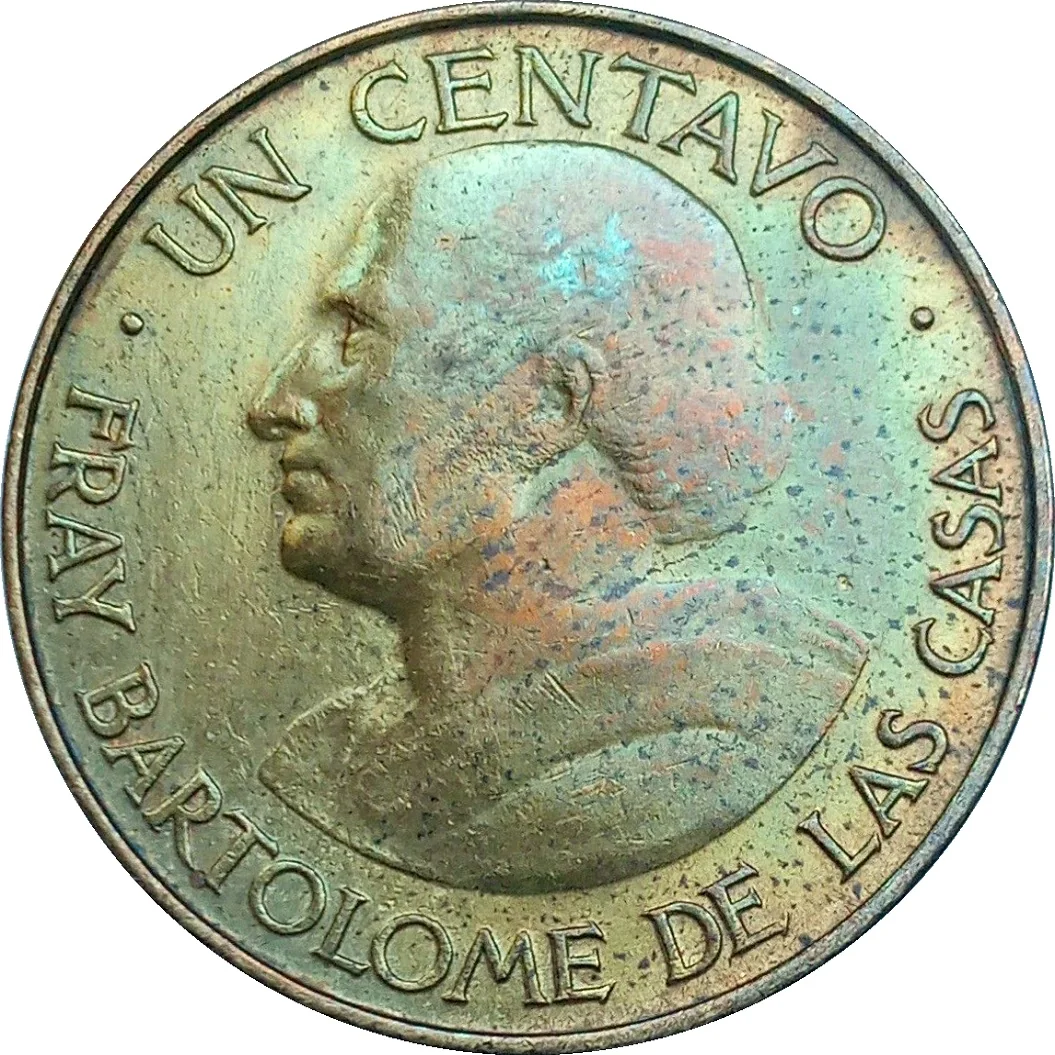
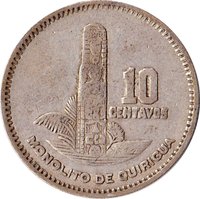
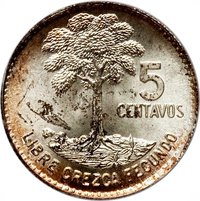
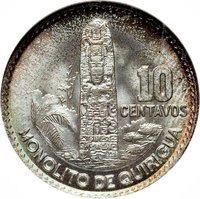
Reverse
Edge
Plain
Categories
| Symbols> Coat of Arms |
| Person> Religious figure |
Mints
| Name | Mark |
|---|---|
| Kings Norton Metal Company | — |
Mintings
| Year | Mint Mark | Mintage | Quality | Collection |
|---|---|---|---|---|
| 1954 | — | — | ||
| 1957 | — | 1,600,000 | ||
| 1958 | — | 2,000,000 |
Historical background
In 1954, Guatemala's currency situation was intrinsically linked to the political and economic upheaval surrounding the overthrow of President Jacobo Árbenz Guzmán. The national currency, the quetzal, was notably strong and stable, famously pegged at par to the United States dollar since its introduction in 1925. This stability was a point of national pride and was meticulously managed by the Banco de Guatemala, established in 1946. However, underlying this formal stability were significant tensions, as Árbenz's reformist government, particularly its landmark agrarian reform decree (Decree 900), challenged the economic interests of the powerful United Fruit Company and domestic elites, creating investor uncertainty.
The primary economic pressure on the currency was not devaluation but rather a climate of capital flight and restricted credit. The agrarian reform, which expropriated unused land from large plantations for redistribution, was compensated with government bonds, a move seen as threatening by the landed oligarchy and foreign corporations. This, combined with Árbenz's perceived communist sympathies during the Cold War, led to a loss of confidence. Wealthy Guatemalans and foreign investors began moving capital out of the country, straining the banking system. While the quetzal's peg held, the economy faced liquidity shortages and investment strikes, undermining overall economic stability.
The CIA-backed coup in June 1954 that ousted Árbenz immediately sought to reverse his economic policies. The new military government under Colonel Carlos Castillo Armas swiftly returned nationalized land to the United Fruit Company and other large landowners, dismantling the agrarian reform. While this action aimed to restore confidence with the U.S. and the traditional elite, the immediate post-coup period was one of disruption. The long-term currency stability of the quetzal endured, but the political shift entrenched an economic model favoring export agriculture and foreign capital, setting a course that would perpetuate deep social and economic inequalities for decades, with the stable currency masking underlying structural issues.
The primary economic pressure on the currency was not devaluation but rather a climate of capital flight and restricted credit. The agrarian reform, which expropriated unused land from large plantations for redistribution, was compensated with government bonds, a move seen as threatening by the landed oligarchy and foreign corporations. This, combined with Árbenz's perceived communist sympathies during the Cold War, led to a loss of confidence. Wealthy Guatemalans and foreign investors began moving capital out of the country, straining the banking system. While the quetzal's peg held, the economy faced liquidity shortages and investment strikes, undermining overall economic stability.
The CIA-backed coup in June 1954 that ousted Árbenz immediately sought to reverse his economic policies. The new military government under Colonel Carlos Castillo Armas swiftly returned nationalized land to the United Fruit Company and other large landowners, dismantling the agrarian reform. While this action aimed to restore confidence with the U.S. and the traditional elite, the immediate post-coup period was one of disruption. The long-term currency stability of the quetzal endured, but the political shift entrenched an economic model favoring export agriculture and foreign capital, setting a course that would perpetuate deep social and economic inequalities for decades, with the stable currency masking underlying structural issues.
Series: System: 1949-1964
🌱 Common