

5 centavos – Guatemala
Add to wishlist
Guatemala
Context
Material
References
KM: #
Numista: #14299
Value
Exchange value: 0.05 GTQ
Bullion value: $3.03
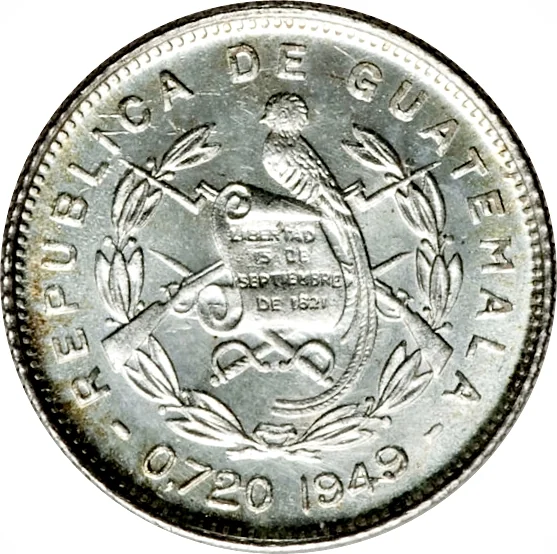
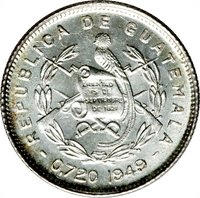
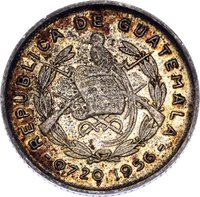
Obverse
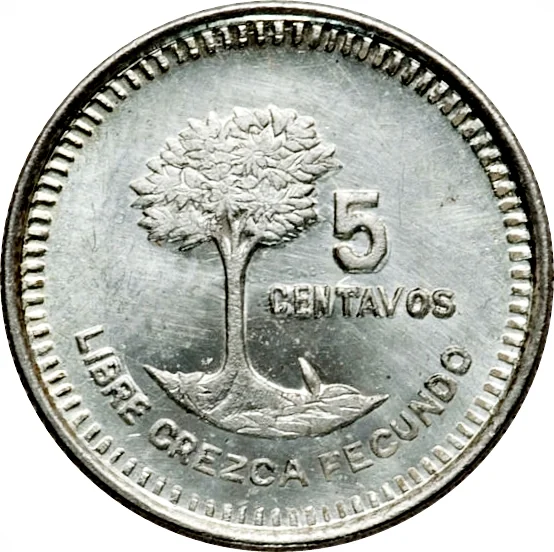
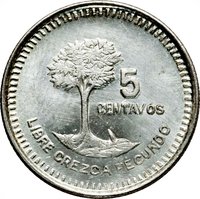
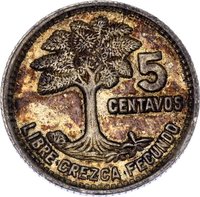
Reverse
Description:
Tree with right-side values and bottom legend.
Inscription:
5
CENTAVOS
LIBRE CREZCA FECUNDO
CENTAVOS
LIBRE CREZCA FECUNDO
Translation:
5
CENTAVOS
FREE GROW FERTILE
CENTAVOS
FREE GROW FERTILE
Script: Latin
Language: Spanish
Engraver: Paul Vincze
Edge
Categories
| Symbols> Coat of Arms |
| Plant> Tree |
Mints
| Name | Mark |
|---|---|
| Casa de Moneda de Guatemala | — |
Mintings
| Year | Mint Mark | Mintage | Quality | Collection |
|---|---|---|---|---|
| 1949 | — | 305,000 |
Historical background
In 1949, Guatemala's currency situation was defined by the Quetzal (GTQ), which had been established in 1925 during the government of President José María Orellana. The currency was created to replace the peso and was uniquely designed to be on par with the United States dollar, a fixed exchange rate of 1:1. This stability was backed by a gold standard and conservative fiscal management, making the Quetzal one of the most stable currencies in Latin America at the time. The Banco Central de Guatemala, founded in 1946, had taken over monetary authority and maintained significant gold and foreign exchange reserves to defend this parity.
The economic context of 1949, however, presented underlying pressures. The country was in the early years of the presidencies of Juan José Arévalo (1945-1951), a period of significant social and political reform known as the "Ten Years of Spring." While not in immediate crisis, the government's expanding social programs and increased public spending, alongside a reliance on agricultural exports like coffee and bananas, created a complex fiscal landscape. The fixed exchange rate, while a symbol of stability, required disciplined economic management to maintain, especially as the state increased its role in the economy.
Consequently, the currency situation in 1949 was one of apparent surface stability masking emerging tensions. The Quetzal-dollar parity held firm, supported by the central bank's reserves and continued strong export earnings. However, the transformative political agenda of the era, which would intensify under Arévalo's successor, Jacobo Árbenz, began to set the stage for future economic challenges. The stability of 1949, therefore, represented a calm before the profound political and economic shifts that would later lead to international confrontation and eventual currency instability in the mid-1950s.
The economic context of 1949, however, presented underlying pressures. The country was in the early years of the presidencies of Juan José Arévalo (1945-1951), a period of significant social and political reform known as the "Ten Years of Spring." While not in immediate crisis, the government's expanding social programs and increased public spending, alongside a reliance on agricultural exports like coffee and bananas, created a complex fiscal landscape. The fixed exchange rate, while a symbol of stability, required disciplined economic management to maintain, especially as the state increased its role in the economy.
Consequently, the currency situation in 1949 was one of apparent surface stability masking emerging tensions. The Quetzal-dollar parity held firm, supported by the central bank's reserves and continued strong export earnings. However, the transformative political agenda of the era, which would intensify under Arévalo's successor, Jacobo Árbenz, began to set the stage for future economic challenges. The stability of 1949, therefore, represented a calm before the profound political and economic shifts that would later lead to international confrontation and eventual currency instability in the mid-1950s.
Series: System: 1949-1964
🌟 Limited