

2.5 escudos – Mozambique
Add to wishlist
Mozambique
Context
Years: 1952–1973
Issuer: Mozambique
Period:
(1951—1975)
Currency:
(1911—1974)
Demonetized: Yes
Total mintage: 25,767,000
Material
Diameter: 20.2 mm
Weight: 3.5 g
Thickness: 1.4 mm
Shape: Round
Composition: Copper-nickel
Technique: Milled
Alignment: Coin alignment
flip
References
KM: #
Numista: #3823
Obverse
Description:
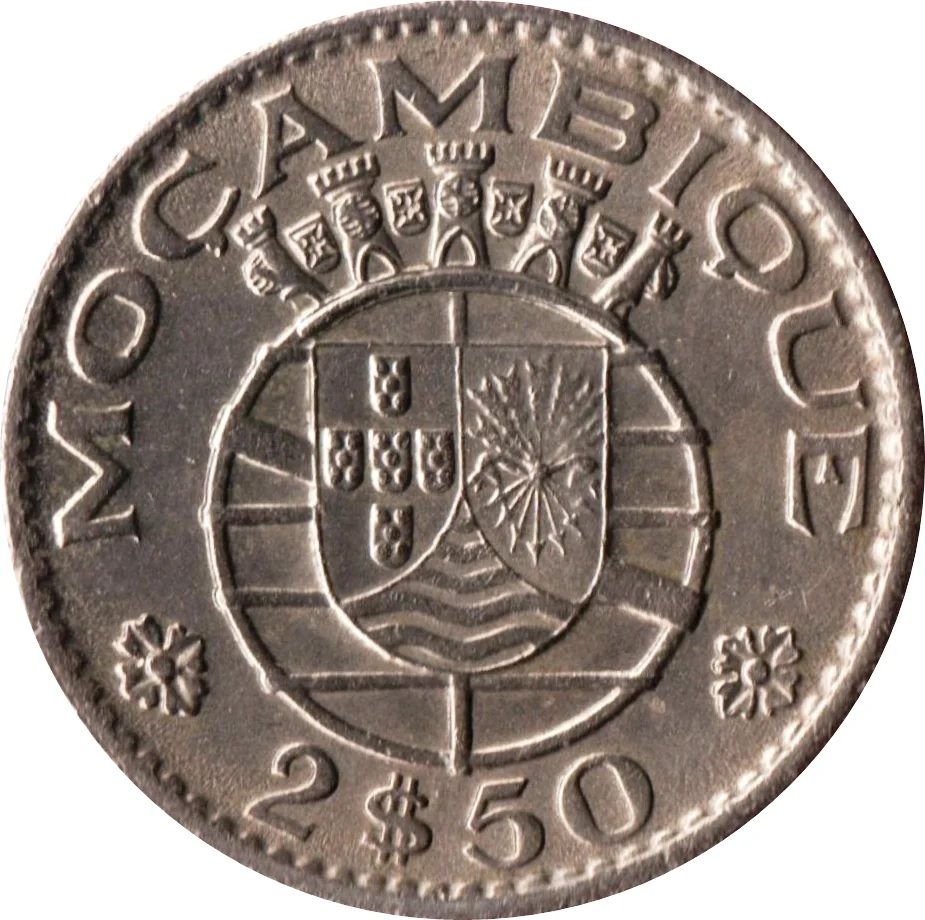
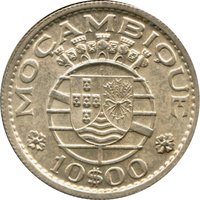
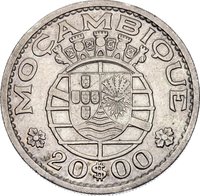
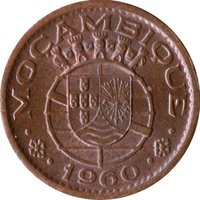
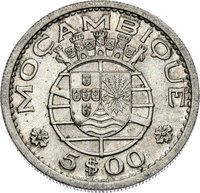
Shield of Mozambique on crowned armillary sphere, value below.
Inscription:
MOÇAMBIQUE
2$50
2$50
Translation:
MOZAMBIQUE
2.50 Meticais
2.50 Meticais
Script: Latin
Language: Portuguese
Reverse
Description:
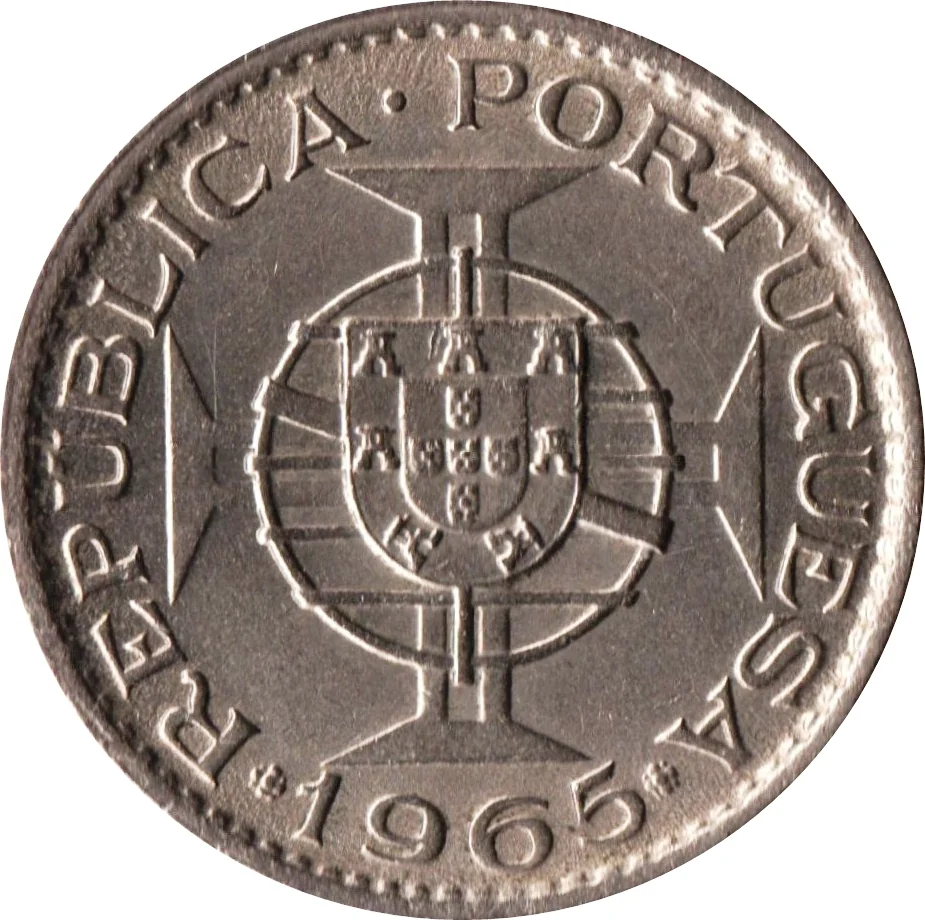
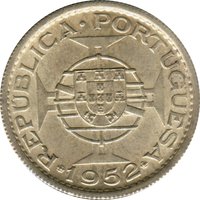
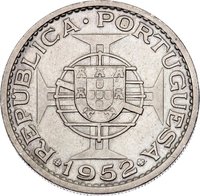
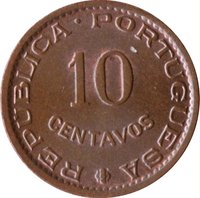
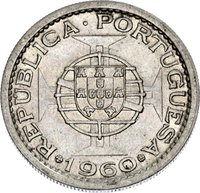
Order of the Colonial Empire emblem. Dated.
Inscription:
REPÚBLICA · PORTUGUESA
1965
1965
Translation:
Portuguese Republic
1965
1965
Script: Latin
Language: Portuguese
Edge
Milled
Categories
| Symbol> Cross |
| Symbols> Coat of Arms |
Mintings
| Year | Mint Mark | Mintage | Quality | Collection |
|---|---|---|---|---|
| 1952 | — | 4,000,000 | ||
| 1953 | — | 4,000,000 | ||
| 1954 | — | 4,000,000 | ||
| 1955 | — | 4,000,000 | ||
| 1965 | — | 8,000,000 | ||
| 1973 | — | 1,767,000 |
Historical background
In 1952, Mozambique's currency situation was fundamentally shaped by its status as a Portuguese colony, integrated into Portugal's broader imperial monetary system. The official currency was the Portuguese escudo (PTE), which circulated alongside local banknotes and coins issued specifically for the "Province of Mozambique" by the Banco Nacional Ultramarino (BNU). These Mozambican escudos were pegged at par with the metropolitan Portuguese escudo, creating a fixed and centralized exchange system controlled from Lisbon. This arrangement facilitated trade and financial flows within the Portuguese empire but subordinated Mozambique's monetary policy entirely to Portugal's economic interests and conditions.
The economy was primarily geared toward exporting raw materials—such as cotton, cashews, sugar, and later tea—to Portugal and other international markets. The currency's fixed peg provided stability for Portuguese settlers and trading companies operating in the colony, ensuring easy repatriation of profits. However, it offered little autonomy to address local economic needs. Furthermore, the limited banking infrastructure, largely confined to major port cities like Lourenço Marques (now Maputo) and Beira, meant that a vast majority of the indigenous population engaged in subsistence agriculture and had minimal interaction with the formal monetary system, often relying on barter or informal trade.
This period fell within the late colonial era under the authoritarian Estado Novo regime, which enforced a strict protectionist and mercantilist economic policy. Consequently, Mozambique's currency was not freely convertible outside the Portuguese escudo zone, and capital controls were stringent. The stability of the escudo in 1952 was thus intrinsically linked to the economic health of Portugal itself and the management of the BNU, embedding Mozambique's financial fate within the fortunes and policies of its colonial ruler, a relationship that would persist until the independence wars of the 1960s and beyond.
The economy was primarily geared toward exporting raw materials—such as cotton, cashews, sugar, and later tea—to Portugal and other international markets. The currency's fixed peg provided stability for Portuguese settlers and trading companies operating in the colony, ensuring easy repatriation of profits. However, it offered little autonomy to address local economic needs. Furthermore, the limited banking infrastructure, largely confined to major port cities like Lourenço Marques (now Maputo) and Beira, meant that a vast majority of the indigenous population engaged in subsistence agriculture and had minimal interaction with the formal monetary system, often relying on barter or informal trade.
This period fell within the late colonial era under the authoritarian Estado Novo regime, which enforced a strict protectionist and mercantilist economic policy. Consequently, Mozambique's currency was not freely convertible outside the Portuguese escudo zone, and capital controls were stringent. The stability of the escudo in 1952 was thus intrinsically linked to the economic health of Portugal itself and the management of the BNU, embedding Mozambique's financial fate within the fortunes and policies of its colonial ruler, a relationship that would persist until the independence wars of the 1960s and beyond.
Series: 4th System (1952/74)
🌱 Very Common