

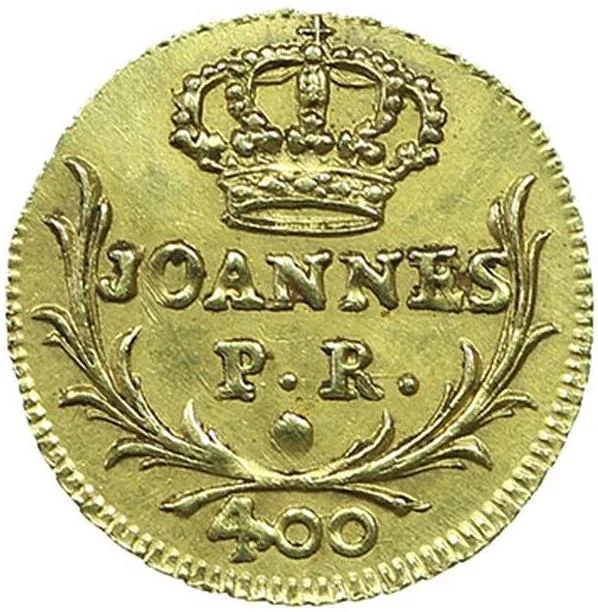

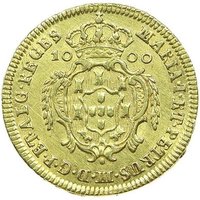
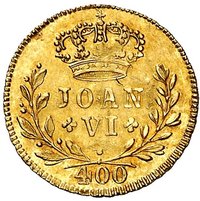
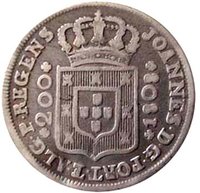
Obverse
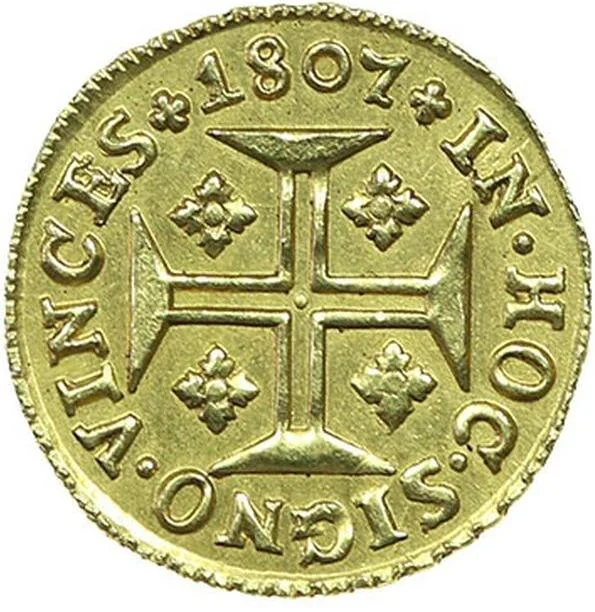
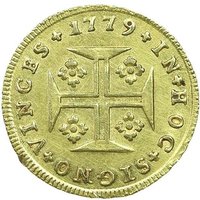
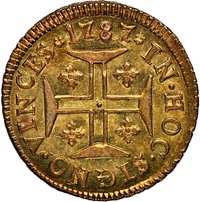
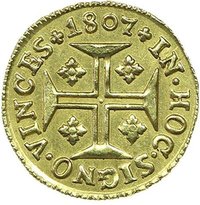
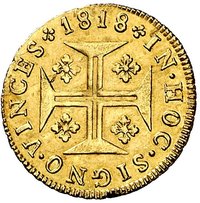
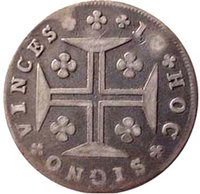
Reverse
Description:
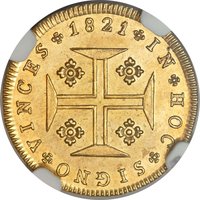
Cross of the Military Order of Christos with a flower at each corner.
Inscription:
*1807*
IN.HOC.SIGNO.VINCES
IN.HOC.SIGNO.VINCES
Script: Latin
Edge
Rope shaped
Mints
| Name | Mark |
|---|---|
| Imprensa Nacional - Casa da Moeda | — |
Mintings
| Year | Mint Mark | Mintage | Quality | Collection |
|---|---|---|---|---|
| 1807 | — | — |
Historical background
In 1807, Portugal found itself in a precarious monetary situation, caught between the lingering effects of a colonial empire and the immediate pressures of the Napoleonic Wars. The economy was still fundamentally tied to the influx of Brazilian gold and diamonds, which had fueled the circulation of gold coins like the moeda and supported a complex system of accounting in réis. However, this metallic wealth was increasingly unstable; the peak of Brazilian gold production had passed, and much of the specie was siphoned off to pay for manufactured imports from Britain, leading to periodic shortages of circulating coinage within Portugal itself.
The political crisis of late 1807 drastically exacerbated these underlying weaknesses. Facing Napoleon's invading armies and the Continental System's blockade, the Portuguese royal court, under Prince Regent João, made the momentous decision to flee to Brazil in November. This exodus had direct financial consequences: the state treasury was essentially emptied to fund the voyage and the establishment of a new government in Rio de Janeiro. A significant portion of the kingdom's remaining gold reserves, along with valuable assets from the royal collection, was taken aboard the fleet, creating an acute liquidity crisis in the metropole.
Consequently, Portugal entered a period of severe monetary dislocation. With the royal authority absent and the country under British administration during the Peninsular War, the circulating medium became chaotic. The scarcity of official coinage led to a proliferation of irregular and debased coins, while the government and occupying forces resorted to issuing paper notes and promissory orders to pay for supplies and troops. This period marked the beginning of a significant decline in the value and stability of Portuguese currency, a problem that would deepen in the coming decades as Brazil moved toward independence, permanently severing the vital colonial subsidy that had long underpinned the Portuguese economy.
The political crisis of late 1807 drastically exacerbated these underlying weaknesses. Facing Napoleon's invading armies and the Continental System's blockade, the Portuguese royal court, under Prince Regent João, made the momentous decision to flee to Brazil in November. This exodus had direct financial consequences: the state treasury was essentially emptied to fund the voyage and the establishment of a new government in Rio de Janeiro. A significant portion of the kingdom's remaining gold reserves, along with valuable assets from the royal collection, was taken aboard the fleet, creating an acute liquidity crisis in the metropole.
Consequently, Portugal entered a period of severe monetary dislocation. With the royal authority absent and the country under British administration during the Peninsular War, the circulating medium became chaotic. The scarcity of official coinage led to a proliferation of irregular and debased coins, while the government and occupying forces resorted to issuing paper notes and promissory orders to pay for supplies and troops. This period marked the beginning of a significant decline in the value and stability of Portuguese currency, a problem that would deepen in the coming decades as Brazil moved toward independence, permanently severing the vital colonial subsidy that had long underpinned the Portuguese economy.
Series: Cross of Christ
✨ Legendary