Logo Title
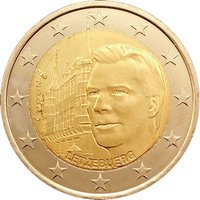
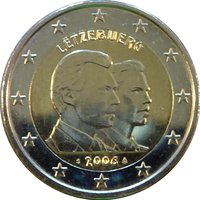
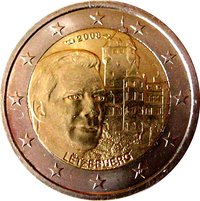
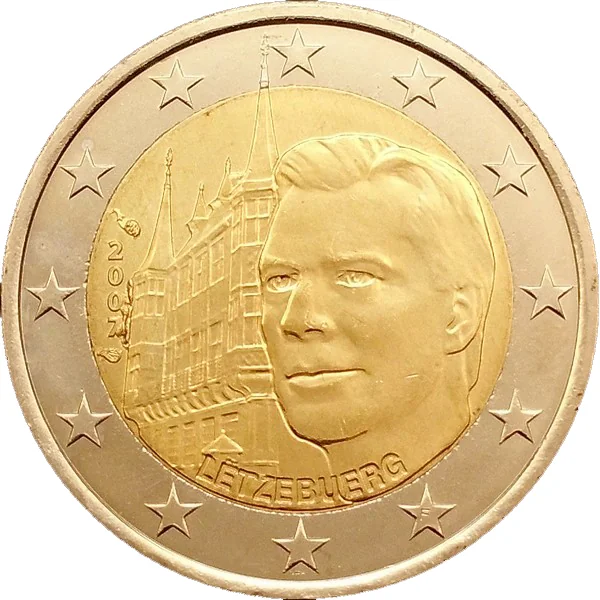
obverse
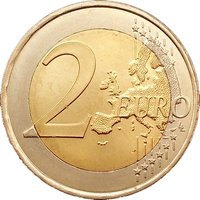
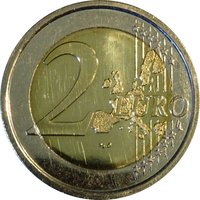
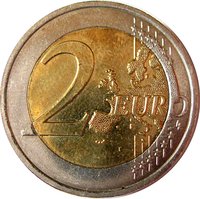
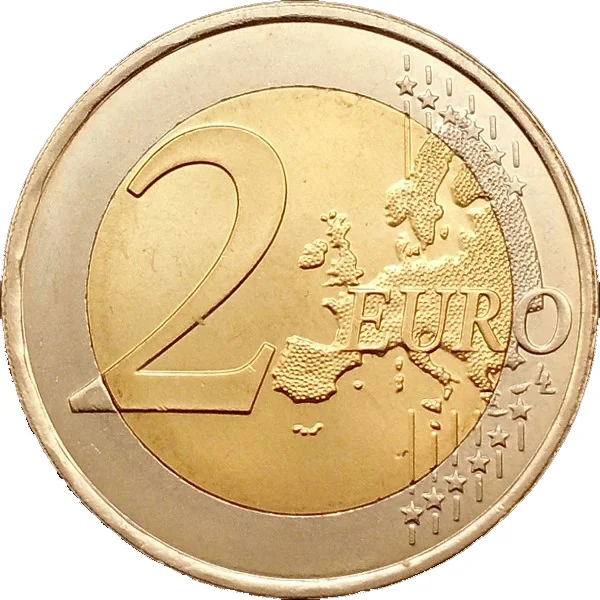
reverse
Ma collection de monnaies

2 Euro – Grand Duchy of Luxembourg

Circulating commemorative coins
Commemoration: Luxemburg castles - 1st issue - Palais Grand-Ducal
Luxembourg
Context
Year: 2007
Country: Luxembourg Country flag
Ruler: Henry
Currency:
(since 2002)
Total mintage: 1,031,000
Material
Diameter: 25.75 mm
Weight: 8.5 g
Thickness: 2.2 mm
Shape: Round
Composition: Bimetallic (Nickel brass center, Copper-nickel ring)
Technique: Milled
Alignment: Medal alignment
Obverse
OBVERSE ↑
flip
Reverse
REVERSE ↑
References
KM: #Click to copy to clipboard95
Numista: #2202
Value
Exchange value: 2 EUR = $2.36
Inflation-adjusted value: 2.99 EUR

Obverse

Description:
The coin depicts Grand-Duke Henri superimposed on the Grand Ducal Palace, with the year 2007, engraver's and mint marks, and 'LËTZEBUERG' at the base. The EU stars are on the outer ring.
Inscription:
LËTZEBUERG 2007 F
Translation:
Luxembourg 2007 F
Script: Latin
Languages: French, Luxembourgish

Reverse

Description:
A map shows Europe borderless beside its face value.
Inscription:
2 EURO LL
Script: Latin
Engraver: Luc Luycx

Edge

Finely ribbed with edge lettering: six times the sequence "2 * * " alternately upright and inverted
Legend:
2 ** 2 ** 2 ** 2 ** 2 ** 2 **
Categories

Building> Palace
Map

Mints

NameMark
Monnaie de ParisF

Mintings

YearMint MarkMintageQualityCollection
2007F1,000,000
2007F26,000BU
2007F5,000Proof

Historical background

In 2007, the Grand Duchy of Luxembourg was a fully integrated member of the Eurozone, having adopted the euro as its sole legal tender on 1 January 1999 (for electronic transactions) and seeing the introduction of euro banknotes and coins in 2002. This move permanently replaced the Luxembourgish franc, which had been pegged to the Belgian franc since the 1920s under the Belgium-Luxembourg Economic Union (BLEU). Consequently, by 2007, Luxembourg's monetary policy was entirely set by the European Central Bank (ECB) in Frankfurt, with the country participating in the common interest rate and exchange rate regime aimed at price stability across the Eurozone.

The domestic currency situation was characterized by robust economic health, with Luxembourg enjoying one of the highest GDP per capita rates in the world, driven by its dominant banking, financial services, and steel sectors. This prosperity, coupled with its status as a founding EU member, solidified its commitment to the euro project. The Central Bank of Luxembourg (BCL) operated as part of the Eurosystem, responsible for implementing ECB policy, ensuring financial stability, and issuing euro coins (with the Luxembourgish national side). Notably, Luxembourg, like other Eurozone members, did not have the autonomy to devalue its currency to gain competitive advantage, relying instead on fiscal policy and structural reforms.

However, 2007 marked the beginning of the global financial crisis, which would soon test the Eurozone's framework. While the immediate currency situation in Luxembourg appeared stable, the underlying vulnerabilities in international banking systems—highly relevant to Luxembourg's economy—were starting to surface. The year ended with growing uncertainty, setting the stage for the severe financial storms of 2008 that would challenge the stability of the euro itself and Luxembourg's financial-centric economy, despite the solidity of its currency union membership.

Series: Grand Duchy of Luxembourg 2 euro commemoratives

2 Euro obverse
2 Euro reverse
2 Euro
2004-2008
2 Euro obverse
2 Euro reverse
2 Euro
2005-2008
2 Euro obverse
2 Euro reverse
2 Euro
2006-2008
2 Euro obverse
2 Euro reverse
2 Euro
2007
2 Euro obverse
2 Euro reverse
2 Euro
2007
2 Euro obverse
2 Euro reverse
2 Euro
2008
2 Euro obverse
2 Euro reverse
2 Euro
2009
🌱 Very Common