

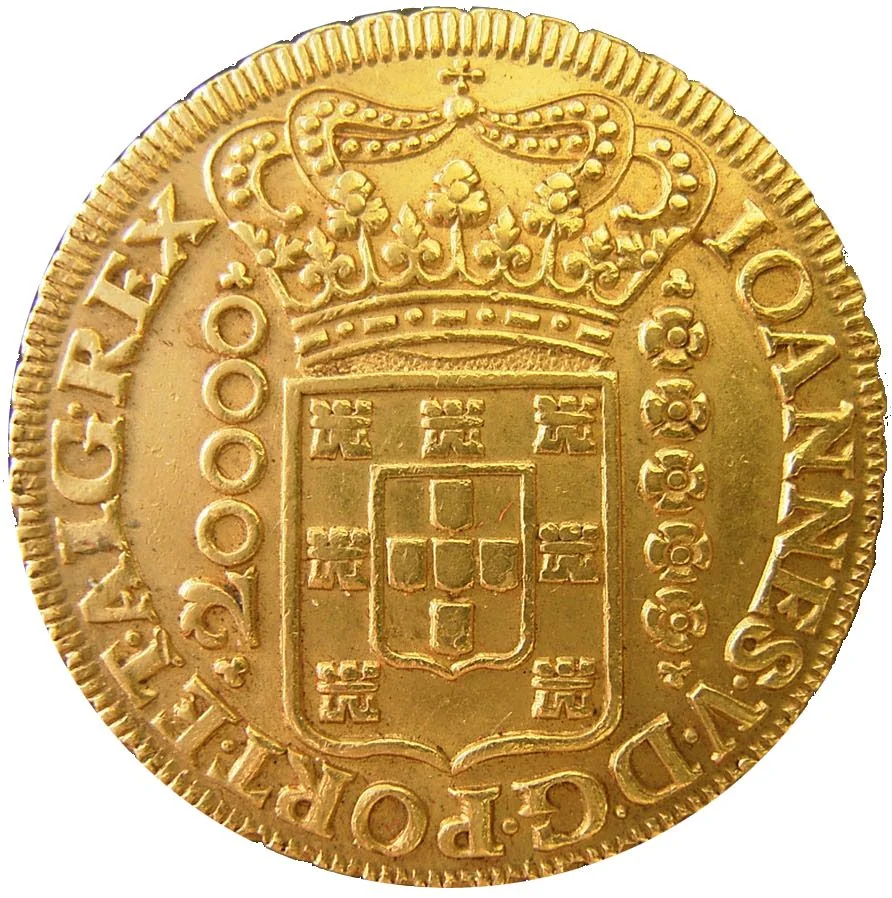
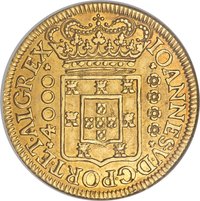
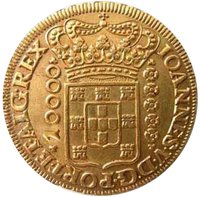
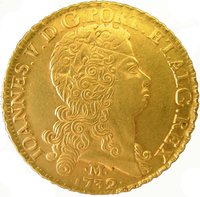
Obverse
Inscription:
IOANNES.V.D.G.PORT.ET.ALG.REX
20000
20000
Script: Latin
Engraver: António Mengin
Designer: Vieira Lusitano
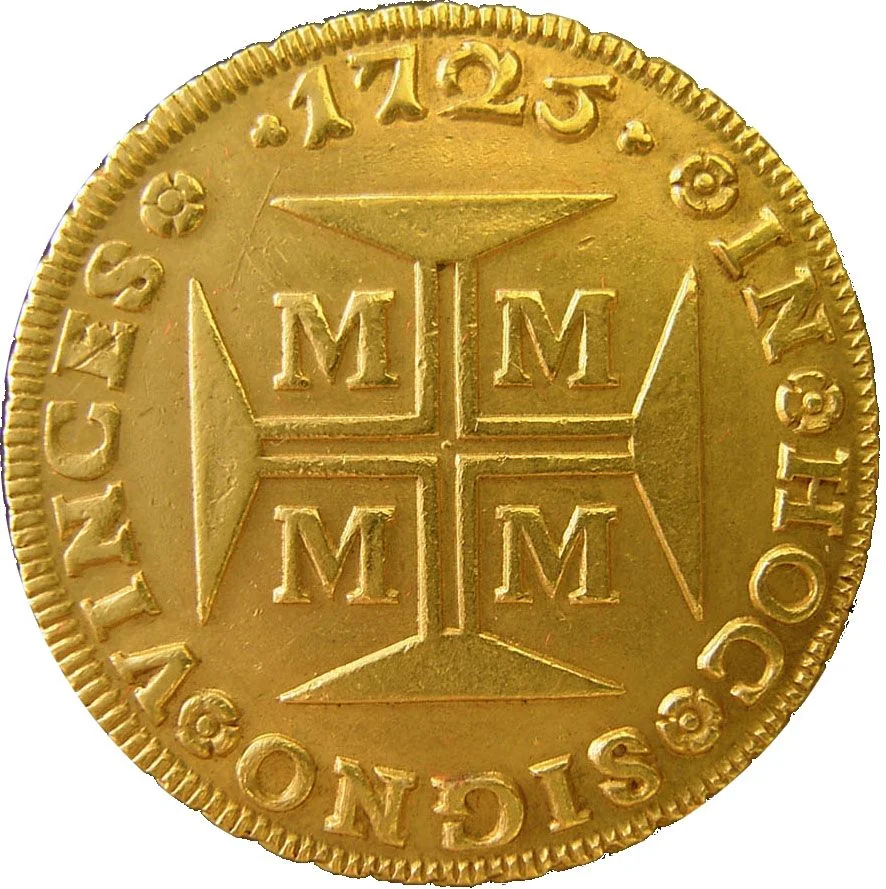
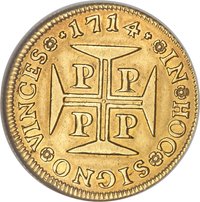
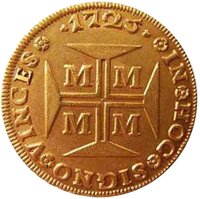
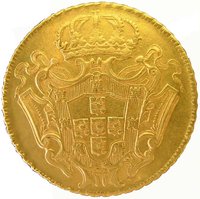
Reverse
Description:
Military Order of the Cross of Christ with four M's.
Inscription:
*1725* *IN*HOC*SIGNO*VINCES
M M
M M
M M
M M
Script: Latin
Engraver: António Mengin
Designer: Vieira Lusitano
Edge
Rope shaped
Mints
| Name | Mark |
|---|---|
| Vila Rica | MMMM |
Historical background
In 1724, Portugal’s currency situation was defined by a severe shortage of gold and silver coinage in circulation, a problem stemming from decades of economic strain. The kingdom was in the midst of the "Crisis of 1724," a period of acute monetary scarcity that crippled daily commerce. While vast quantities of Brazilian gold were arriving in Lisbon, this wealth was largely siphoned off to pay for chronic trade deficits, especially with England, and to fund the crown’s expenditures, rather than being minted into coins for the domestic economy. The result was a stark contradiction: a state growing richer in bullion reserves while its people and markets starved for usable currency.
The physical coins in circulation were a chaotic mix of old and debased Portuguese réis, Spanish pieces of eight, and other foreign coins, leading to confusion and facilitating fraud. To address the crisis, King John V’s government had initiated a major monetary reform, which would culminate in 1725 with the issuance of new gold moedas. The intent was to stabilize and unify the monetary system by introducing high-value gold coins, like the 12,800 réis piece, and new silver denominations. However, in 1724, this reform was in its preparatory stages, meaning the scarcity was at its peak and public anxiety was high as the kingdom awaited the promised injection of new, trustworthy coinage.
This monetary crisis had profound social and economic effects. The lack of specie stifled trade, depressed wages paid in increasingly worthless copper, and exacerbated social tensions. The crown’s focus on high-value gold coins for large-scale and international transactions did little to alleviate the everyday hardships of the common people, who relied on small-denomination copper and silver. Thus, in 1724, Portugal stood at a monetary crossroads, its economy hampered by acute shortage and disorganization, yet on the brink of a top-down reform aimed at harnessing its Brazilian gold to restore royal financial authority, albeit with limited immediate relief for the broader economy.
The physical coins in circulation were a chaotic mix of old and debased Portuguese réis, Spanish pieces of eight, and other foreign coins, leading to confusion and facilitating fraud. To address the crisis, King John V’s government had initiated a major monetary reform, which would culminate in 1725 with the issuance of new gold moedas. The intent was to stabilize and unify the monetary system by introducing high-value gold coins, like the 12,800 réis piece, and new silver denominations. However, in 1724, this reform was in its preparatory stages, meaning the scarcity was at its peak and public anxiety was high as the kingdom awaited the promised injection of new, trustworthy coinage.
This monetary crisis had profound social and economic effects. The lack of specie stifled trade, depressed wages paid in increasingly worthless copper, and exacerbated social tensions. The crown’s focus on high-value gold coins for large-scale and international transactions did little to alleviate the everyday hardships of the common people, who relied on small-denomination copper and silver. Thus, in 1724, Portugal stood at a monetary crossroads, its economy hampered by acute shortage and disorganization, yet on the brink of a top-down reform aimed at harnessing its Brazilian gold to restore royal financial authority, albeit with limited immediate relief for the broader economy.
Series: Cross of Christ
✨ Legendary