

2 Euro – Estonia
Circulating commemorative coins
Commemoration: Estonia’s road to independence
Estonia

Obverse
Description:
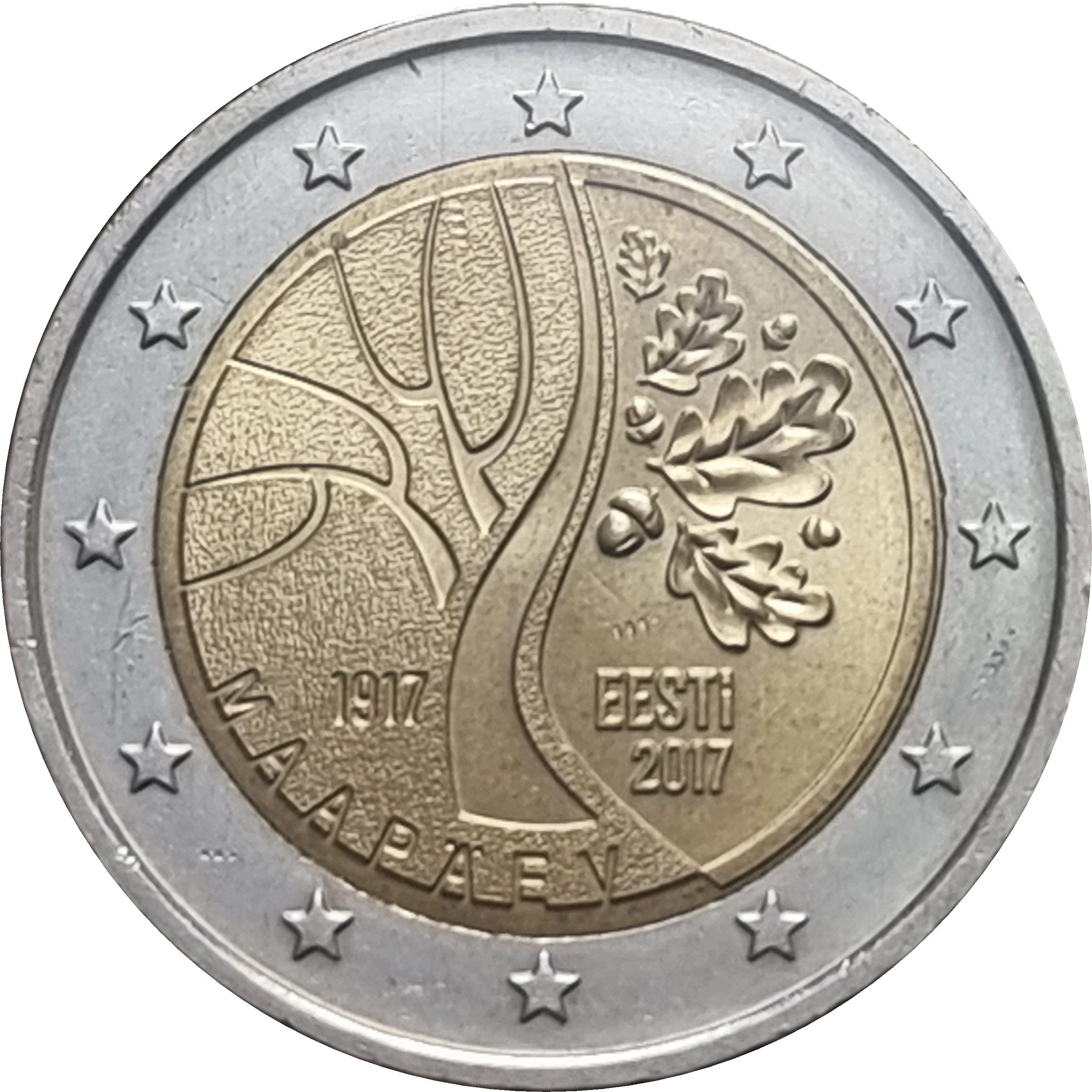
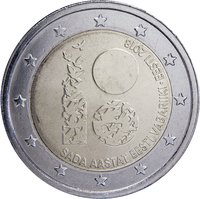
An oak's sinuous trunk centers the coin, with leftward branches symbolizing the revolutionary struggles leading to Estonian independence and rightward leaves representing Estonia's strength, achievements, and longevity. "MAAPÄEV" and "1917" appear at the trunk's lower left, with "EESTI" and "2017" at the lower right. The outer ring features the 12 stars of the European Union.
Inscription:
1917
EESTI
2017
MAAPÄEV
EESTI
2017
MAAPÄEV
Translation:
Estonia
Land Council
Land Council
Script: Latin
Language: Estonian
Reverse
Edge
Finely ribbed with edge lettering repeated two times upright and inverted.
Legend:
EESTI O EESTI O
Translation:
O Estonia, O Estonia
Language: Estonian
Categories
| Plant> Tree |
| Map |
| Event> Independence |
Mints
| Name | Mark |
|---|---|
| Lithuanian Mint | — |
Mintings
| Year | Mint Mark | Mintage | Quality | Collection |
|---|---|---|---|---|
| 2017 | — | 1,500,000 |
Historical background
In 2017, Estonia was a stable and integrated member of the Eurozone, having adopted the euro as its official currency on 1 January 2011. The transition was considered a success, solidifying the country's economic and political alignment with core European institutions. By 2017, the euro was well-established in daily life, providing benefits like eliminated exchange rate risk with major trading partners, lower transaction costs, and enhanced investor confidence. The currency was managed by the European Central Bank (ECB), with Estonia's central bank, Eesti Pank, participating in the Eurosystem's decision-making processes.
The broader economic context in 2017 was one of steady growth and careful fiscal management. Estonia's economy grew at a robust rate of approximately 4.9% that year, outperforming the Eurozone average. This growth was supported by strong domestic demand, increased investment, and vibrant exports. The government maintained a policy of fiscal discipline, boasting one of the lowest public debt-to-GDP ratios in the European Union, which stood at around 9%—a stark contrast to the Eurozone's average of over 85%. This prudent approach further underpinned confidence in the country's financial stability within the single currency area.
However, the national discourse occasionally revisited the topic of currency, not as a debate about abandoning the euro, but in discussions about economic overheating and competitiveness. With rapid wage growth and rising inflation (which reached 3.4% by year-end), some economists and commentators voiced concerns about losing cost competitiveness within the Eurozone, as Estonia could not independently adjust interest rates or devalue its currency. These were standard challenges of a booming economy within a monetary union, and the primary policy responses focused on fiscal restraint and structural reforms rather than any fundamental questioning of euro membership, which remained overwhelmingly popular among the public and political establishment.
The broader economic context in 2017 was one of steady growth and careful fiscal management. Estonia's economy grew at a robust rate of approximately 4.9% that year, outperforming the Eurozone average. This growth was supported by strong domestic demand, increased investment, and vibrant exports. The government maintained a policy of fiscal discipline, boasting one of the lowest public debt-to-GDP ratios in the European Union, which stood at around 9%—a stark contrast to the Eurozone's average of over 85%. This prudent approach further underpinned confidence in the country's financial stability within the single currency area.
However, the national discourse occasionally revisited the topic of currency, not as a debate about abandoning the euro, but in discussions about economic overheating and competitiveness. With rapid wage growth and rising inflation (which reached 3.4% by year-end), some economists and commentators voiced concerns about losing cost competitiveness within the Eurozone, as Estonia could not independently adjust interest rates or devalue its currency. These were standard challenges of a booming economy within a monetary union, and the primary policy responses focused on fiscal restraint and structural reforms rather than any fundamental questioning of euro membership, which remained overwhelmingly popular among the public and political establishment.
Series: Estonia 2 euro commemoratives
🌱 Very Common