

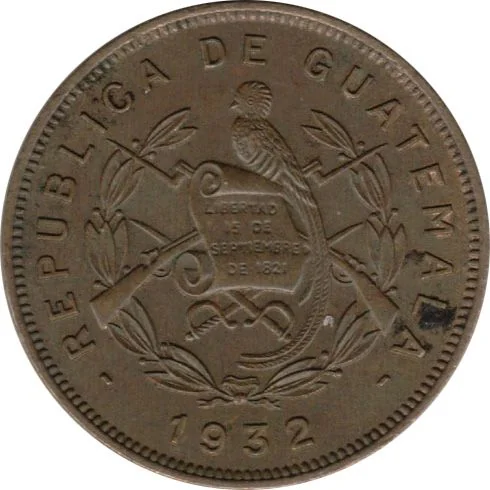
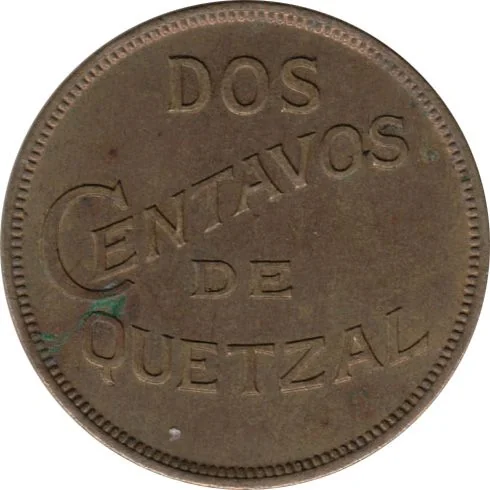
2 centavos – Guatemala
Add to wishlist
Guatemala
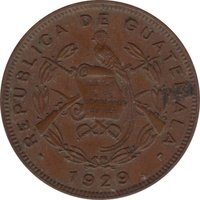
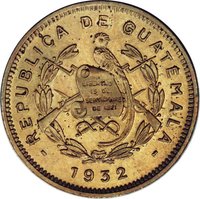
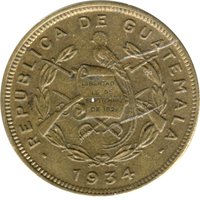
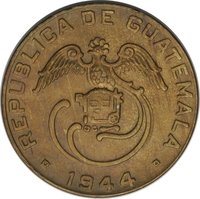
Obverse
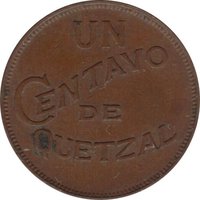
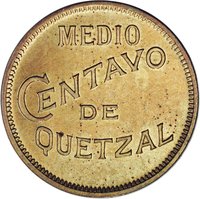
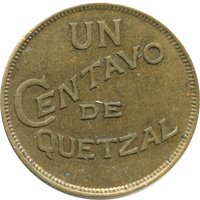
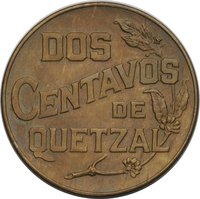
Reverse
Edge
Plain
Categories
| Symbols> Coat of Arms |
Mints
| Name | Mark |
|---|---|
| Royal Mint (Tower Hill) | — |
Mintings
| Year | Mint Mark | Mintage | Quality | Collection |
|---|---|---|---|---|
| 1932 | — | 3,000,000 | ||
| 1932 | — | — | Proof |
Historical background
In 1932, Guatemala’s currency situation was defined by its adherence to the gold standard under the authoritarian regime of General Jorge Ubico, who had taken power earlier that year. The national currency, the peso, was pegged to the US dollar at a fixed rate of 1 quetzal (which replaced the peso in 1925) to 1 US dollar, a parity backed by gold reserves. This rigid system provided a degree of monetary stability and was favored by the landed elite and foreign investors, particularly the powerful United Fruit Company, as it guaranteed predictable exchange rates for coffee and banana exports.
However, this stability came at a severe social cost, especially during the onset of the Great Depression. As global commodity prices for coffee collapsed, the fixed exchange rate made Guatemalan exports more expensive internationally, exacerbating the economic downturn. The government's commitment to the gold standard and fiscal austerity prevented devaluation, which could have made exports more competitive. Instead, Ubico enforced deflationary policies, slashing public spending and maintaining a balanced budget, which deepened unemployment and rural poverty while protecting the value of the currency for the wealthy.
Consequently, the currency regime of 1932 was a pillar of the conservative economic order that prioritized external stability over internal welfare. It reflected and reinforced the extreme inequality of the period, as the peasant majority and urban workers bore the brunt of the Depression through low wages and high unemployment, while the state safeguarded the financial interests of the export oligarchy. This economic framework, devoid of monetary flexibility, was integral to Ubico’s centralized control and set the stage for the entrenched social tensions that would characterize Guatemalan politics for decades to come.
However, this stability came at a severe social cost, especially during the onset of the Great Depression. As global commodity prices for coffee collapsed, the fixed exchange rate made Guatemalan exports more expensive internationally, exacerbating the economic downturn. The government's commitment to the gold standard and fiscal austerity prevented devaluation, which could have made exports more competitive. Instead, Ubico enforced deflationary policies, slashing public spending and maintaining a balanced budget, which deepened unemployment and rural poverty while protecting the value of the currency for the wealthy.
Consequently, the currency regime of 1932 was a pillar of the conservative economic order that prioritized external stability over internal welfare. It reflected and reinforced the extreme inequality of the period, as the peasant majority and urban workers bore the brunt of the Depression through low wages and high unemployment, while the state safeguarded the financial interests of the export oligarchy. This economic framework, devoid of monetary flexibility, was integral to Ubico’s centralized control and set the stage for the entrenched social tensions that would characterize Guatemalan politics for decades to come.
Series: System: 1925-1949
🌱 Common