

5 francs – France
Add to wishlist
France
Context
Years: 1969–2001
Issuer: France
Period:
(since 1958)
Currency:
(1960—2001)
Demonetization: 17 February 2002
Total mintage: 368,624,756
Material
References
KM: #
Numista: #8
Value
Exchange value: 5 FRF
Inflation-adjusted value: 47.06 FRF
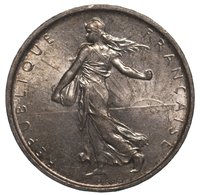
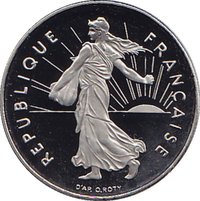
Obverse
Description:
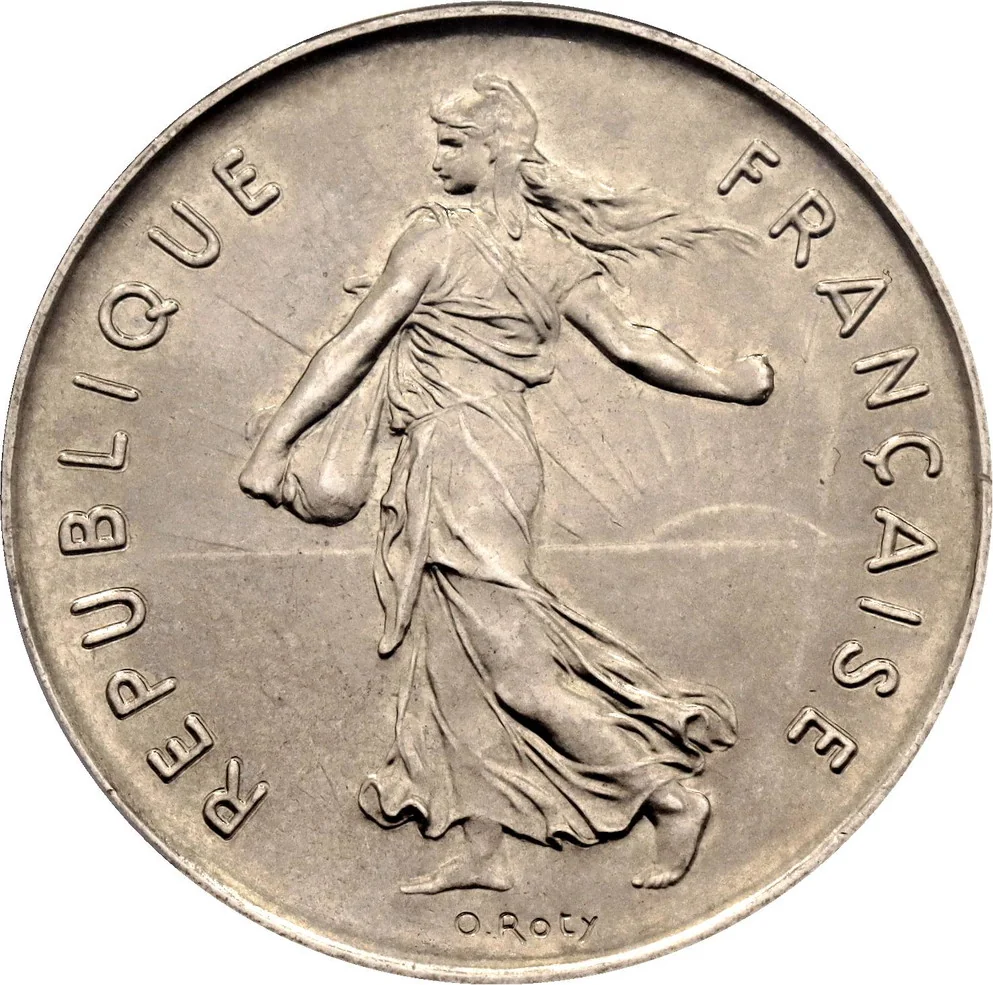
The Sower, a French national emblem designed by Oscar Roty in 1900.
Inscription:
REPUBLIQUE FRANÇAISE
O. Roty
O. Roty
Translation:
French Republic
O. Roty
O. Roty
Script: Latin
Language: French
Engraver: Louis-Oscar Roty
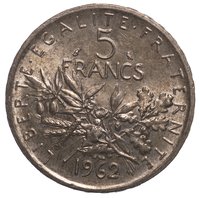
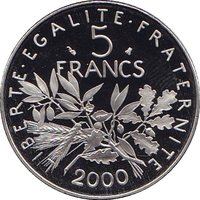
Reverse
Description:
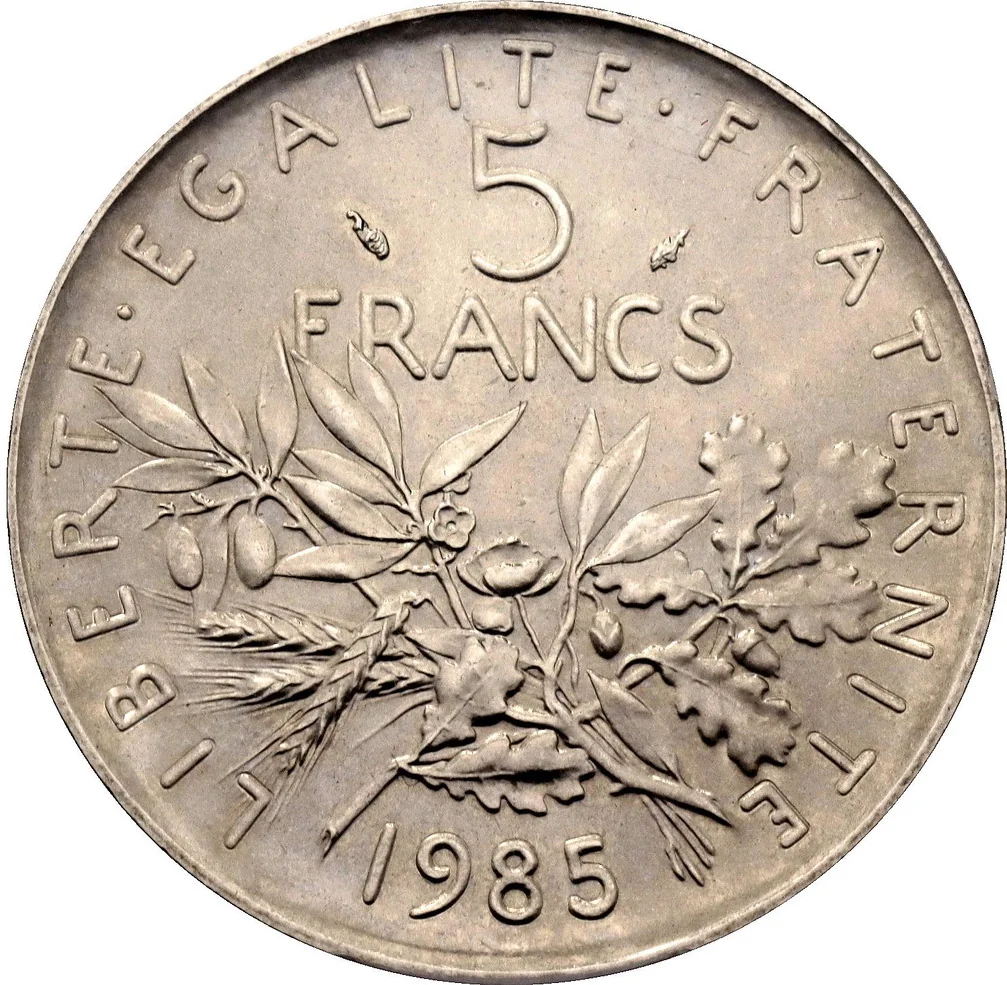
Olive and oak branches and wheat ears frame the value, encircled by the French motto.
Inscription:
LIBERTE•EGALITE•FRATERNITE
5
FRANCS
1983
5
FRANCS
1983
Translation:
LIBERTY•EQUALITY•FRATERNITY
5
FRANCS
1983
5
FRANCS
1983
Script: Latin
Language: French
Engraver: Louis-Oscar Roty
Edge
Reeded
Categories
| Symbol> Phrygian cap |
Mints
| Name | Mark |
|---|---|
| Monnaie de Paris | — |
Mintings
| Year | Mint Mark | Mintage | Quality | Collection |
|---|---|---|---|---|
| 1969 | — | — | ||
| 1970 | — | 5,000 | ||
| 1971 | — | 142,216,000 | ||
| 1972 | — | 45,507,000 | ||
| 1973 | — | 45,079,000 | ||
| 1974 | — | 26,986,811 | ||
| 1975 | — | 16,764,011 | ||
| 1976 | — | 1,665,711 | ||
| 1977 | — | 485,011 | ||
| 1978 | — | 30,046,011 | ||
| 1979 | — | 50,511 | ||
| 1980 | — | 60,000 | In sets | |
| 1981 | — | 50,011 | ||
| 1982 | — | 59,711 | ||
| 1983 | — | 100,972 | ||
| 1984 | — | 50,247 | ||
| 1985 | — | 20,111 | ||
| 1986 | — | 15,000 | In sets | |
| 1987 | — | 19,993,967 | ||
| 1988 | — | 95,576 | ||
| 1989 | — | 94,449 | ||
| 1990 | — | 15,000,011 | ||
| 1991 | — | 2,500 | ||
| 1992 | — | 2,698 | ||
| 1993 | — | 3,095 | ||
| 1994 | — | 3,973,818 | ||
| 1995 | — | 19,990,011 | ||
| 1996 | — | 17,013 | ||
| 1997 | — | 15,000 | BU | |
| 1998 | — | 25,000 | BU | |
| 1999 | — | 25,500 | BU | |
| 2000 | — | 100,000 | BU | |
| 2001 | — | 125,000 | BU |
Historical background
In 1969, France's currency situation was defined by the enduring strength of the franc within the Bretton Woods system and the political imperative to maintain its fixed parity. The French franc, pegged at 4.937 francs to one US dollar, was considered a strong currency, a point of national pride meticulously defended by President Charles de Gaulle. This stability, however, came at a cost. To maintain the peg, France had to hold large gold and dollar reserves and implement strict capital controls, limiting the free flow of money in and out of the country. The system created underlying tensions, as domestic economic pressures periodically challenged the official exchange rate.
The year itself was marked by a significant monetary crisis. In the wake of the social upheaval of May 1968, the government had increased wages to restore calm, fueling inflation and a widening trade deficit. Speculators, doubting France's ability to uphold the franc's value, began a massive sell-off. Despite implementing austerity measures, the new Prime Minister, Jacques Chaban-Delmas, and his Finance Minister, Valéry Giscard d'Estaing, were forced to devalue the franc by 11.1% in August 1969. This decision, taken shortly after Georges Pompidou succeeded de Gaulle as president, was a strategic retreat to restore competitiveness and halt the drain on reserves.
This devaluation was a pivotal moment, signaling a pragmatic shift from de Gaulle's rigid defense of the franc fort. It successfully stabilized the currency for a time, but it also exposed the growing fragility of the Bretton Woods system itself. The 1969 devaluation set the stage for France's subsequent monetary policy, which would increasingly focus on European exchange rate cooperation, a path that would eventually lead to the European Monetary System and, later, the euro.
The year itself was marked by a significant monetary crisis. In the wake of the social upheaval of May 1968, the government had increased wages to restore calm, fueling inflation and a widening trade deficit. Speculators, doubting France's ability to uphold the franc's value, began a massive sell-off. Despite implementing austerity measures, the new Prime Minister, Jacques Chaban-Delmas, and his Finance Minister, Valéry Giscard d'Estaing, were forced to devalue the franc by 11.1% in August 1969. This decision, taken shortly after Georges Pompidou succeeded de Gaulle as president, was a strategic retreat to restore competitiveness and halt the drain on reserves.
This devaluation was a pivotal moment, signaling a pragmatic shift from de Gaulle's rigid defense of the franc fort. It successfully stabilized the currency for a time, but it also exposed the growing fragility of the Bretton Woods system itself. The 1969 devaluation set the stage for France's subsequent monetary policy, which would increasingly focus on European exchange rate cooperation, a path that would eventually lead to the European Monetary System and, later, the euro.

🌱 Very Common