

5 centimes – France
Add to wishlist
France
Obverse
Description:
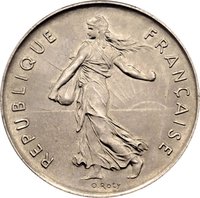
Marianne in left profile, wearing France's Phrygian cap of liberty, encircled by "REPUBLIQUE FRANÇAISE."
Inscription:
REPUBLIQUE FRANÇAISE
LAGRIFFOUL
LAGRIFFOUL
Translation:
FRENCH REPUBLIC
LAGRIFFOUL
LAGRIFFOUL
Script: Latin
Language: French
Engraver: Henri Lagriffoul
Reverse
Description:
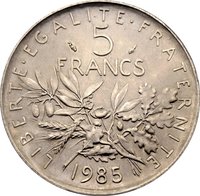
The face value is encircled by a wheat ear, an olive branch, and the French motto "LIBERTÉ - ÉGALITÉ - FRATERNITÉ".
Inscription:
A.DIEUDONNE
LIBERTE·EGALITE
·FRATERNITE·
5
CENTIMES
1986
LIBERTE·EGALITE
·FRATERNITE·
5
CENTIMES
1986
Translation:
By the Grace of God
Liberty, Equality
Fraternity
5
Centimes
1986
Liberty, Equality
Fraternity
5
Centimes
1986
Script: Latin
Language: French
Engraver: Adrien Dieudonné
Edge
Plain
Categories
| Symbol> Allegory |
| Symbol> Phrygian cap |
Mints
| Name | Mark |
|---|---|
| Monnaie de Paris | — |
Mintings
| Year | Mint Mark | Mintage | Quality | Collection |
|---|---|---|---|---|
| 1966 | — | 4,128 | ||
| 1967 | — | 11,747,305 | ||
| 1968 | — | 110,398,000 | ||
| 1969 | — | 94,961,050 | ||
| 1970 | — | 58,910,000 | ||
| 1971 | — | 93,202,000 | ||
| 1972 | — | 100,530,000 | ||
| 1973 | — | 100,423,000 | ||
| 1974 | — | 103,988,811 | ||
| 1975 | — | 95,887,011 | ||
| 1976 | — | 148,430,711 | ||
| 1977 | — | 115,310,011 | ||
| 1978 | — | 189,828,011 | ||
| 1979 | — | 180,040,511 | ||
| 1980 | — | 180,010,011 | ||
| 1981 | — | 135,000,011 | ||
| 1982 | — | 138,002,511 | ||
| 1983 | — | 132,000,972 | ||
| 1984 | — | 150,002,447 | ||
| 1985 | — | 170,010,511 | ||
| 1986 | — | 280,008,011 | BU | |
| 1987 | — | 309,995,967 | BU | |
| 1988 | — | 200,002,576 | BU | |
| 1989 | — | 95,449 | BU | |
| 1990 | — | 80,002,011 | ||
| 1991 | — | 49,992,011 | ||
| 1991 | — | 6,232 | Proof | |
| 1991 | — | 2,500 | BU | |
| 1992 | — | 179,976,011 | ||
| 1992 | — | 4,938 | Proof | |
| 1992 | — | 2,582 | BU | |
| 1993 | — | 154,968,011 | ||
| 1993 | — | 5,309 | Proof | |
| 1993 | — | 2,898 | BU | |
| 1994 | — | 59,979,768 | ||
| 1994 | — | 4,566 | Proof | |
| 1995 | — | 129,976,011 | ||
| 1995 | — | 4,796 | Proof | |
| 1996 | — | 139,990,013 | ||
| 1996 | — | — | Proof | |
| 1997 | — | 199,995,013 | ||
| 1997 | — | 6,436 | Proof | |
| 1998 | — | 25,000 | ||
| 1998 | — | 7,404 | Proof | |
| 1999 | — | 25,500 | BU | |
| 1999 | — | 10,000 | Proof | |
| 2000 | — | 100,500 | BU | |
| 2000 | — | 15,000 | Proof | |
| 2001 | — | 125,000 | BU | |
| 2001 | — | 35,000 | Proof |
Historical background
In 1966, France's currency situation was defined by its participation in the Bretton Woods system, which pegged the French franc to the US dollar and, by extension, to gold. This framework required France to maintain strict exchange rate stability, a challenge given the nation's economic priorities. The period was one of relative calm for the franc itself, following the difficult years of the early Fifth Republic, which had seen devaluations in 1958 and 1959 as part of President Charles de Gaulle's stabilization plan. By the mid-1960s, those reforms had fostered strong industrial growth and rising reserves, allowing the franc to be a stable and credible currency within the international monetary order.
However, this external stability belied significant underlying tensions, most notably France's growing criticism of the Bretton Woods system's reliance on the US dollar. Under the influence of economist Jacques Rueff, de Gaulle became a vocal advocate for a return to the classical gold standard, arguing that the dollar's "exorbitant privilege" allowed the United States to run persistent deficits without constraint. In a dramatic move, France began converting portions of its dollar reserves into gold from the US Treasury, a policy announced in 1965 and actively pursued in 1966. This action directly challenged American monetary hegemony and introduced strain into the international financial system.
Domestically, the focus was on controlling inflation and modernizing the financial sector. The government, led by Prime Minister Georges Pompidou and Finance Minister Michel Debré, maintained a policy of "franc fort" (strong franc), prioritizing price stability over competitive devaluation. Key reforms in 1966-67, such as the easing of credit regulations and the creation of the Marché Hypothécaire (mortgage market), aimed to deepen capital markets and modernize a historically conservative banking system. Thus, 1966 was a year of assertive French monetary sovereignty on the global stage, coupled with domestic efforts to build a more robust financial infrastructure for a modern economy.
However, this external stability belied significant underlying tensions, most notably France's growing criticism of the Bretton Woods system's reliance on the US dollar. Under the influence of economist Jacques Rueff, de Gaulle became a vocal advocate for a return to the classical gold standard, arguing that the dollar's "exorbitant privilege" allowed the United States to run persistent deficits without constraint. In a dramatic move, France began converting portions of its dollar reserves into gold from the US Treasury, a policy announced in 1965 and actively pursued in 1966. This action directly challenged American monetary hegemony and introduced strain into the international financial system.
Domestically, the focus was on controlling inflation and modernizing the financial sector. The government, led by Prime Minister Georges Pompidou and Finance Minister Michel Debré, maintained a policy of "franc fort" (strong franc), prioritizing price stability over competitive devaluation. Key reforms in 1966-67, such as the easing of credit regulations and the creation of the Marché Hypothécaire (mortgage market), aimed to deepen capital markets and modernize a historically conservative banking system. Thus, 1966 was a year of assertive French monetary sovereignty on the global stage, coupled with domestic efforts to build a more robust financial infrastructure for a modern economy.
🌱 Very Common