

5 francs – France
Add to wishlist
France
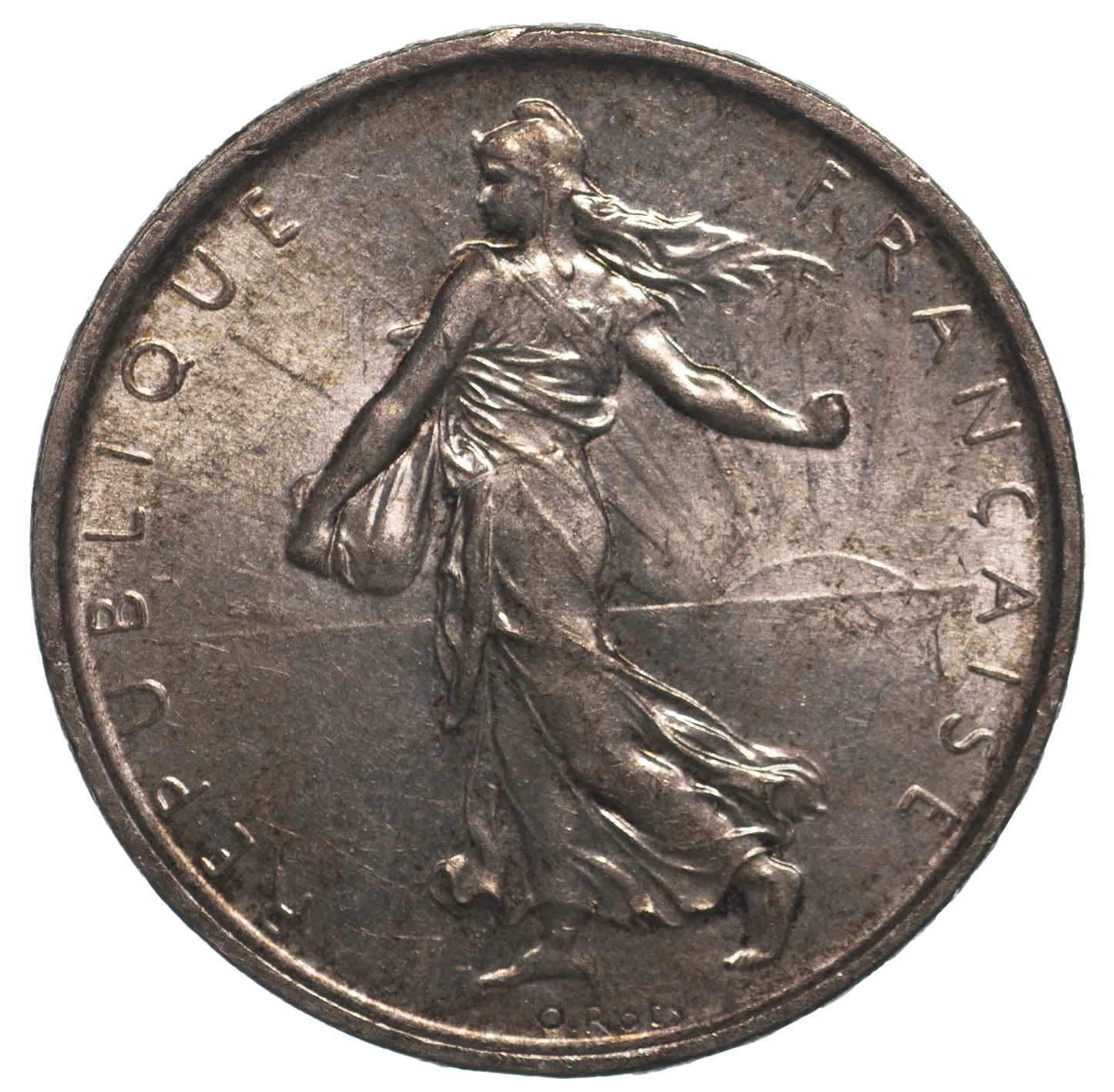
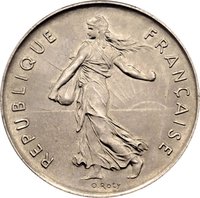
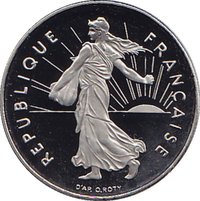
Obverse
Description:
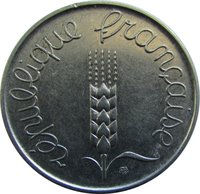
Sower facing left.
Inscription:
REPUBLIQUE FRANÇAISE
O. Roty
O. Roty
Translation:
French Republic
O. Roty
O. Roty
Script: Latin
Language: French
Engraver: Louis-Oscar Roty
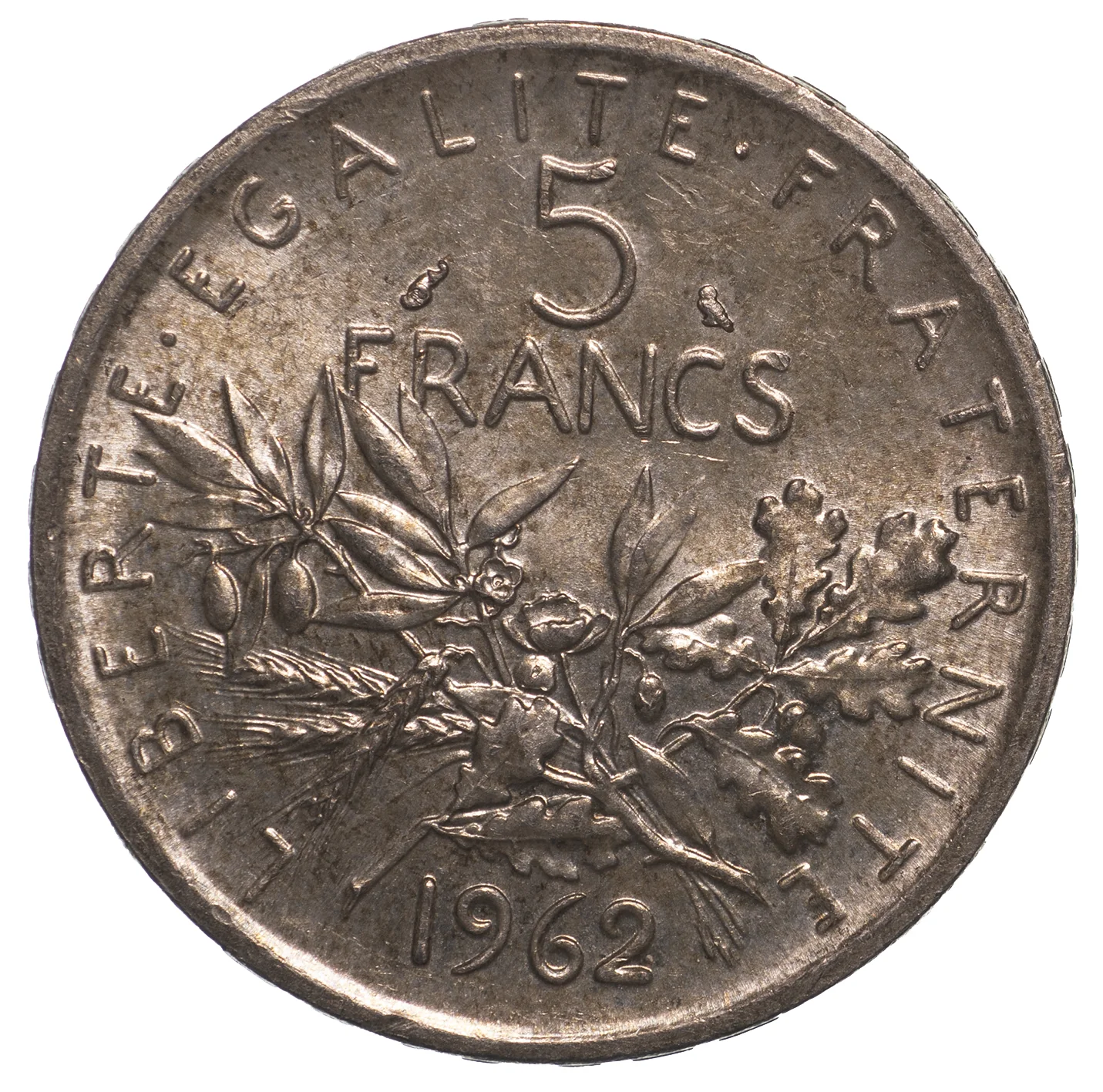
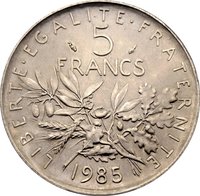
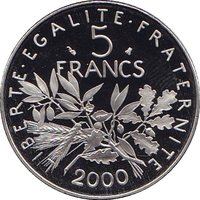
Reverse
Description:
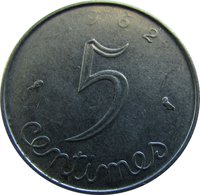
Wheat, acorns, and olives intermingle with the denomination above and date below.
Inscription:
LIBERTE·EGALITE·FRATERNITE
5
FRANCS
1960
5
FRANCS
1960
Translation:
LIBERTY EQUALITY FRATERNITY
5
FRANCS
1960
5
FRANCS
1960
Script: Latin
Language: French
Engraver: Louis-Oscar Roty
Edge
Smooth and inscripted.
Legend:
LIBERTE EGALITE FRATERNITE
Translation:
Liberty Equality Fraternity
Language: French
Mints
| Name | Mark |
|---|---|
| Monnaie de Paris | — |
Mintings
| Year | Mint Mark | Mintage | Quality | Collection |
|---|---|---|---|---|
| 1960 | — | 55,082,000 | ||
| 1961 | — | 15,630,000 | ||
| 1962 | — | 42,500,000 | ||
| 1963 | — | 37,936,000 | ||
| 1964 | — | 32,403,600 | ||
| 1965 | — | 5,156,000 | ||
| 1966 | — | 5,017,171 | ||
| 1967 | — | 702,305 | ||
| 1968 | — | 357,000 | ||
| 1969 | — | 504,050 |
Historical background
By 1960, France was in the midst of a profound monetary transition aimed at stabilizing its economy and restoring national prestige. The post-war period had been plagued by persistent inflation and a weak currency, with the old franc having lost immense value. To address this, President Charles de Gaulle's government, with Finance Minister Antoine Pinay, enacted a radical reform on December 27, 1958, which came into full effect in 1960. This reform introduced the nouveau franc (new franc), which was worth 100 old francs.
The primary goal was psychological and practical: to simplify accounting, restore public confidence in the currency, and signal France's economic modernization. Prices were redenominated, so that 1 new franc equaled 100 old francs (for example, 1000 old francs became 10 NF). New banknotes and coins were issued, though the old currency remained legal tender for a time. This "heavy franc" policy was part of a broader stabilization plan that included budget austerity, trade liberalization, and the creation of a convertible franc within the European Payment Union, ultimately paving the way for France to join the European Economic Community.
Thus, the currency situation in 1960 was one of cautious optimism. The new franc was successfully established in daily life, representing a break from the inflationary past and aligning France with stronger European currencies. It served as a cornerstone for the period of strong economic growth known as the Trente Glorieuses (1945–1975), though it would itself be replaced decades later by the introduction of the euro in 1999.
The primary goal was psychological and practical: to simplify accounting, restore public confidence in the currency, and signal France's economic modernization. Prices were redenominated, so that 1 new franc equaled 100 old francs (for example, 1000 old francs became 10 NF). New banknotes and coins were issued, though the old currency remained legal tender for a time. This "heavy franc" policy was part of a broader stabilization plan that included budget austerity, trade liberalization, and the creation of a convertible franc within the European Payment Union, ultimately paving the way for France to join the European Economic Community.
Thus, the currency situation in 1960 was one of cautious optimism. The new franc was successfully established in daily life, representing a break from the inflationary past and aligning France with stronger European currencies. It served as a cornerstone for the period of strong economic growth known as the Trente Glorieuses (1945–1975), though it would itself be replaced decades later by the introduction of the euro in 1999.

🌱 Very Common