

50 centavos – Portugal
Add to wishlist
Portugal
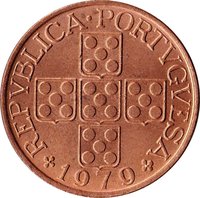
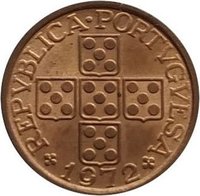
Obverse
Description:
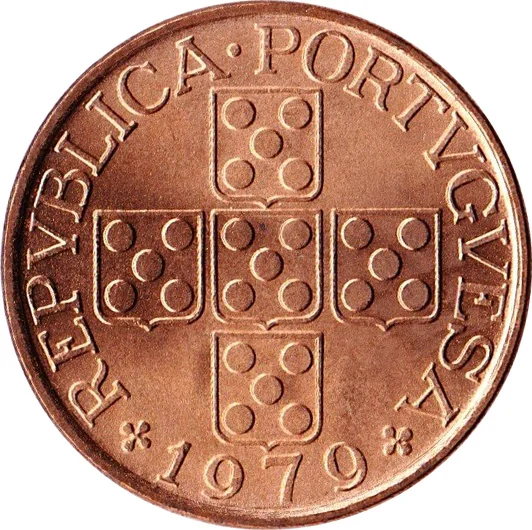
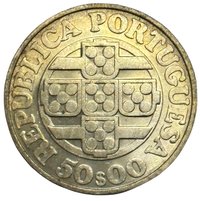
Five shields in a cross, each with five bezants and a date.
Inscription:
REPVBLICA PORTVGVESA
1979
1979
Translation:
REPUBLIC PORTUGUESE
1979
1979
Script: Latin
Language: Latin
Engraver: Marcelino Norte de Almeida
Reverse
Description:
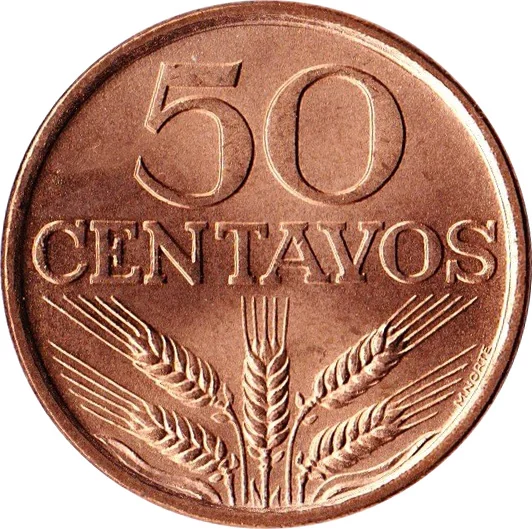
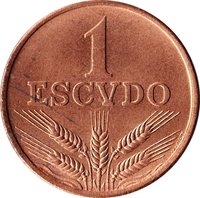
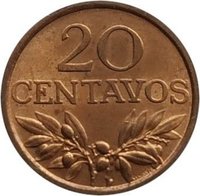
Five wheat ears below the value.
Inscription:
50
CENTAVOS
MNORTE
CENTAVOS
MNORTE
Script: Latin
Engraver: Marcelino Norte de Almeida
Edge
Plain
Categories
| Agriculture |
| Symbol> Cross |
Mints
| Name | Mark |
|---|---|
| Imprensa Nacional - Casa da Moeda | — |
Mintings
| Year | Mint Mark | Mintage | Quality | Collection |
|---|---|---|---|---|
| 1969 | — | 3,481,000 | ||
| 1970 | — | 17,280,000 | ||
| 1971 | — | 9,139,000 | ||
| 1972 | — | 24,729,000 | ||
| 1973 | — | 35,588,000 | ||
| 1974 | — | 28,719,000 | ||
| 1975 | — | 17,793,000 | ||
| 1976 | — | 23,734,000 | ||
| 1977 | — | 16,340,000 | ||
| 1978 | — | 48,348,000 | ||
| 1979 | — | 61,652,000 |
Historical background
In 1969, Portugal's currency situation was defined by the Escudo, which operated under a tightly controlled regime emblematic of the authoritarian Estado Novo government led by Prime Minister António de Oliveira Salazar (and from September 1968, his successor Marcelo Caetano). The escudo was not a freely convertible currency; its exchange rate was fixed and managed by the Bank of Portugal through a complex system of multiple exchange rates. This system funneled transactions through different "windows," with preferential rates for essential imports and for the country's colonial trade, while applying less favorable rates for other transactions, effectively subsidizing key sectors and controlling capital flows.
This rigid financial control existed against a backdrop of significant economic strain. Portugal was heavily burdened by the costs of colonial wars in Africa (Angola, Mozambique, and Guinea-Bissau), which consumed roughly 40% of the state budget. While the 1960s had seen industrial growth and rising emigration that boosted remittances, the wars drained foreign reserves and created underlying inflationary pressures. The regime's primary focus was on maintaining monetary stability and defending the escudo's official parity, even as these military expenditures and a growing need for imported manufactured goods pressured the balance of payments.
Consequently, the currency picture in 1969 was one of superficial stability masking underlying fragility. The escudo's fixed rate and exchange controls insulated it from immediate market shocks but did not address the structural economic distortions caused by the colonial conflict. This system would become increasingly unsustainable in the early 1970s, leading to a devaluation in 1973, and would be utterly transformed following the Carnation Revolution of 1974, which ended both the dictatorship and the colonial wars, paving the way for eventual financial liberalization and European integration.
This rigid financial control existed against a backdrop of significant economic strain. Portugal was heavily burdened by the costs of colonial wars in Africa (Angola, Mozambique, and Guinea-Bissau), which consumed roughly 40% of the state budget. While the 1960s had seen industrial growth and rising emigration that boosted remittances, the wars drained foreign reserves and created underlying inflationary pressures. The regime's primary focus was on maintaining monetary stability and defending the escudo's official parity, even as these military expenditures and a growing need for imported manufactured goods pressured the balance of payments.
Consequently, the currency picture in 1969 was one of superficial stability masking underlying fragility. The escudo's fixed rate and exchange controls insulated it from immediate market shocks but did not address the structural economic distortions caused by the colonial conflict. This system would become increasingly unsustainable in the early 1970s, leading to a devaluation in 1973, and would be utterly transformed following the Carnation Revolution of 1974, which ended both the dictatorship and the colonial wars, paving the way for eventual financial liberalization and European integration.
Series: System 1969-1980
🌱 Very Common