

20 Francs – Switzerland
Switzerland
Context
Years: 1897–1947
Issuer: Switzerland 
Period:
(since 1848)
Currency:
(since 1850)
Demonetization: 29 July 1944
Total mintage: 39,434,255
Material
References
KM: #Click to copy to clipboard35.1
Numista: #7497
Value
Exchange value: 20 CHF = $25.85
Bullion value: $968.26
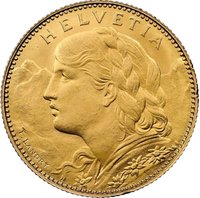
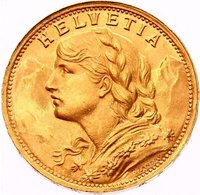
Obverse
Description:
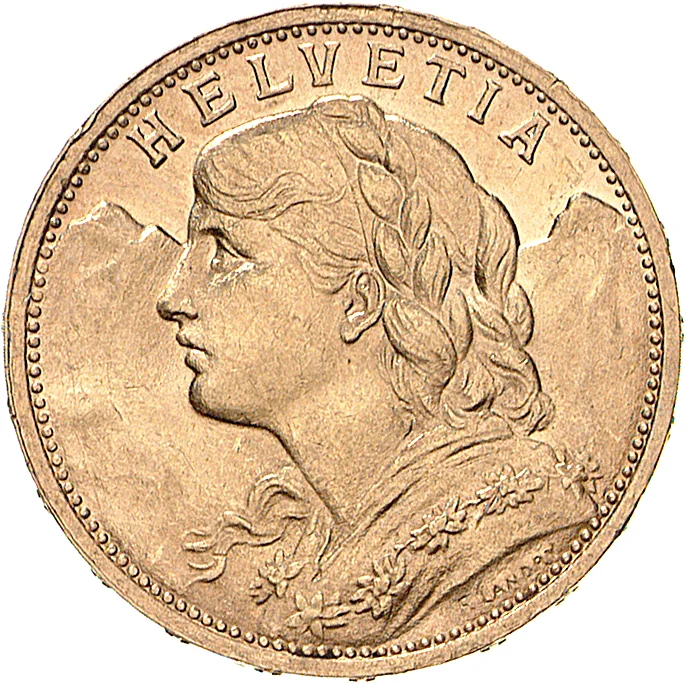
Young woman from Oberhasli in profile, with braided hair and an edelweiss garland, against a mountain backdrop.
Inscription:
HELVETIA
Script: Latin
Designer: Fritz Ulysse Landry
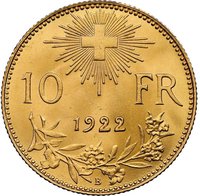
Reverse
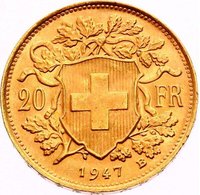
Description:
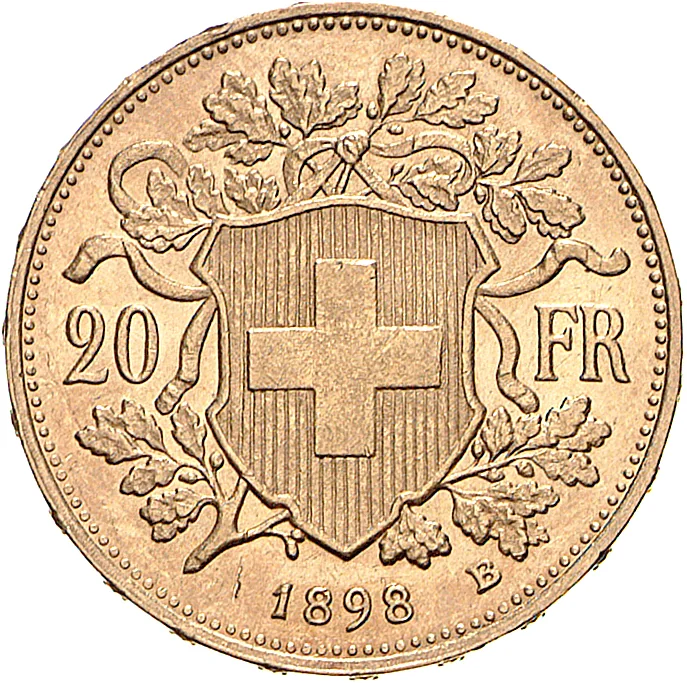
Swiss coat of arms with an oak branch, acorns, and ribbons.
Inscription:
20 FR
1911 B
1911 B
Script: Latin
Designer: Fritz Ulysse Landry
Edge
Embossed pattern with 22 stars in three groups, two of seven and one of eight stars.
Legend:
🟉🟉🟉🟉🟉🟉🟉 | 🟉🟉🟉🟉🟉🟉🟉🟉 | 🟉🟉🟉🟉🟉🟉🟉
Categories
| Symbols> Coat of Arms |
Mints
| Name | Mark |
|---|---|
| Bern | B |
Mintings
| Year | Mint Mark | Mintage | Quality | Collection |
|---|---|---|---|---|
| 1897 | B | 400,000 | ||
| 1898 | B | 400,000 | ||
| 1899 | B | 300,000 | ||
| 1900 | B | 400,000 | ||
| 1901 | B | 500,000 | ||
| 1902 | B | 600,000 | ||
| 1903 | B | 200,000 | ||
| 1904 | B | 100,000 | ||
| 1905 | B | 100,000 | ||
| 1906 | B | 100,000 | ||
| 1907 | B | 150,000 | ||
| 1908 | B | 355,000 | ||
| 1909 | B | 400,000 | ||
| 1910 | B | 375,000 | ||
| 1911 | B | 350,000 | ||
| 1912 | B | 450,000 | ||
| 1913 | B | 700,000 | ||
| 1914 | B | 700,000 | ||
| 1915 | B | 750,000 | ||
| 1916 | B | 300,000 | ||
| 1922 | B | 2,783,678 | ||
| 1925 | B | 400,000 | ||
| 1926 | B | 50,000 | ||
| 1927 | B | 5,015,000 | ||
| 1930 | B | 3,371,764 | ||
| 1935 | B | 175,000 | ||
| 1935 | 1945-1947 | 20,008,813 |
Historical background
In 1897, Switzerland existed as a monetary patchwork, a situation common in Europe before widespread national currency unification. While the Swiss franc, established by the Federal Coinage Act of 1850, was the official unit of account, it circulated alongside a substantial volume of foreign coins. French francs, Italian lire, and other foreign currencies were not only accepted but were legally recognized as valid tender within Switzerland, creating a de facto multi-currency system. This reflected the country's deep economic integration with its neighbours and the absence of a central bank, as the right of note issuance was held by a multitude of cantonal and private banks issuing their own, often incompatible, banknotes.
This fragmented system posed significant practical and economic challenges. The fluctuating values of foreign coins led to complexity and inefficiency in everyday trade, requiring merchants and citizens to constantly assess the worth of different pieces of money. More critically, the lack of a uniform national paper currency was seen as a hindrance to economic development and a mark against Swiss financial credibility. The multitude of private banknotes, some from less stable institutions, raised concerns about financial security and transparency, especially following banking failures in the 1880s.
Consequently, 1897 was a pivotal year of legislative action, not for the coins themselves, but for the paper currency. The Swiss National Bank had not yet been founded (it would be established in 1907), but the Federal Law on Banknotes of 1897 laid its essential groundwork. This law revoked the note-issuing privileges of the cantonal and private banks, establishing a federal monopoly on banknote issuance for the future. It was the decisive first step toward creating a stable, uniform, and nationally controlled currency, setting Switzerland on an irreversible path toward the modern, singular monetary system it would fully achieve in the early 20th century.
This fragmented system posed significant practical and economic challenges. The fluctuating values of foreign coins led to complexity and inefficiency in everyday trade, requiring merchants and citizens to constantly assess the worth of different pieces of money. More critically, the lack of a uniform national paper currency was seen as a hindrance to economic development and a mark against Swiss financial credibility. The multitude of private banknotes, some from less stable institutions, raised concerns about financial security and transparency, especially following banking failures in the 1880s.
Consequently, 1897 was a pivotal year of legislative action, not for the coins themselves, but for the paper currency. The Swiss National Bank had not yet been founded (it would be established in 1907), but the Federal Law on Banknotes of 1897 laid its essential groundwork. This law revoked the note-issuing privileges of the cantonal and private banks, establishing a federal monopoly on banknote issuance for the future. It was the decisive first step toward creating a stable, uniform, and nationally controlled currency, setting Switzerland on an irreversible path toward the modern, singular monetary system it would fully achieve in the early 20th century.
Series: Vreneli series



🌱 Common