

5 francs – Switzerland
Add to wishlist
Switzerland
Context
Years: 1888–1916
Issuer: Switzerland
Period:
(since 1848)
Currency:
(since 1850)
Demonetization: 1 February 1934
Total mintage: 1,645,000
Material
References
KM: #
Numista: #192
Value
Exchange value: 5 CHF
Bullion value: $57.49
Obverse
Description:
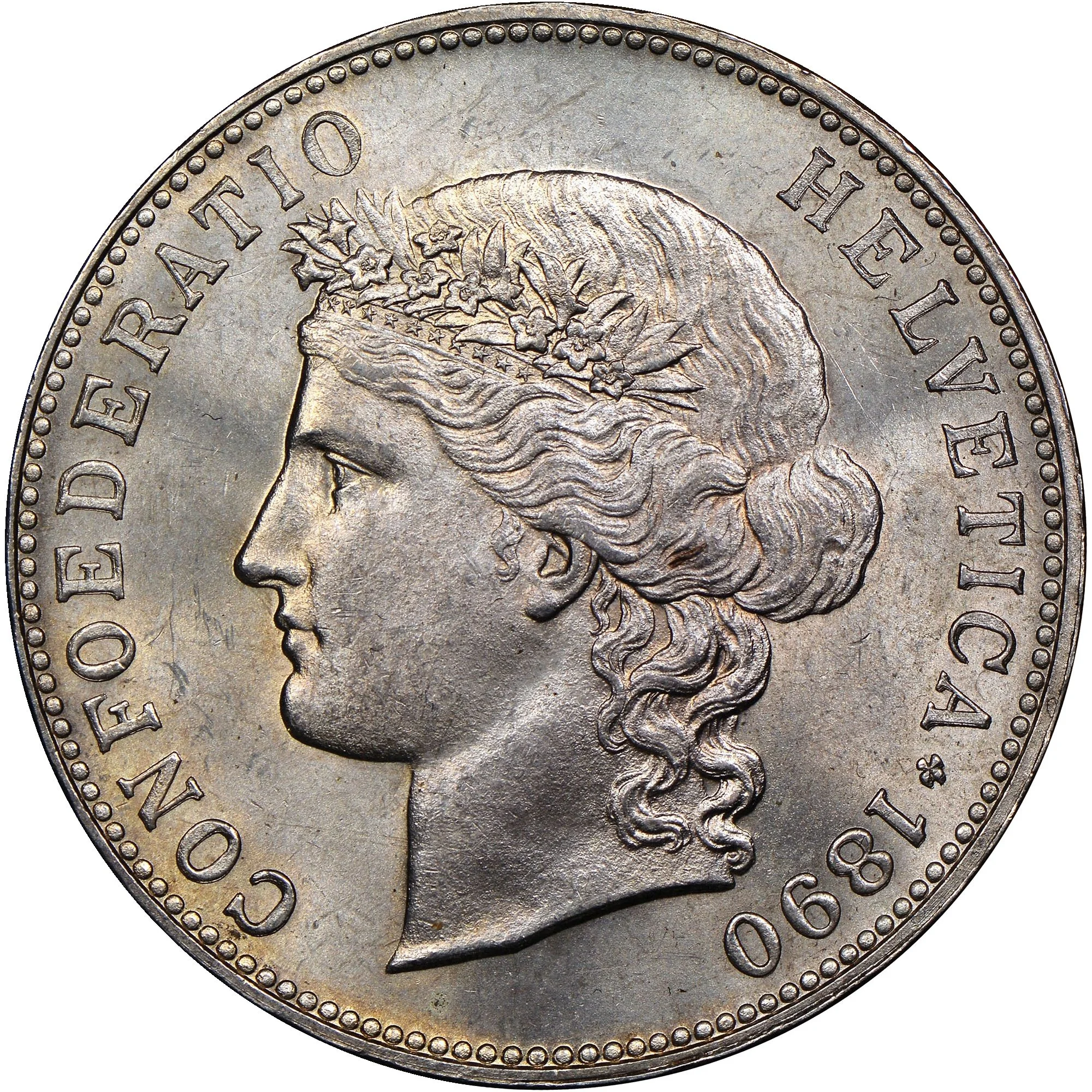
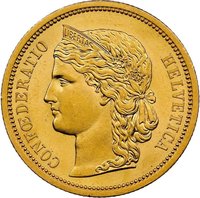
Helvetia facing left, wearing an alpenrose tiara.
Inscription:
CONFOEDERATIO HELVETICA ᕀ 1890
Translation:
Swiss Confederation 1890
Script: Latin
Designer: Karl Schwenzer
Reverse
Description:
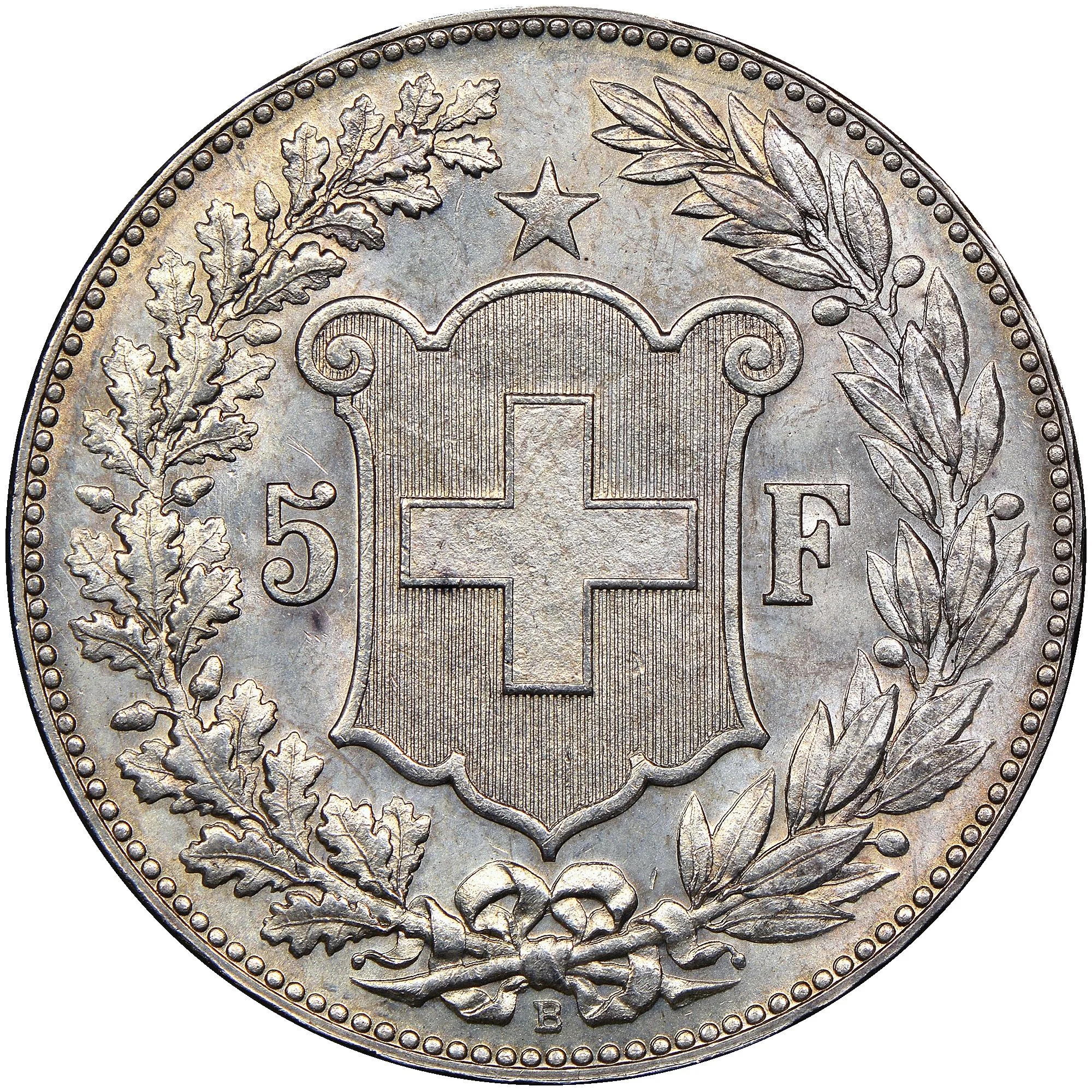
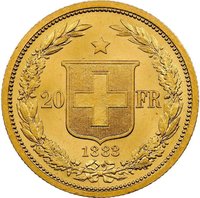
Swiss coat of arms on a decorative shield, topped by a star and flanked by an oak and laurel wreath below.
Inscription:
5 F
B
B
Script: Latin
Designer: Christian Bühler
Edge
Smooth with embossed inscriptions
Legend:
DOMINUS ★★★ | PROVIDEBIT | ★★★★★★★★★★
Categories
| Symbols> Coat of Arms |
| Symbol> Wreath |
Mints
| Name | Mark |
|---|---|
| Bern | B |
Mintings
Historical background
In 1888, Switzerland existed as a monetary federation rather than a single currency area. The Swiss franc, established by the Federal Coinage Act of 1850, was the official unit of account, but the right to issue banknotes was not yet a federal monopoly. Instead, a multitude of private cantonal and other banks issued their own notes, leading to a complex and sometimes confusing circulation of over 800 different banknote designs. This fragmented system, while functional, was seen as inefficient and posed risks to monetary stability, as the credibility of each note depended solely on the issuing bank's solvency.
The period was one of transition and mounting pressure for reform. The federal constitution of 1848 had given the Confederation power over currency, but the 1850 act had only standardized coins, leaving banknotes decentralized. By the 1880s, a growing consensus among politicians and economists argued that a unified note issue was essential for modern commerce, financial security, and national identity. The failure of several banks in the 1880s, particularly the Spar- und Leihkasse in Bern in 1886, heightened public and political concern about the fragility of the private note system.
Consequently, 1888 was a pivotal year in the decade-long debate that would culminate in the Swiss National Bank. The Federal Council was actively preparing legislation, and discussions in parliament were intense, focusing on whether the new central bank should be entirely state-owned or a privately managed institution with federal oversight. The outcome of this debate would be the Federal Law on the Swiss National Bank, passed in 1891, which paved the way for the bank's eventual opening in 1907 and established the federal monopoly on banknote issuance that defines the modern Swiss franc.
The period was one of transition and mounting pressure for reform. The federal constitution of 1848 had given the Confederation power over currency, but the 1850 act had only standardized coins, leaving banknotes decentralized. By the 1880s, a growing consensus among politicians and economists argued that a unified note issue was essential for modern commerce, financial security, and national identity. The failure of several banks in the 1880s, particularly the Spar- und Leihkasse in Bern in 1886, heightened public and political concern about the fragility of the private note system.
Consequently, 1888 was a pivotal year in the decade-long debate that would culminate in the Swiss National Bank. The Federal Council was actively preparing legislation, and discussions in parliament were intense, focusing on whether the new central bank should be entirely state-owned or a privately managed institution with federal oversight. The outcome of this debate would be the Federal Law on the Swiss National Bank, passed in 1891, which paved the way for the bank's eventual opening in 1907 and established the federal monopoly on banknote issuance that defines the modern Swiss franc.
🌱 Fairly Common