

5 centimes – France
Add to wishlist
France
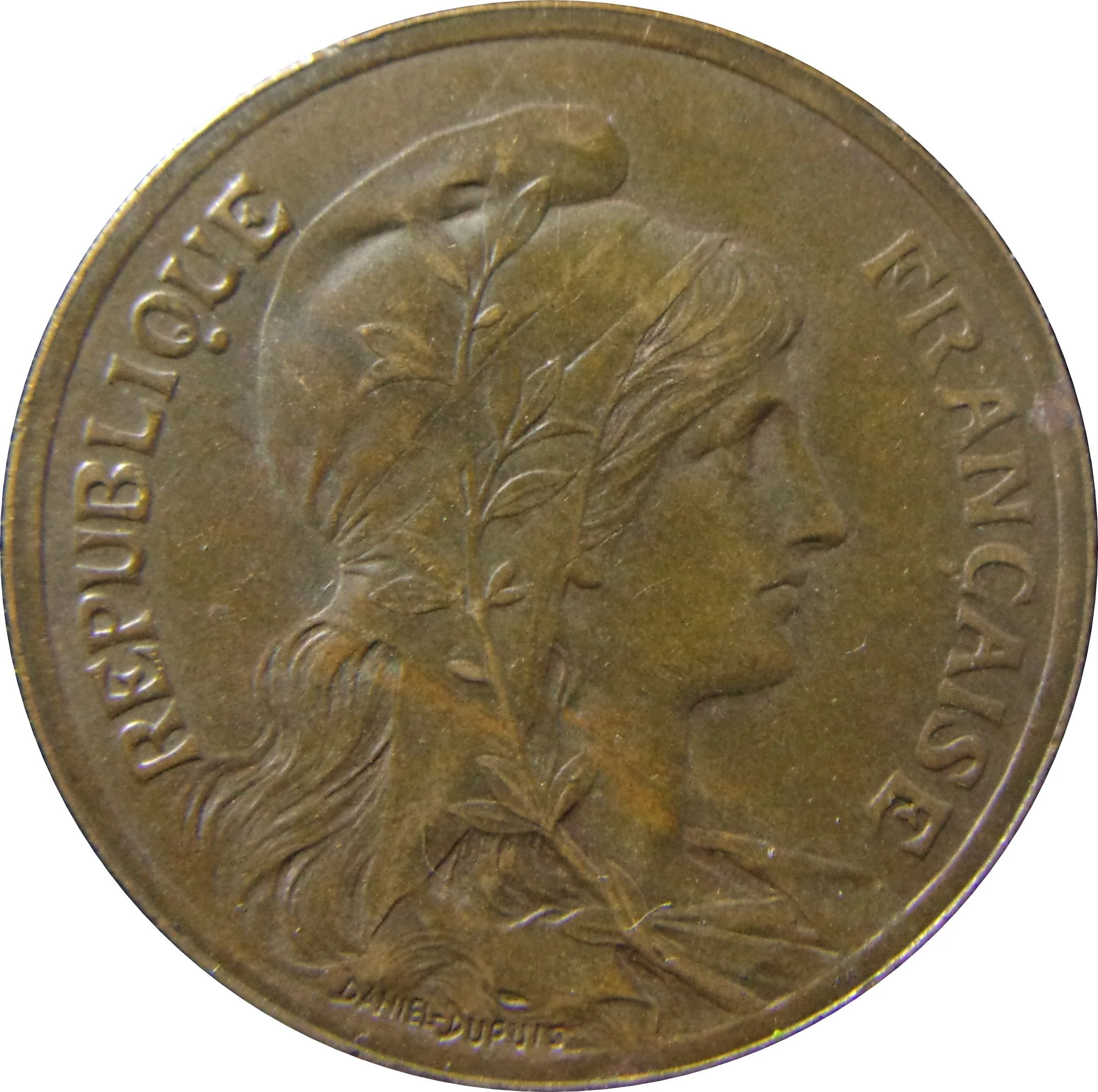
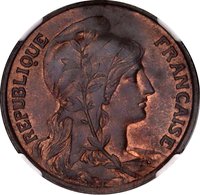
Obverse
Description:
Liberty facing right.
Inscription:
REPUBLIQUE FRANÇAISE
DANIEL-DUPUIS
DANIEL-DUPUIS
Translation:
FRENCH REPUBLIC
DANIEL-DUPUIS
DANIEL-DUPUIS
Script: Latin
Language: French
Engraver: Jean-Baptiste-Daniel Dupuis
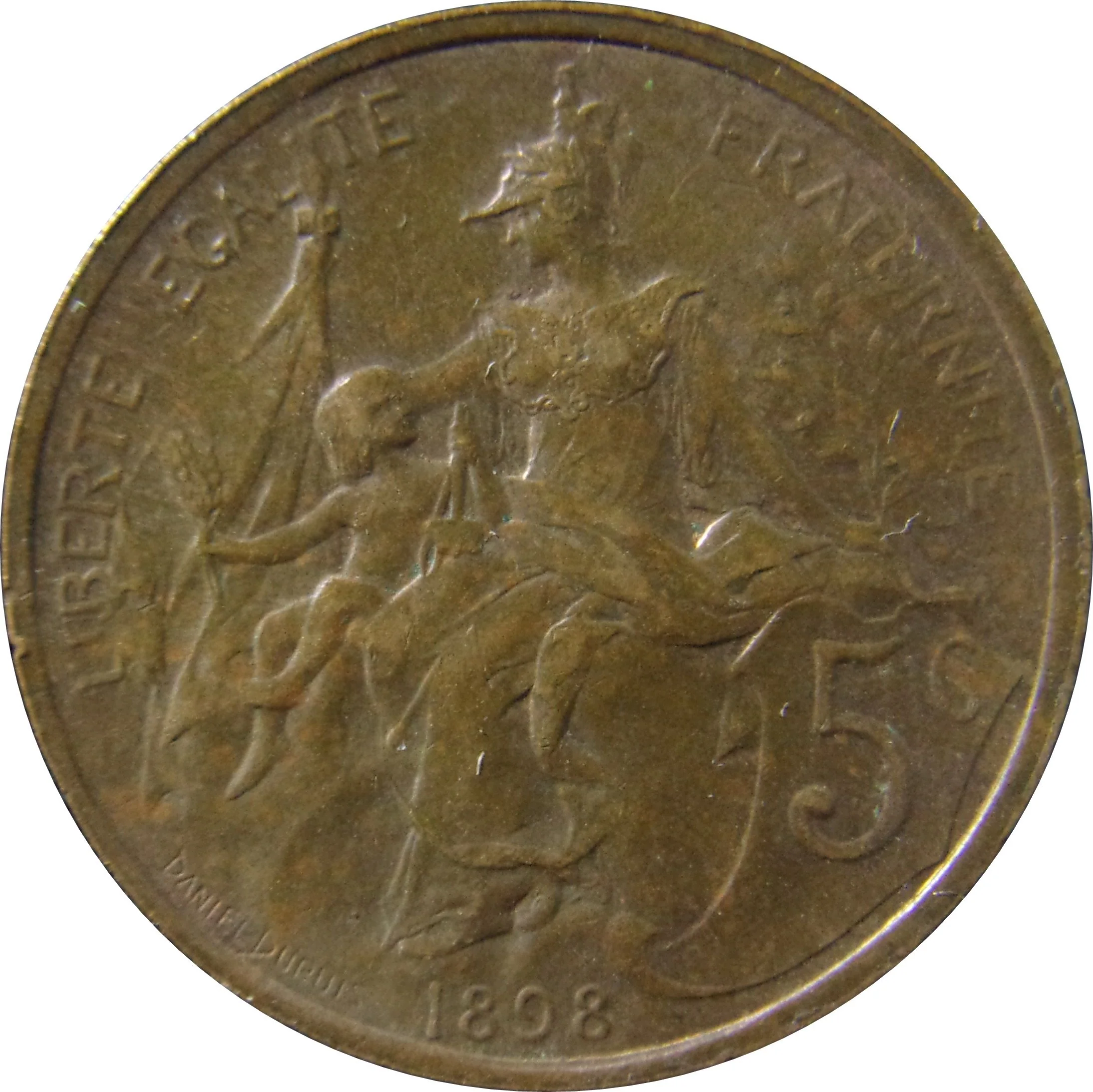
Reverse
Description:
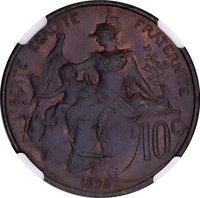
Motherland shielding her future.
Inscription:
LIBERTE EGALITE FRATERNITE
5 c
DANIEL-DUPUIS 1898
5 c
DANIEL-DUPUIS 1898
Translation:
LIBERTY EQUALITY FRATERNITY
5 c
DANIEL-DUPUIS 1898
5 c
DANIEL-DUPUIS 1898
Script: Latin
Language: French
Engraver: Jean-Baptiste-Daniel Dupuis
Edge
Plain
Categories
| Symbol> Allegory |
| Symbol> Phrygian cap |
Mints
| Name | Mark |
|---|---|
| Monnaie de Paris | — |
| Royal Mint of Madrid | (★) |
Mintings
| Year | Mint Mark | Mintage | Quality | Collection |
|---|---|---|---|---|
| 1897 | — | — | ||
| 1897 | — | — | Proof | |
| 1898 | — | — | Proof | |
| 1898 | — | — | ||
| 1899 | — | 7,400,000 | ||
| 1899 | — | — | Proof | |
| 1900 | — | 7,400,000 | ||
| 1900 | — | — | Proof | |
| 1901 | — | 6,000,000 | ||
| 1902 | — | 7,900,000 | ||
| 1903 | — | 2,879,219 | ||
| 1904 | — | 8,000,000 | ||
| 1905 | — | 2,100,000 | ||
| 1906 | — | 8,394,000 | ||
| 1907 | — | 7,900,000 | ||
| 1908 | — | — | ||
| 1909 | — | 8,000,000 | ||
| 1910 | — | — | ||
| 1911 | — | 15,386,000 | ||
| 1912 | — | 20,000,000 | ||
| 1913 | — | 12,603,000 | ||
| 1914 | — | 7,000,000 | ||
| 1915 | — | 6,032,140 | ||
| 1916 | — | 41,531,365 | ||
| 1916 | ★ | — | ||
| 1917 | — | 16,962,837 | ||
| 1920 | — | 8,010,587 | ||
| 1921 | — | 141,751 |
Historical background
In 1897, France operated under the Latin Monetary Union (LMU), a multinational bimetallic system it had spearheaded in 1865. The franc was defined by a fixed ratio of gold to silver (1:15.5), meaning both metals could be minted into legal tender coins. However, this system was under severe strain. A global decline in the market value of silver had created a significant discrepancy; silver coins, whose metallic value was now lower than their face value, flooded circulation, while gold coins were increasingly hoarded or exported (Gresham's Law in action). This effectively pushed France toward a de facto gold standard, as it restricted the minting of silver to prop up the system.
Domestically, the currency was stable and trusted, with the franc germinal—established by Napoleon in 1803—providing a century of remarkable consistency. The Bank of France held substantial gold reserves to back the currency, ensuring public and international confidence. However, the state's finances were preoccupied with the massive project of issuing the first series of interest-bearing bonds (rentes) to fund the payment of the war indemnity to Germany following the Franco-Prussian War (1870-71). This financial burden, though largely managed by the 1890s, had long-term implications for fiscal policy.
Internationally, the flaws of the LMU were becoming untenable. Member states struggled to coordinate, and the union was slowly disintegrating under the pressure of fluctuating silver prices. For France, this period was one of monetary transition and anxiety, caught between its historic commitment to bimetallism and the inexorable global shift toward the gold standard, which it would formally adopt in practice within a few years. The currency situation of 1897 was thus characterized by outward stability masking deep structural fragility within the multinational system France had created.
Domestically, the currency was stable and trusted, with the franc germinal—established by Napoleon in 1803—providing a century of remarkable consistency. The Bank of France held substantial gold reserves to back the currency, ensuring public and international confidence. However, the state's finances were preoccupied with the massive project of issuing the first series of interest-bearing bonds (rentes) to fund the payment of the war indemnity to Germany following the Franco-Prussian War (1870-71). This financial burden, though largely managed by the 1890s, had long-term implications for fiscal policy.
Internationally, the flaws of the LMU were becoming untenable. Member states struggled to coordinate, and the union was slowly disintegrating under the pressure of fluctuating silver prices. For France, this period was one of monetary transition and anxiety, caught between its historic commitment to bimetallism and the inexorable global shift toward the gold standard, which it would formally adopt in practice within a few years. The currency situation of 1897 was thus characterized by outward stability masking deep structural fragility within the multinational system France had created.
Series: 1897 France circulation coins
🌱 Very Common