

Obverse
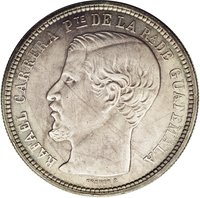
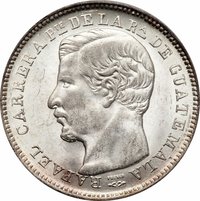
Description:
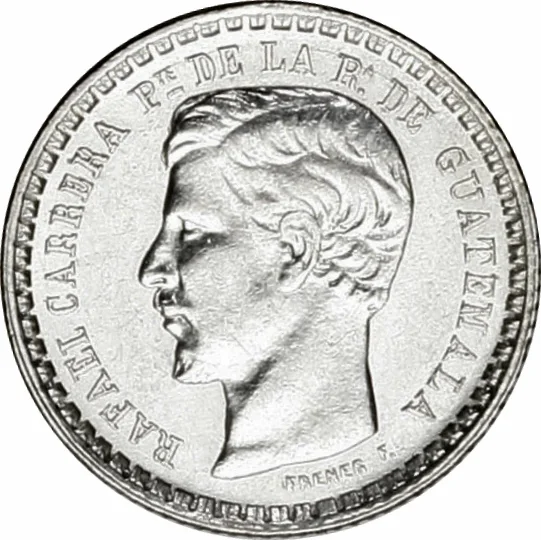
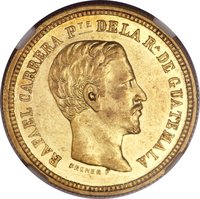
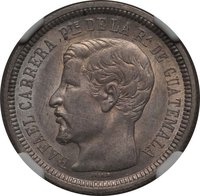
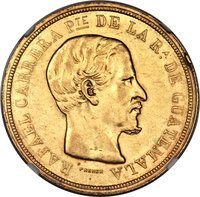
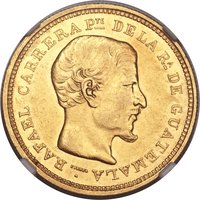
Left-facing head encircled by legend.
Inscription:
RAFAEL CARRERA P.te DE LA R.A DE GUATEMALA
FRENER F.
FRENER F.
Translation:
RAFAEL CARRERA President of the Republic of Guatemala
FRENER F.
FRENER F.
Script: Latin
Language: Spanish
Engraver: Johann-Baptist Frener
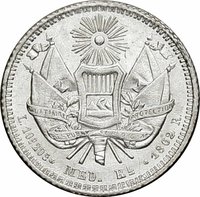
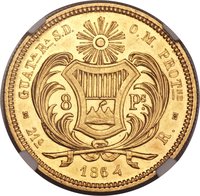
Reverse
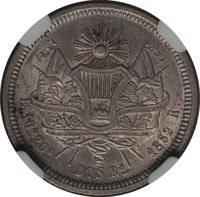
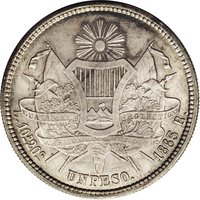
Description:
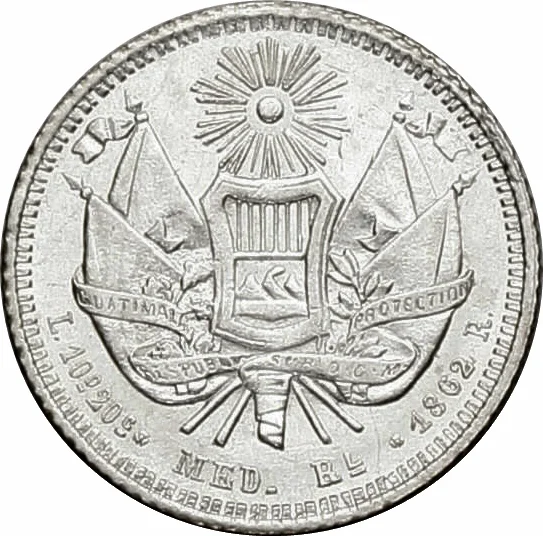
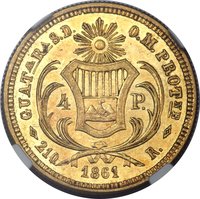
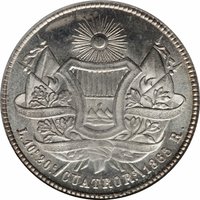
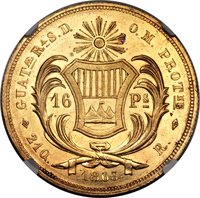
Sun over shield, flanked by flags.
Inscription:
L 10D 20C MED_ RL * 1862 R.
Translation:
Ten Dollars or Twenty Crowns, Medal of the Royal Society, 1862.
Script: Latin
Engraver: Johann-Baptist Frener
Edge
Reeded
Categories
| Person> Politician |
| Symbols> Coat of Arms |
| Symbol> Flag |
| Symbol> Sun |
Mints
| Name | Mark |
|---|---|
| Casa de Moneda de Guatemala | — |
Mintings
| Year | Mint Mark | Mintage | Quality | Collection |
|---|---|---|---|---|
| 1862 | — | 126,728 | ||
| 1863 | — | 71,051 | ||
| 1865 | — | 56,852 |
Historical background
In 1862, Guatemala’s currency system was a complex and unstable mix of foreign and domestic coins, reflecting the economic challenges of the early post-independence period. The country lacked a unified national mint, and the primary circulating silver coin was the Spanish colonial 8 reales "peso" and its fractional parts. However, these were heavily supplemented by coins from other nations, particularly Peruvian and Bolivian pesos, which often circulated at a discount due to lower silver content. This created a chaotic environment for commerce, where the value of money depended not just on face value but on its origin and perceived metallic worth.
The government of General Rafael Carrera, who dominated Guatemalan politics during this era, recognized the economic problems posed by this disorder but had limited means to address it comprehensively. The state treasury was perennially short of funds, and attempts to introduce paper money had failed disastrously in the late 1850s, leading to inflation and public distrust. Consequently, in 1862, the monetary landscape was defined by a hard currency standard reliant on physical silver, with transactions often requiring careful weighing and assaying of coins. The British pound sterling also played a significant role in financing international trade, especially for coffee exports, which were becoming increasingly vital to the economy.
Efforts toward reform were simmering. Under Carrera’s conservative administration, there were discussions about establishing a national bank and creating a more stable, uniform currency. These plans would eventually culminate in the decimalization reform of 1869, which introduced the Guatemalan peso as a unit of account divided into 100 centavos. Therefore, the situation in 1862 was one of transition—caught between the lingering colonial monetary legacy and the pressing need for a modern, sovereign currency system to support the nation’s growing integration into the global market.
The government of General Rafael Carrera, who dominated Guatemalan politics during this era, recognized the economic problems posed by this disorder but had limited means to address it comprehensively. The state treasury was perennially short of funds, and attempts to introduce paper money had failed disastrously in the late 1850s, leading to inflation and public distrust. Consequently, in 1862, the monetary landscape was defined by a hard currency standard reliant on physical silver, with transactions often requiring careful weighing and assaying of coins. The British pound sterling also played a significant role in financing international trade, especially for coffee exports, which were becoming increasingly vital to the economy.
Efforts toward reform were simmering. Under Carrera’s conservative administration, there were discussions about establishing a national bank and creating a more stable, uniform currency. These plans would eventually culminate in the decimalization reform of 1869, which introduced the Guatemalan peso as a unit of account divided into 100 centavos. Therefore, the situation in 1862 was one of transition—caught between the lingering colonial monetary legacy and the pressing need for a modern, sovereign currency system to support the nation’s growing integration into the global market.
Series: System: 1859-1870
💎 Very Rare