

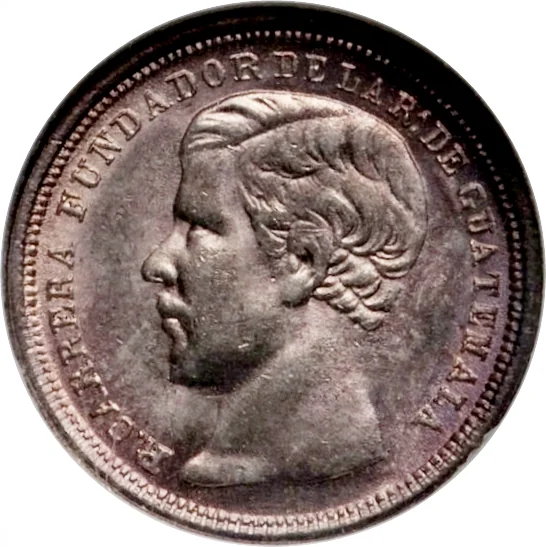
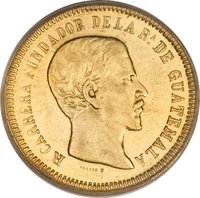
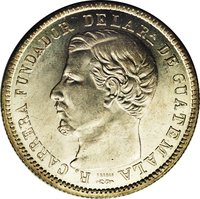
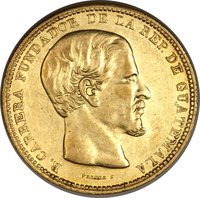
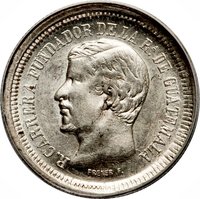
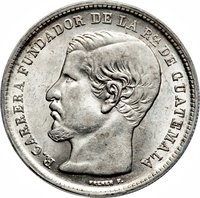
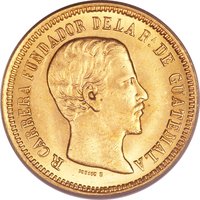
Obverse
Description:
Turn left.
Inscription:
CARRERA FUNDADOR DE LA R: DE GUATEMALA
Translation:
Founder of the Republic of Guatemala.
Script: Latin
Language: Spanish
Engraver: Johann-Baptist Frener
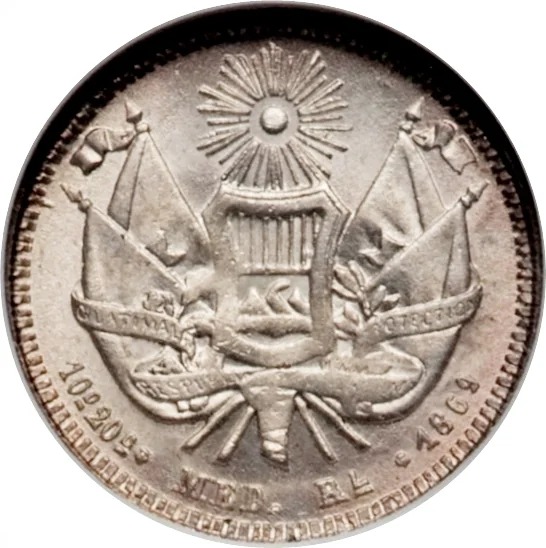
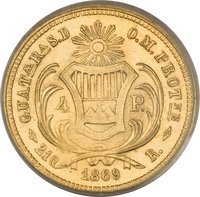
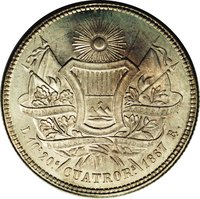
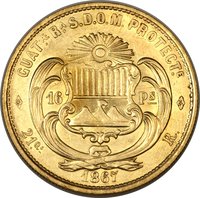
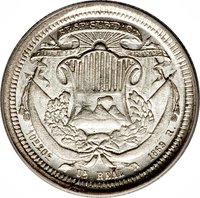
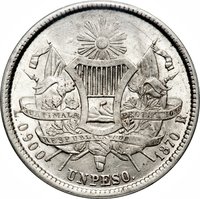
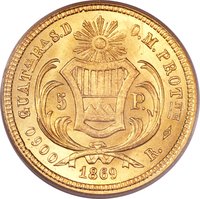
Reverse
Description:
Sun over shield, flanked by flags.
Inscription:
10D 20C MED. RL 1868 *
Translation:
Ten Decimes, Twenty Centimes, Mediterranean, Republic of Liberia, 1868.
Script: Latin
Language: French
Engraver: Johann-Baptist Frener
Edge
Categories
| Symbol> Flag |
| Symbol> Sun |
| Person> Politician |
| Symbols> Coat of Arms |
Mints
| Name | Mark |
|---|---|
| Casa de Moneda de Guatemala | — |
Mintings
| Year | Mint Mark | Mintage | Quality | Collection |
|---|---|---|---|---|
| 1867 | — | 91,600 | ||
| 1868 | — | 102,165 | ||
| 1869 | — | — |
Historical background
In 1867, Guatemala's currency situation was characterized by a complex and often chaotic system inherited from the colonial era and the early years of independence. The primary unit was the peso, but it existed alongside a confusing array of reales (8 reales = 1 peso) and was physically represented by a severe shortage of official, standardized coinage. This void was filled by a proliferation of foreign coins, primarily from Mexico, Peru, and Bolivia, as well as privately issued tokens and fichas from haciendas and merchants. The value of these coins was not fixed by their metal content alone but was subject to fluctuating and often arbitrary tasaciones (official valuations), leading to inconsistent pricing and commercial uncertainty.
The government of President Vicente Cerna, continuing the conservative policies of Rafael Carrera, struggled to assert monetary control. While the Republic of Guatemala began minting its own coins at the Guatemala City mint in 1862, production was limited and failed to displace the foreign currencies dominating circulation. The economy remained heavily reliant on agricultural exports like cochineal and, increasingly, coffee, but the unstable and heterogeneous currency system hindered both domestic trade and international financial transactions. This period was one of transition, caught between the old Spanish monetary traditions and the pressing need for a modern, unified national currency to support economic development.
Ultimately, the situation in 1867 was unsustainable and pointed toward imminent reform. The instability and lack of fiduciary trust in the mixed monetary stew were significant obstacles to the economic modernization desired by the rising liberal commercial elites. The pressure for change would culminate just a few years later following the Liberal Revolution of 1871, which led to the creation of a decimal-based currency system and the introduction of the quetzal in 1924, finally resolving the long-standing monetary disarray of the 19th century.
The government of President Vicente Cerna, continuing the conservative policies of Rafael Carrera, struggled to assert monetary control. While the Republic of Guatemala began minting its own coins at the Guatemala City mint in 1862, production was limited and failed to displace the foreign currencies dominating circulation. The economy remained heavily reliant on agricultural exports like cochineal and, increasingly, coffee, but the unstable and heterogeneous currency system hindered both domestic trade and international financial transactions. This period was one of transition, caught between the old Spanish monetary traditions and the pressing need for a modern, unified national currency to support economic development.
Ultimately, the situation in 1867 was unsustainable and pointed toward imminent reform. The instability and lack of fiduciary trust in the mixed monetary stew were significant obstacles to the economic modernization desired by the rising liberal commercial elites. The pressure for change would culminate just a few years later following the Liberal Revolution of 1871, which led to the creation of a decimal-based currency system and the introduction of the quetzal in 1924, finally resolving the long-standing monetary disarray of the 19th century.
Series: System: 1859-1870
💎 Very Rare