

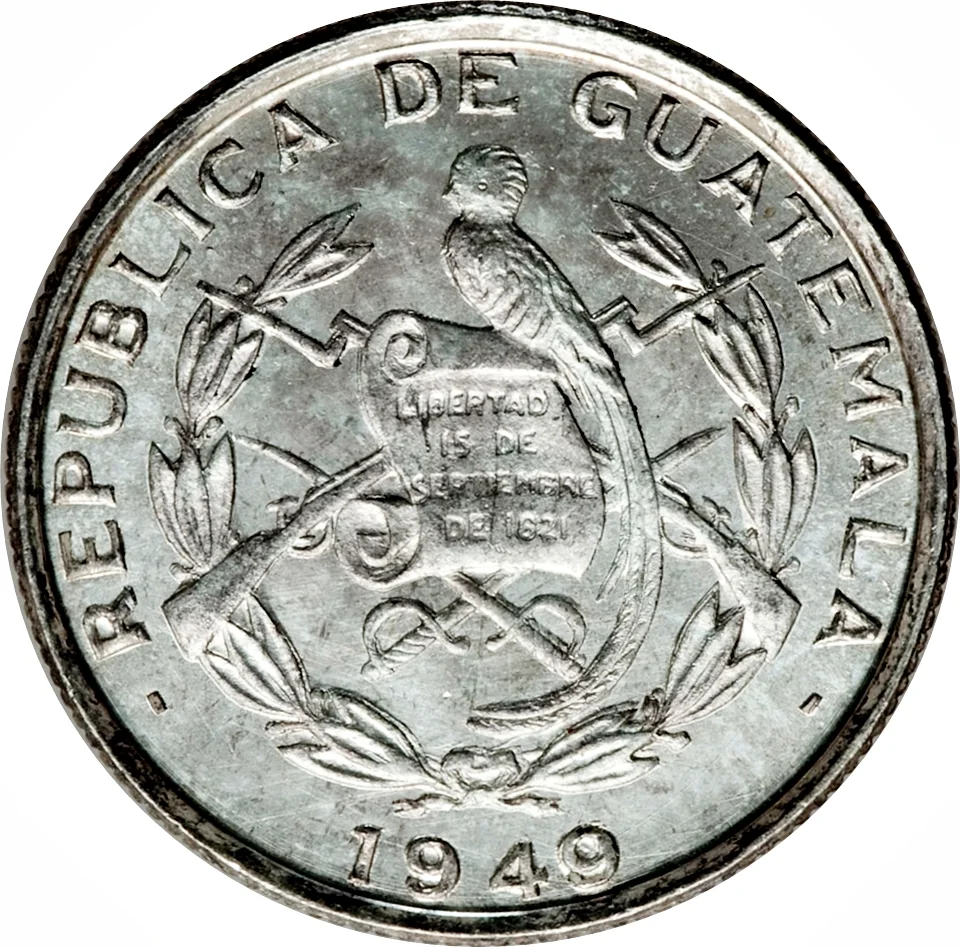
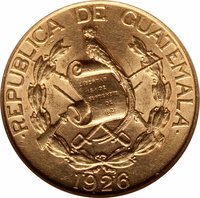
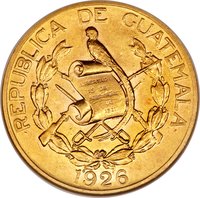
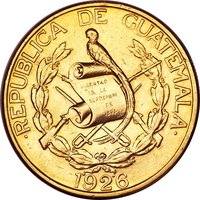
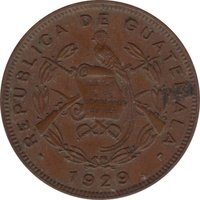
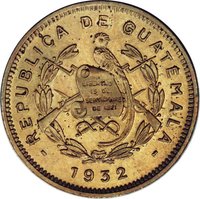
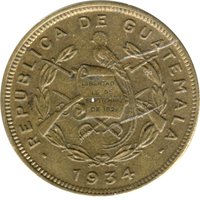
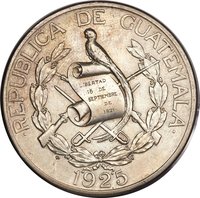
Obverse
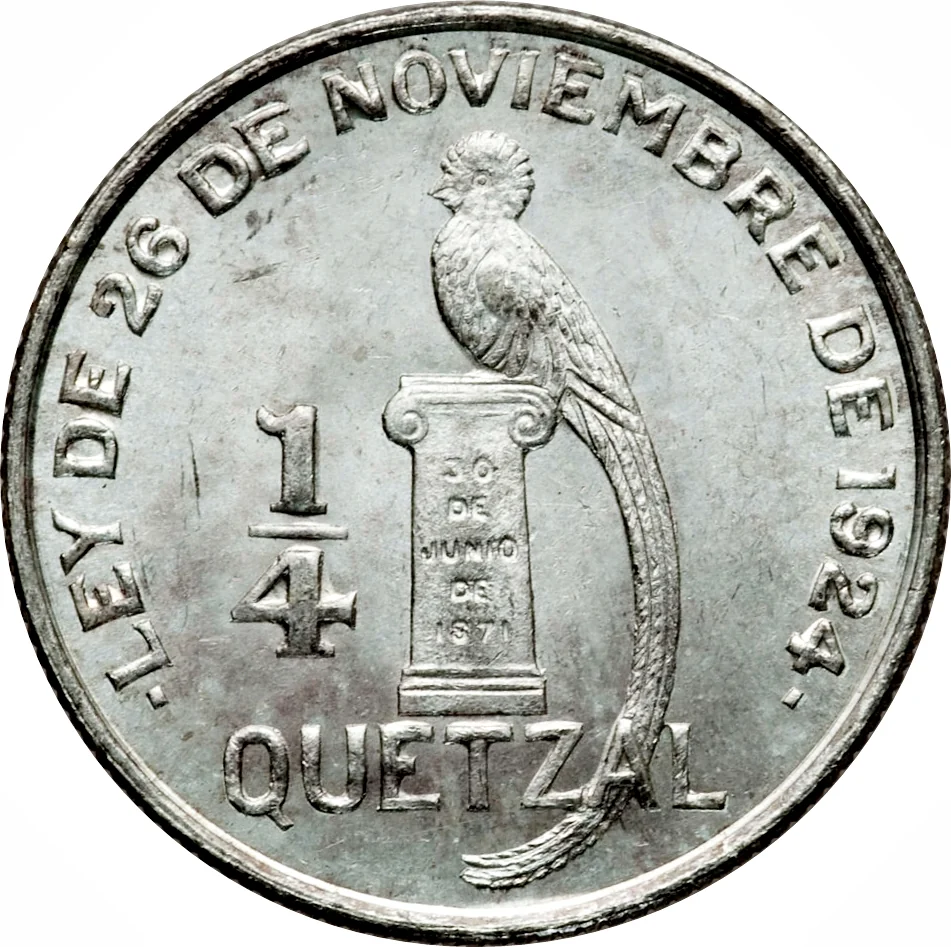
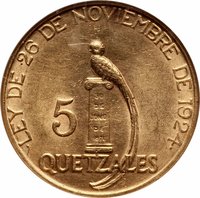
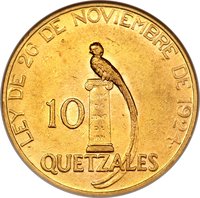
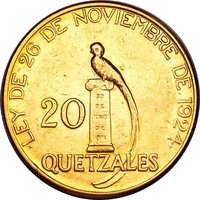
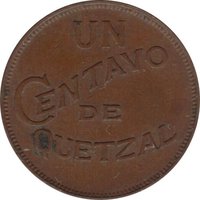
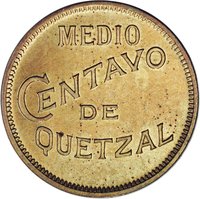
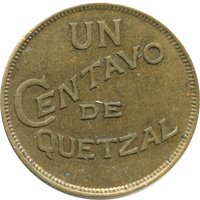
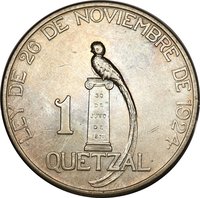
Reverse
Edge
Reeded or lettered variants.
Legend:
AMERICA - CENTRAL - REPUBLICA - DE - GUATEMALA -
Translation:
AMERICA - CENTRAL - REPUBLIC - OF - GUATEMALA -
Language: Spanish
Categories
| Animal> Bird |
| Symbols> Coat of Arms |
Mints
| Name | Mark |
|---|---|
| Casa de Moneda de Guatemala | — |
| Royal Mint (Tower Hill) | — |
Mintings
| Year | Mint Mark | Mintage | Quality | Collection |
|---|---|---|---|---|
| 1926 | — | 2,000,000 | ||
| 1926 | — | — | Proof | |
| 1928 | — | 400,000 | ||
| 1928 | — | — | Proof | |
| 1929 | — | — | Proof | |
| 1929 | — | 400,000 | ||
| 1946 | — | 188,800 | ||
| 1947 | — | 134,000 | ||
| 1948 | — | 129,226 | ||
| 1949 | — | 24,994 |
Historical background
In 1926, Guatemala's currency system was in a state of transition, moving away from the historic silver peso and fully embracing the gold standard under the administration of President José María Orellana. The nation's monetary landscape had been unstable for decades, with a proliferation of foreign coins, private banknotes, and devalued silver. A key turning point came in 1924 with the creation of the Quetzal (GTQ), named after the national bird, which was defined to be equal to one United States dollar and backed by gold reserves. The Quetzal replaced the peso at a rate of 60 pesos to 1 quetzal, a dramatic revaluation aimed at imposing fiscal discipline and attracting foreign investment.
This monetary reform was largely engineered by the American financial expert Edwin Walter Kemmerer, who was invited by Orellana's government to stabilize the economy. The reforms established the Bank of Guatemala (a precursor to the modern central bank) as the sole issuer of currency and pegged the quetzal to the U.S. dollar at 1:1, fully convertible to gold. By 1926, the new system was being consolidated; silver pesos were being withdrawn from circulation and the first series of quetzal banknotes and coins were becoming the official legal tender. This shift was part of a broader regional trend of "Kemmerer missions" that sought to modernize Latin American economies through orthodox gold-standard policies.
The immediate effect in 1926 was a period of relative monetary stability and increased confidence from international creditors, which facilitated loans for infrastructure projects. However, the system's rigidity also tied Guatemala's economy closely to U.S. monetary policy and the international gold market. While successful in ending hyperinflation and chaos, the gold-standard quetzal would later face severe challenges during the Great Depression of the 1930s, when falling coffee export revenues strained the nation's gold reserves and forced a difficult reconsideration of its monetary policy.
This monetary reform was largely engineered by the American financial expert Edwin Walter Kemmerer, who was invited by Orellana's government to stabilize the economy. The reforms established the Bank of Guatemala (a precursor to the modern central bank) as the sole issuer of currency and pegged the quetzal to the U.S. dollar at 1:1, fully convertible to gold. By 1926, the new system was being consolidated; silver pesos were being withdrawn from circulation and the first series of quetzal banknotes and coins were becoming the official legal tender. This shift was part of a broader regional trend of "Kemmerer missions" that sought to modernize Latin American economies through orthodox gold-standard policies.
The immediate effect in 1926 was a period of relative monetary stability and increased confidence from international creditors, which facilitated loans for infrastructure projects. However, the system's rigidity also tied Guatemala's economy closely to U.S. monetary policy and the international gold market. While successful in ending hyperinflation and chaos, the gold-standard quetzal would later face severe challenges during the Great Depression of the 1930s, when falling coffee export revenues strained the nation's gold reserves and forced a difficult reconsideration of its monetary policy.
Series: System: 1925-1949
🌱 Common