

½ Penny – Jamaica
Jamaica
Context
Years: 1955–1963
Issuer: Jamaica 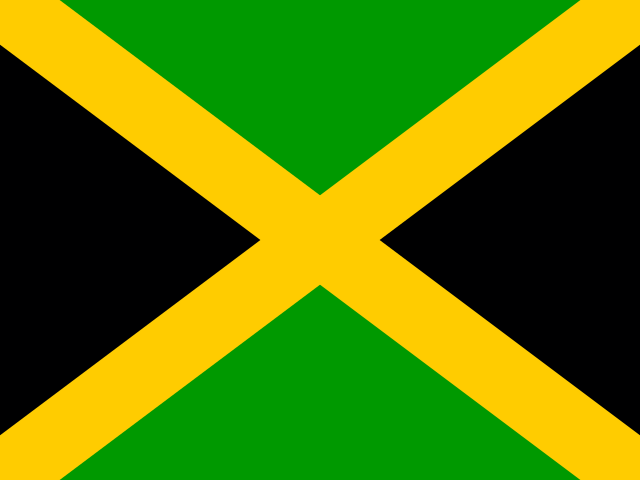
Ruler: Elizabeth II
Currency:
(1655—1969)
Demonetized: Yes
Total mintage: 6,360,000
Material
Diameter: 22.5 mm
Weight: 4.5 g
Thickness: 1.65 mm
Shape: Round
Composition: Nickel brass
Magnetic: No
Technique: Milled
Alignment: Medal alignment
flip
References
KM: #Click to copy to clipboard36
Numista: #4133
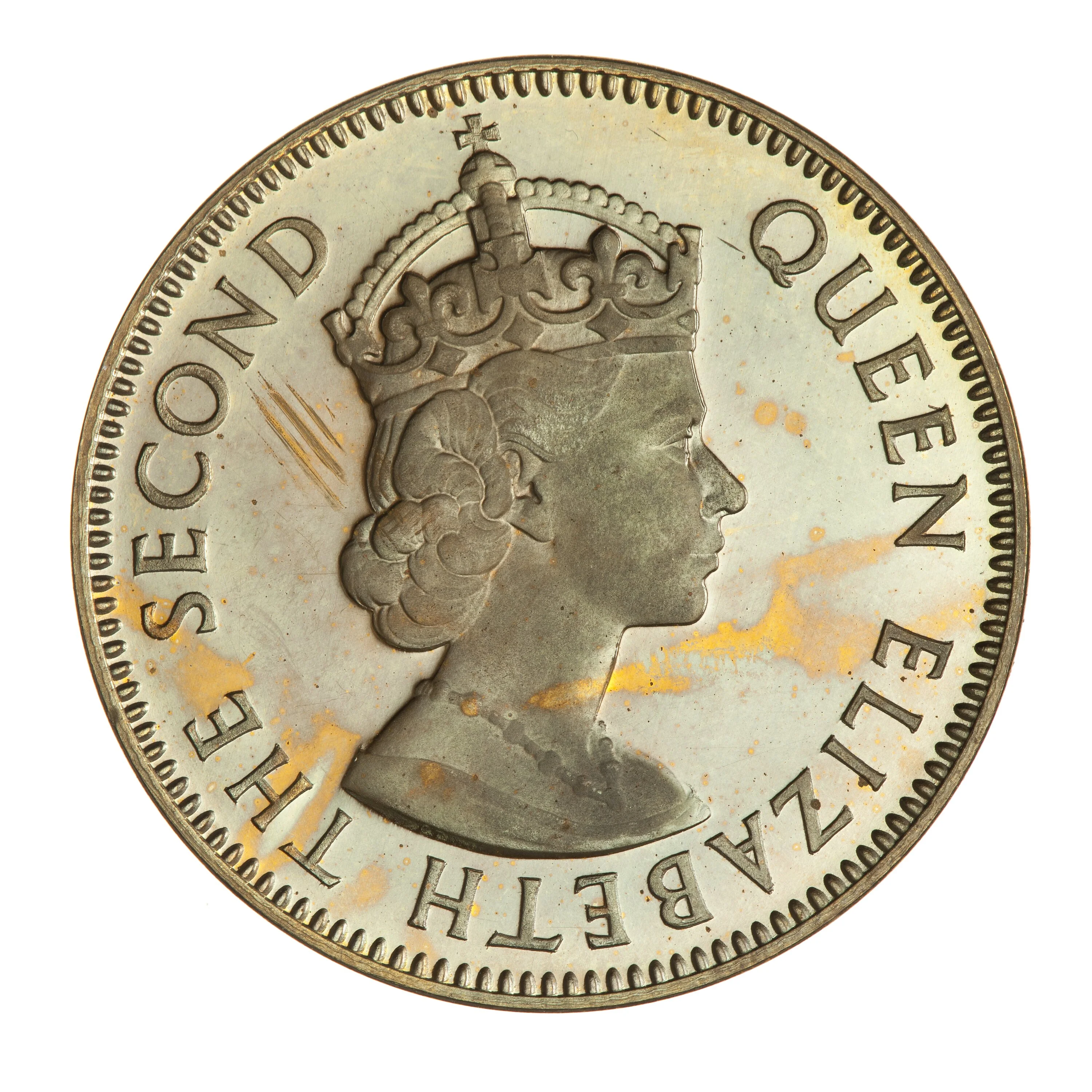
Obverse
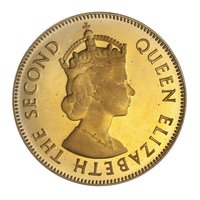
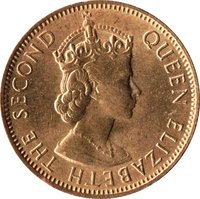
Description:
Crowned right-facing portrait of Queen Elizabeth II with encircling legend.
Inscription:
QUEEN ELIZABETH THE SECOND
Script: Latin
Engraver: Cecil Thomas
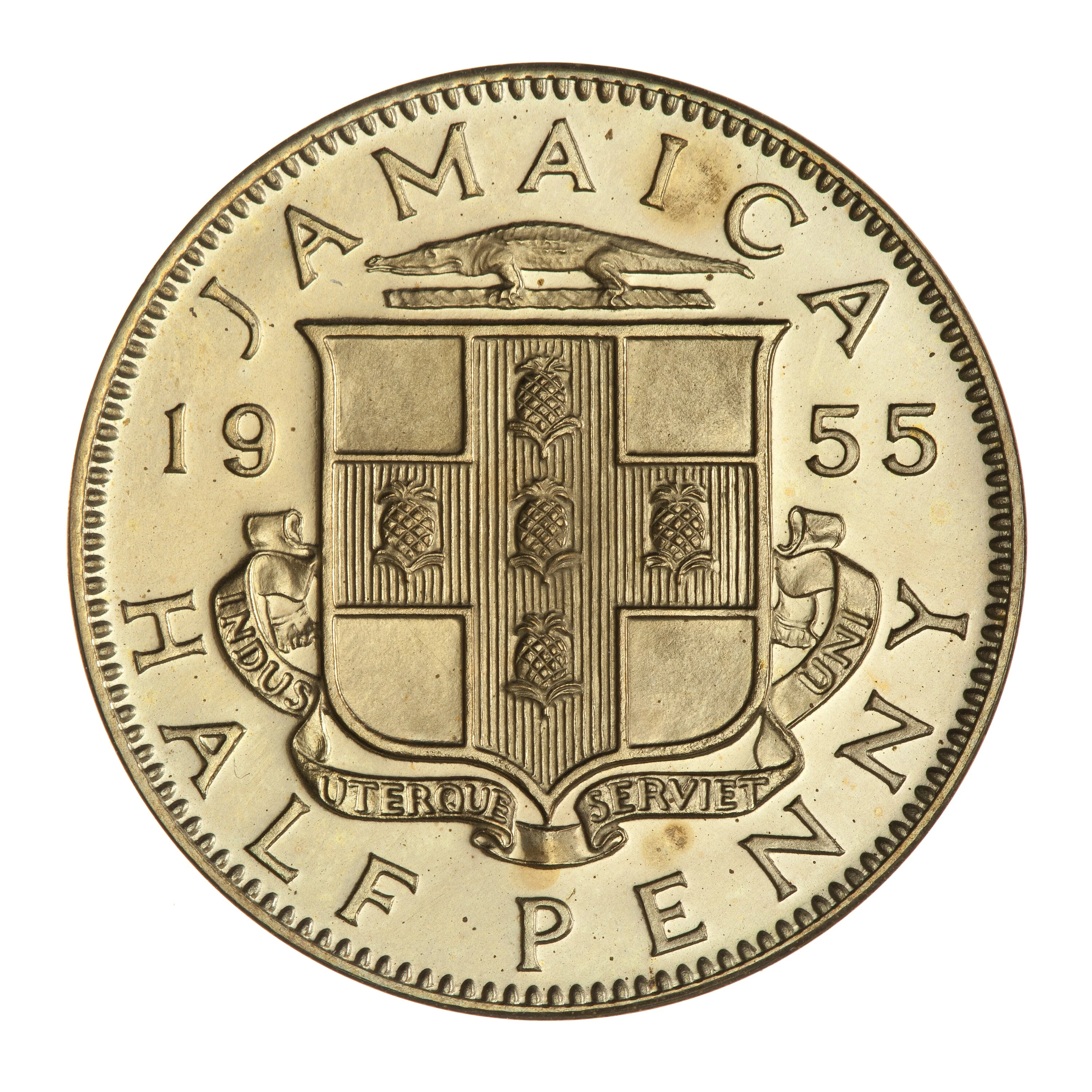
Reverse
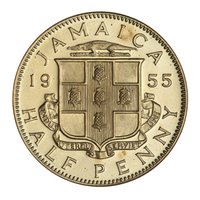
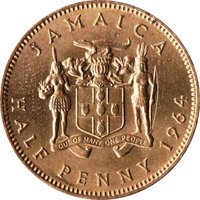
Description:
Jamaican coat of arms with encircling legend.
Inscription:
JAMAICA
HALF PENNY
1957
INDUS UTERQUE SERVIET UNI
HALF PENNY
1957
INDUS UTERQUE SERVIET UNI
Translation:
JAMAICA
HALF PENNY
1957
BOTH INDS WILL SERVE ONE
HALF PENNY
1957
BOTH INDS WILL SERVE ONE
Script: Latin
Engraver: Percy Metcalfe
Edge
Plain
Mints
| Name | Mark |
|---|---|
| Royal Mint (Tower Hill) | — |
Mintings
| Year | Mint Mark | Mintage | Quality | Collection |
|---|---|---|---|---|
| 1955 | — | 1,440,000 | ||
| 1955 | — | — | Proof | |
| 1957 | — | 600,000 | ||
| 1957 | — | — | Proof | |
| 1958 | — | 960,000 | ||
| 1958 | — | — | Proof | |
| 1959 | — | 960,000 | ||
| 1959 | — | — | Proof | |
| 1961 | — | 480,000 | ||
| 1961 | — | — | Proof | |
| 1962 | — | 960,000 | ||
| 1962 | — | — | Proof | |
| 1963 | — | 960,000 | ||
| 1963 | — | — | Proof |
Historical background
In 1955, Jamaica was a British colony operating under a currency system directly tied to the United Kingdom. The official currency was the Jamaican pound (£J), which was pegged at par with the British pound sterling. This meant that banknotes and coins in circulation were issued by a central board on the island, but their value was fully backed by and interchangeable with sterling held in London. The system provided monetary stability and facilitated trade with the UK, which was Jamaica's dominant economic partner, particularly for its key exports of sugar, bananas, and bauxite, the latter then entering a period of significant expansion.
However, this colonial monetary structure also reflected and reinforced Jamaica's dependent economic position. There was no independent central bank to set monetary policy; decisions affecting the island's money supply and credit conditions were ultimately made in accordance with British interests and economic conditions. While the peg provided stability, it also meant Jamaica imported Britain's monetary policy, which might not always align with local economic needs, such as managing domestic inflation or stimulating growth during downturns. The financial infrastructure was dominated by British-owned commercial banks, which primarily served the export sector and larger businesses, often leaving the needs of small local entrepreneurs and farmers underserved.
The currency situation in 1955, therefore, existed in a period of quiet transition. Politically, the movement toward self-government was gaining momentum, culminating in full internal self-rule just four years later in 1959. Economically, the post-war boom and the rise of the bauxite industry were generating new wealth and aspirations. This context sowed the early seeds for future monetary independence, which would eventually lead to the establishment of the Bank of Jamaica in 1960 and the introduction of the Jamaican dollar in 1969, replacing the pound-shilling-pence system. Thus, 1955 represents the latter years of a colonial monetary order soon to be challenged by the forces of decolonization and national economic development.
However, this colonial monetary structure also reflected and reinforced Jamaica's dependent economic position. There was no independent central bank to set monetary policy; decisions affecting the island's money supply and credit conditions were ultimately made in accordance with British interests and economic conditions. While the peg provided stability, it also meant Jamaica imported Britain's monetary policy, which might not always align with local economic needs, such as managing domestic inflation or stimulating growth during downturns. The financial infrastructure was dominated by British-owned commercial banks, which primarily served the export sector and larger businesses, often leaving the needs of small local entrepreneurs and farmers underserved.
The currency situation in 1955, therefore, existed in a period of quiet transition. Politically, the movement toward self-government was gaining momentum, culminating in full internal self-rule just four years later in 1959. Economically, the post-war boom and the rise of the bauxite industry were generating new wealth and aspirations. This context sowed the early seeds for future monetary independence, which would eventually lead to the establishment of the Bank of Jamaica in 1960 and the introduction of the Jamaican dollar in 1969, replacing the pound-shilling-pence system. Thus, 1955 represents the latter years of a colonial monetary order soon to be challenged by the forces of decolonization and national economic development.
🌱 Very Common