

1 penny – Jamaica
Add to wishlist
Jamaica
Context
Years: 1953–1963
Issuer: Jamaica
Ruler: Elizabeth II
Currency:
(1655—1969)
Demonetized: Yes
Total mintage: 10,584,000
Material
Diameter: 27 mm
Weight: 7.5 g
Thickness: 1.8 mm
Shape: Round
Composition: Nickel brass
Magnetic: No
Technique: Milled
Alignment: Medal alignment
flip
References
KM: #
Numista: #1151
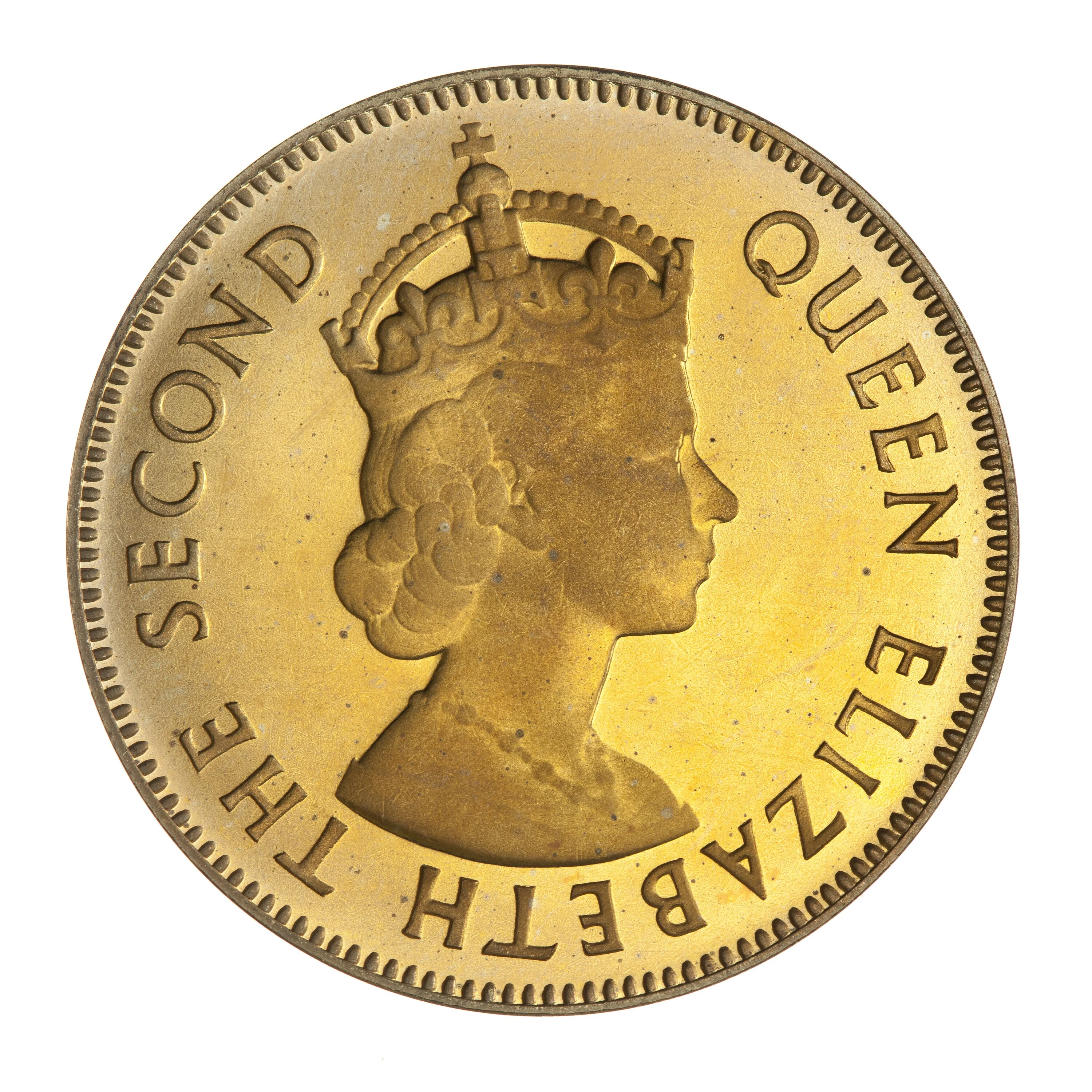
Obverse
Description:
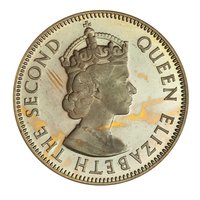
Crowned portrait of Queen Elizabeth II facing right, engraver's initials at truncation. Legend encircles.
Inscription:
QUEEN ELIZABETH THE SECOND
CT
CT
Script: Latin
Engraver: Cecil Thomas
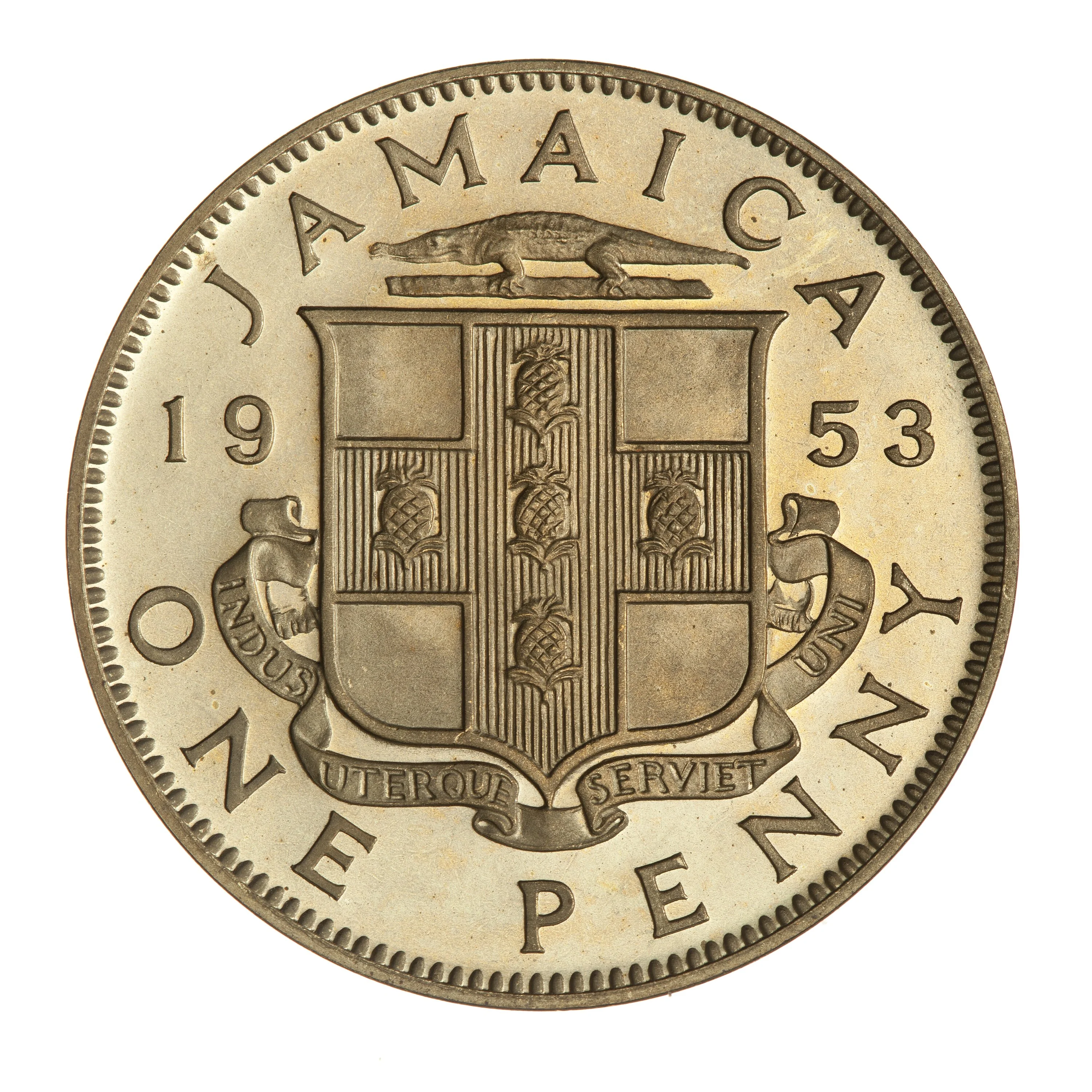
Reverse
Description:
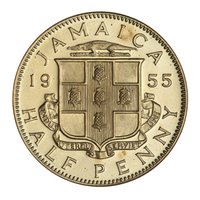
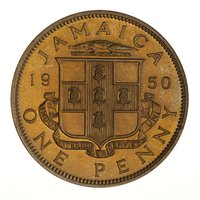
Jamaican coat of arms with encircling legend.
Inscription:
JAMAICA
1962
ONE PENNY
INDUS UTERQUE SERVIET UNI
1962
ONE PENNY
INDUS UTERQUE SERVIET UNI
Translation:
JAMAICA
1962
ONE PENNY
BOTH INDS WILL SERVE ONE
1962
ONE PENNY
BOTH INDS WILL SERVE ONE
Script: Latin
Engraver: Percy Metcalfe
Edge
Plain
Mints
| Name | Mark |
|---|---|
| Royal Mint (Tower Hill) | — |
Mintings
| Year | Mint Mark | Mintage | Quality | Collection |
|---|---|---|---|---|
| 1953 | — | 1,200,000 | ||
| 1953 | — | — | Proof | |
| 1955 | — | — | Proof | |
| 1955 | — | 960,000 | ||
| 1957 | — | 600,000 | ||
| 1957 | — | — | Proof | |
| 1958 | — | 1,080,000 | ||
| 1958 | — | — | Proof | |
| 1959 | — | 1,368,000 | ||
| 1959 | — | — | Proof | |
| 1960 | — | 1,368,000 | ||
| 1960 | — | — | Proof | |
| 1961 | — | 1,368,000 | ||
| 1961 | — | — | Proof | |
| 1962 | — | 1,920,000 | ||
| 1962 | — | — | Proof | |
| 1963 | — | — | Proof | |
| 1963 | — | 720,000 |
Historical background
In 1953, Jamaica's currency situation was fundamentally shaped by its colonial status within the British Empire. The island operated under a sterling exchange standard, with the Jamaican pound (£J) fixed at parity with the British pound sterling. This meant the local currency was fully backed by sterling reserves held in London, and its value was directly tied to the health of the British economy. The currency was issued by a Currency Board, a restrictive system designed primarily to ensure convertibility and monetary stability rather than to manage the domestic economy. This arrangement limited Jamaica's ability to use independent monetary policy to address local economic needs.
Economically, the period was one of transition and growth, driven largely by the booming bauxite industry, which began exports in 1952. This influx of foreign investment and U.S. dollars strengthened the colony's external reserves and balance of payments. However, the benefits were not evenly distributed, and the agricultural sector, particularly sugar and banana exports, remained vulnerable to price fluctuations. The currency board system, while ensuring stability, was criticized for being inflexible, as it could not expand the money supply to fuel development projects unless matched by additional sterling reserves, effectively outsourcing monetary control to the Bank of England.
Politically, the currency framework of 1953 existed on the cusp of major change. With the move towards internal self-government beginning in the mid-1940s, there were growing calls for greater financial autonomy. The rigid currency board system was increasingly seen as an anachronism unfit for a nation pursuing development and eventual independence. These debates would culminate a few years later with the establishment of the Bank of Jamaica in 1960, which replaced the currency board with a central bank capable of conducting active monetary policy. Thus, 1953 represents the final years of a purely colonial monetary order in Jamaica.
Economically, the period was one of transition and growth, driven largely by the booming bauxite industry, which began exports in 1952. This influx of foreign investment and U.S. dollars strengthened the colony's external reserves and balance of payments. However, the benefits were not evenly distributed, and the agricultural sector, particularly sugar and banana exports, remained vulnerable to price fluctuations. The currency board system, while ensuring stability, was criticized for being inflexible, as it could not expand the money supply to fuel development projects unless matched by additional sterling reserves, effectively outsourcing monetary control to the Bank of England.
Politically, the currency framework of 1953 existed on the cusp of major change. With the move towards internal self-government beginning in the mid-1940s, there were growing calls for greater financial autonomy. The rigid currency board system was increasingly seen as an anachronism unfit for a nation pursuing development and eventual independence. These debates would culminate a few years later with the establishment of the Bank of Jamaica in 1960, which replaced the currency board with a central bank capable of conducting active monetary policy. Thus, 1953 represents the final years of a purely colonial monetary order in Jamaica.
🌱 Very Common