

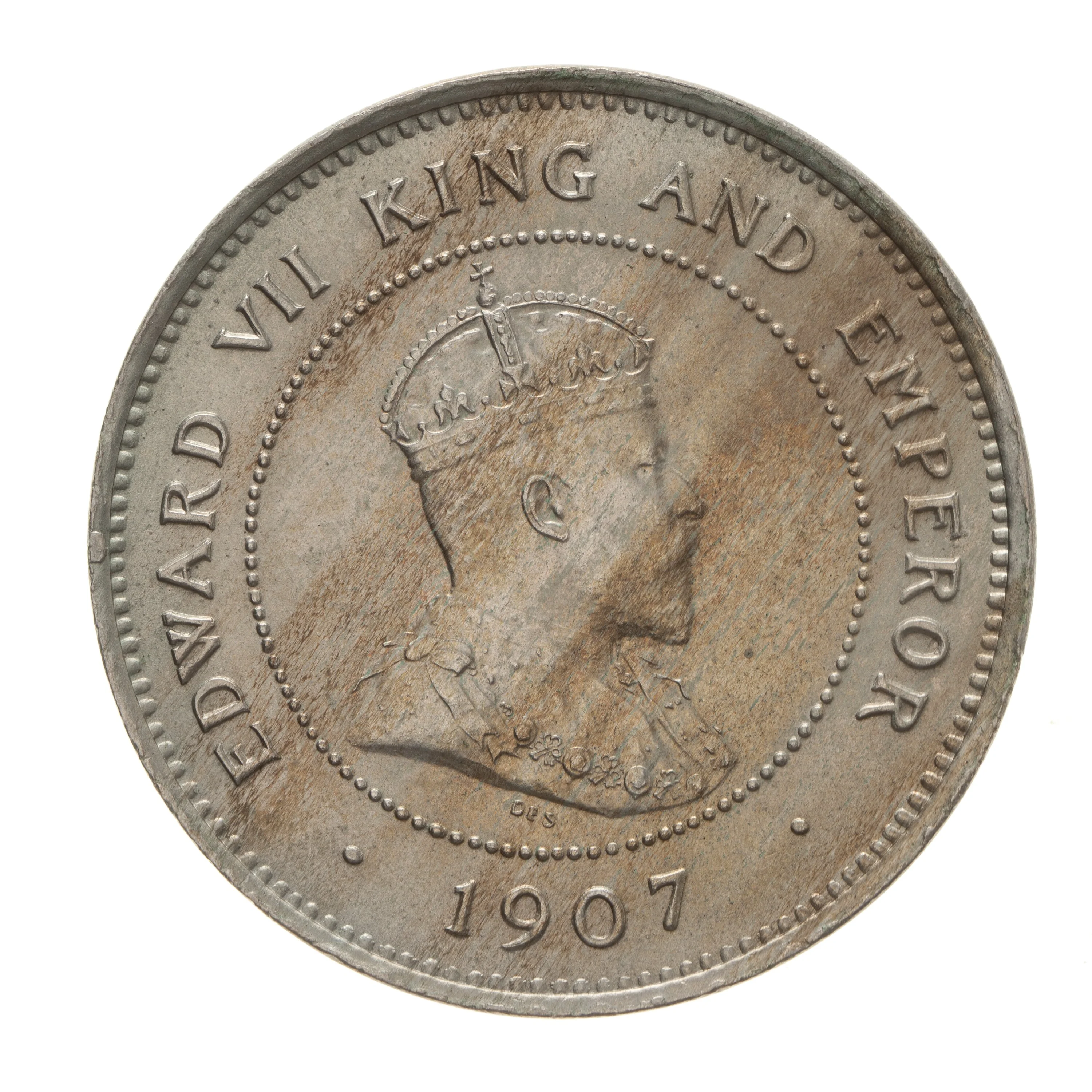
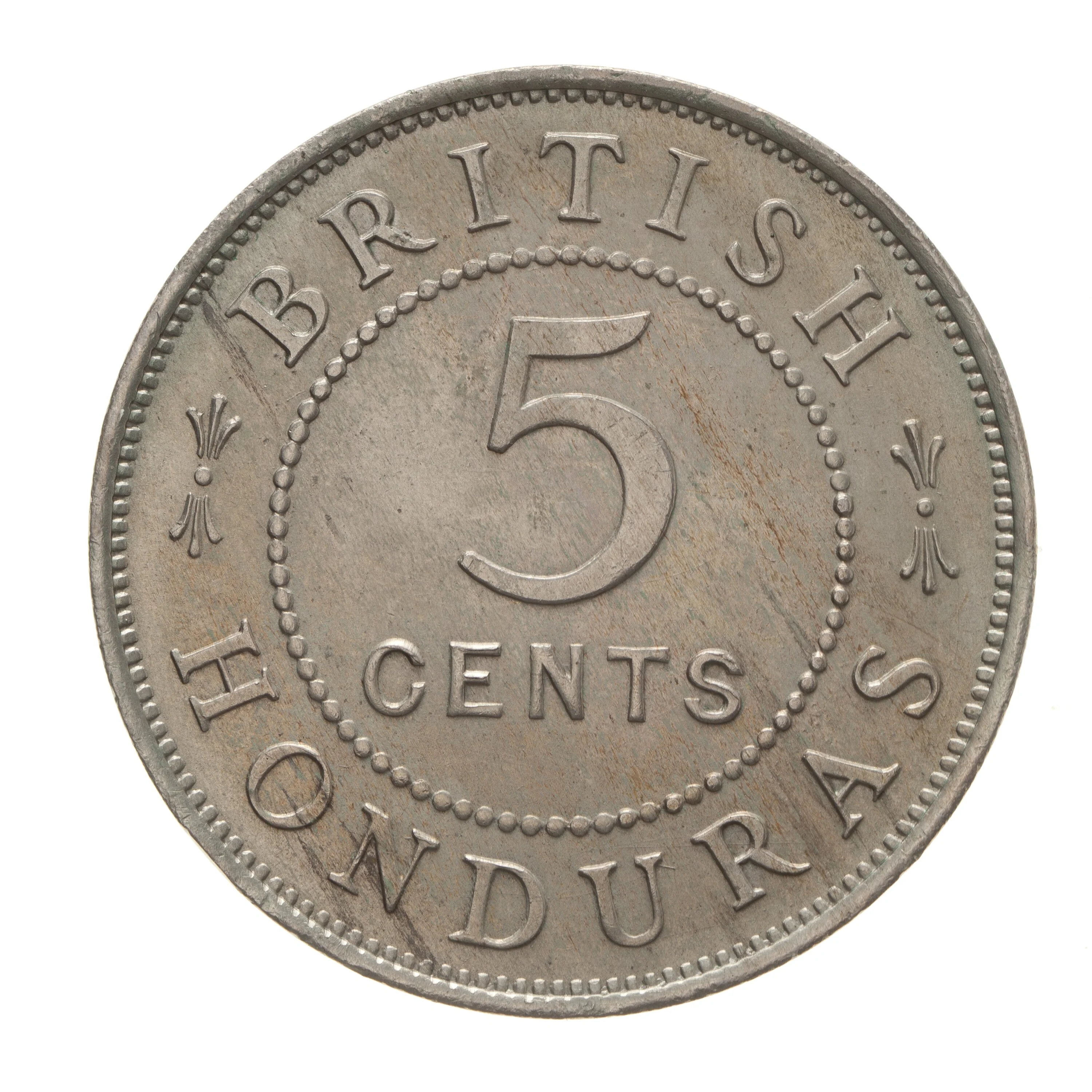
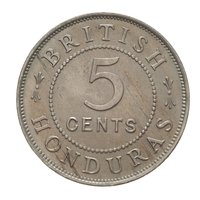
5 Cents – British Honduras
Belize
Context
Years: 1907–1909
Country: Belize 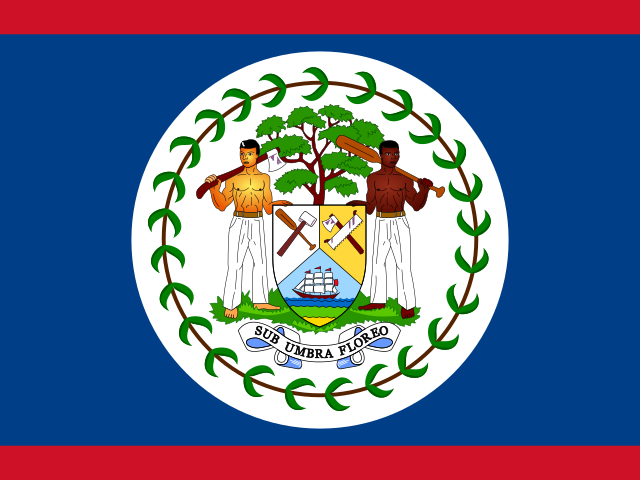
Issuer: British Honduras
Ruler: Edward VII
Currency:
(1885—1973)
Total mintage: 20,000
Material
Diameter: 20 mm
Weight: 3.63 g
Shape: Round
Composition: Copper-nickel
Technique: Milled
Alignment: Medal alignment
flip
References
KM: #Click to copy to clipboard14
Numista: #33980
Obverse
Description:
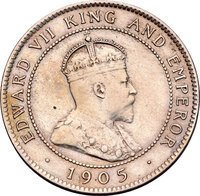
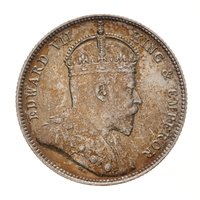
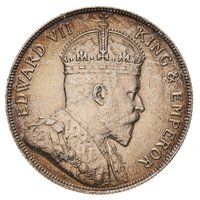
King Edward VII crowned bust right, within beaded circle.
Inscription:
EDWARD VII KING AND EMPEROR
DES
· 1909 ·
DES
· 1909 ·
Translation:
EDWARD VII KING AND EMPEROR
BY THE GRACE OF GOD
· 1909 ·
BY THE GRACE OF GOD
· 1909 ·
Script: Latin
Engraver: George William de Saulles
Reverse
Edge
Plain
Categories
| Symbol> Crown |
| Person> Monarch |
| Mustache/Beard |
Mints
| Name | Mark |
|---|---|
| Royal Mint (Tower Hill) | — |
Mintings
| Year | Mint Mark | Mintage | Quality | Collection |
|---|---|---|---|---|
| 1907 | — | 10,000 | ||
| 1909 | — | 10,000 |
Historical background
In 1907, the currency situation in British Honduras (modern-day Belize) was characterized by a complex and somewhat chaotic system of multiple, concurrently circulating currencies, none of which were issued locally. The official currency was the British pound sterling, but in practice, the most commonly used medium of exchange was the silver Mexican peso and its fractional parts (reales). This reliance on Mexican coinage was a legacy of the colony's historical trade ties with its neighbours and the broader Spanish-American commercial sphere, a dependency that colonial administrators viewed with increasing concern due to the volatility and external control it represented.
The core problem was a chronic shortage of official British coinage, which led to the widespread use of not only Mexican silver but also US gold dollars and even banknotes from Canadian and British banks. To bring order, the British Honduras dollar had been introduced in 1885, pegged at a fixed rate of four shillings and two pence sterling (or 50 US cents). However, this "dollar" existed primarily as a unit of account for government transactions and did not initially circulate as physical local currency. The 1907 period thus represented a transitional phase where the accounting system was modern and dollar-based, but the physical money in people's hands remained an unstable mixture of foreign silver and gold coins.
This unsatisfactory situation culminated in the pivotal Currency Ordinance of 1907, which authorized the establishment of a Board of Commissioners to issue the first government paper money for the colony. These notes, denominated in dollars and fully backed by sterling securities held in London, began circulating in 1908. This reform marked a decisive step toward monetary sovereignty, aiming to displace the heterogeneous foreign coinage with a stable, locally administered paper currency firmly tied to the British sterling standard, thereby simplifying trade and asserting greater colonial financial control.
The core problem was a chronic shortage of official British coinage, which led to the widespread use of not only Mexican silver but also US gold dollars and even banknotes from Canadian and British banks. To bring order, the British Honduras dollar had been introduced in 1885, pegged at a fixed rate of four shillings and two pence sterling (or 50 US cents). However, this "dollar" existed primarily as a unit of account for government transactions and did not initially circulate as physical local currency. The 1907 period thus represented a transitional phase where the accounting system was modern and dollar-based, but the physical money in people's hands remained an unstable mixture of foreign silver and gold coins.
This unsatisfactory situation culminated in the pivotal Currency Ordinance of 1907, which authorized the establishment of a Board of Commissioners to issue the first government paper money for the colony. These notes, denominated in dollars and fully backed by sterling securities held in London, began circulating in 1908. This reform marked a decisive step toward monetary sovereignty, aiming to displace the heterogeneous foreign coinage with a stable, locally administered paper currency firmly tied to the British sterling standard, thereby simplifying trade and asserting greater colonial financial control.
Series: 1904 series
💎 Very Rare