

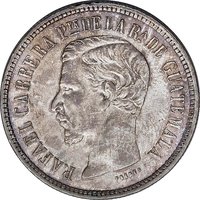
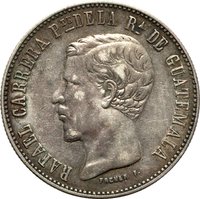
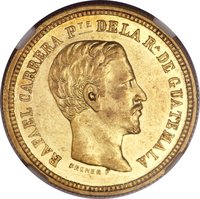
Obverse
Description:
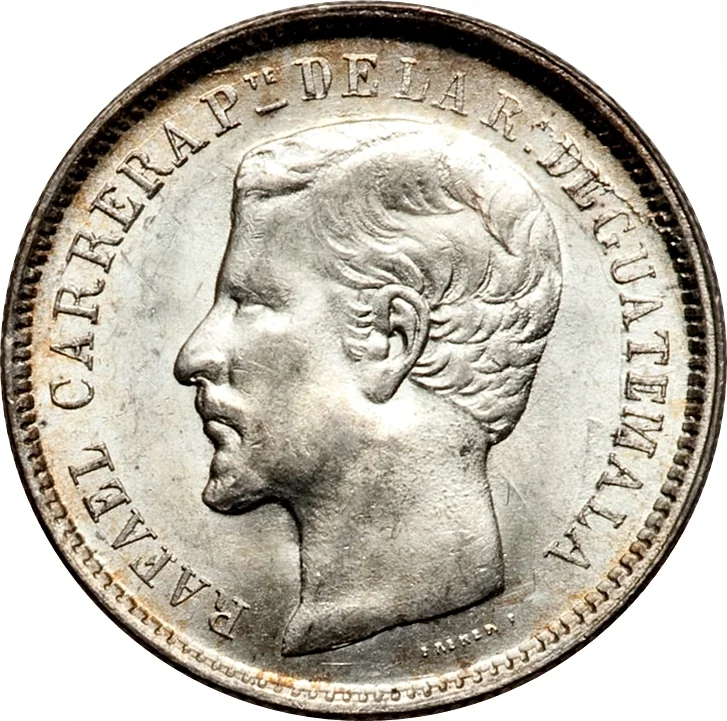
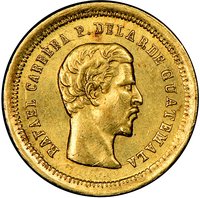
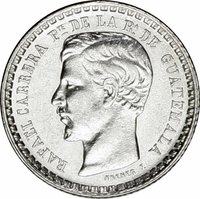
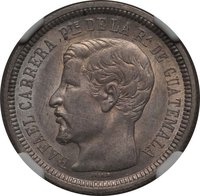
Bust left, legend around, engraver's name below neck.
Inscription:
RAFAEL CARRERA PTE. DE LA RA. DE GUATEMALA
FRENER F.
FRENER F.
Translation:
RAFAEL CARRERA PRESIDENT OF THE REPUBLIC OF GUATEMALA
FRENER F.
FRENER F.
Script: Latin
Language: Spanish
Engraver: Johann-Baptist Frener
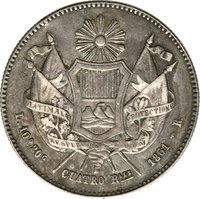
Reverse
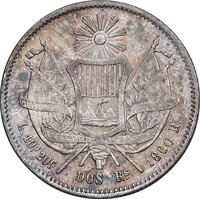
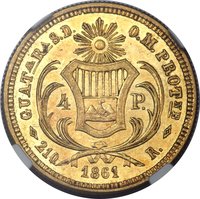
Description:
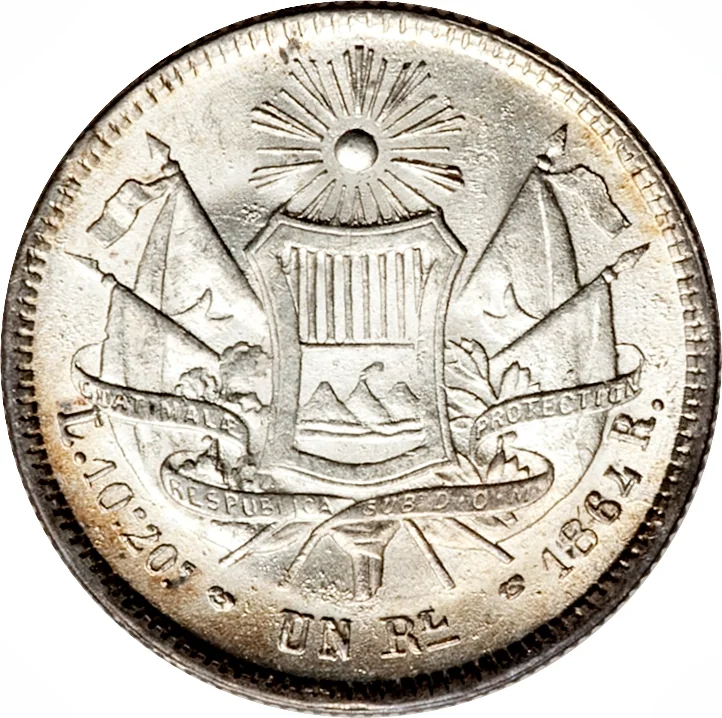
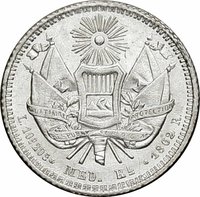
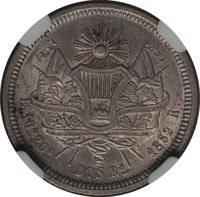
Coat of arms, with fineness, value, and date below.
Inscription:
L.10D.20G. *UN RL* 1864 R.
Translation:
Ten Decimes, Twenty Centimes. *French Republic* 1864, Paris.
Script: Latin
Engraver: Johann-Baptist Frener
Edge
Reeded
Categories
| Symbols> Coat of Arms |
| Person> Politician |
Mints
| Name | Mark |
|---|---|
| Casa de Moneda de Guatemala | — |
Mintings
| Year | Mint Mark | Mintage | Quality | Collection |
|---|---|---|---|---|
| 1861 | — | 87,959 | ||
| 1862 | — | 307,685 | ||
| 1863 | — | 152,297 | ||
| 1864 | — | 196,699 | ||
| 1865 | — | — |
Historical background
In 1861, Guatemala’s currency system was in a state of transition and disarray, reflecting the broader economic and political instability following the dissolution of the Federal Republic of Central America in 1841. The country operated on a bimetallic standard (gold and silver) in theory, but in practice, the circulation was dominated by a chaotic mix of foreign and domestic coins. Spanish colonial reales, Mexican pesos, and even coins from other Central American states circulated alongside a limited and often debased supply of Guatemalan-minted currency. This proliferation of foreign coinage, all with varying weights and purities, created significant challenges for commerce and state revenue, complicating transactions and fostering distrust.
The government of President Rafael Carrera, who held firm control after the establishment of the Republic of Guatemala in 1847, recognized the need for monetary reform to assert economic sovereignty and simplify trade. In the years leading up to 1861, efforts were made to standardize the currency. A pivotal moment came with the Monetary Law of November 1859, which officially adopted the Peso as the national unit, divided into 100 centavos, and aimed to align Guatemala with the French Latin Monetary Union standard. By 1861, the nation was in the early stages of implementing this law, planning for the minting of new gold and silver coins bearing the national seal to replace the foreign mosaic in circulation.
However, the situation in 1861 remained one of protracted change rather than completed reform. The actual supply of the new, standardized national currency was still limited, meaning that the older, heterogeneous coins remained in widespread daily use. This period was thus characterized by a dual reality: a legal framework for a modern decimalized currency system was newly established, but the tangible monetary experience for most Guatemalans continued to be one of complexity and inconsistency. The success of the 1859 law depended on the government's ability to physically produce and distribute enough sound currency to drive out the old mixed specie, a process that would extend well beyond 1861.
The government of President Rafael Carrera, who held firm control after the establishment of the Republic of Guatemala in 1847, recognized the need for monetary reform to assert economic sovereignty and simplify trade. In the years leading up to 1861, efforts were made to standardize the currency. A pivotal moment came with the Monetary Law of November 1859, which officially adopted the Peso as the national unit, divided into 100 centavos, and aimed to align Guatemala with the French Latin Monetary Union standard. By 1861, the nation was in the early stages of implementing this law, planning for the minting of new gold and silver coins bearing the national seal to replace the foreign mosaic in circulation.
However, the situation in 1861 remained one of protracted change rather than completed reform. The actual supply of the new, standardized national currency was still limited, meaning that the older, heterogeneous coins remained in widespread daily use. This period was thus characterized by a dual reality: a legal framework for a modern decimalized currency system was newly established, but the tangible monetary experience for most Guatemalans continued to be one of complexity and inconsistency. The success of the 1859 law depended on the government's ability to physically produce and distribute enough sound currency to drive out the old mixed specie, a process that would extend well beyond 1861.
Series: System: 1859-1870
⭐ Somewhat Rare