

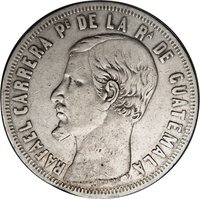
Obverse
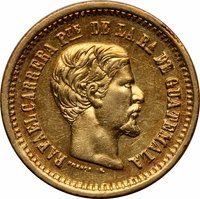
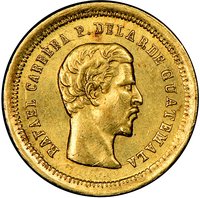
Description:
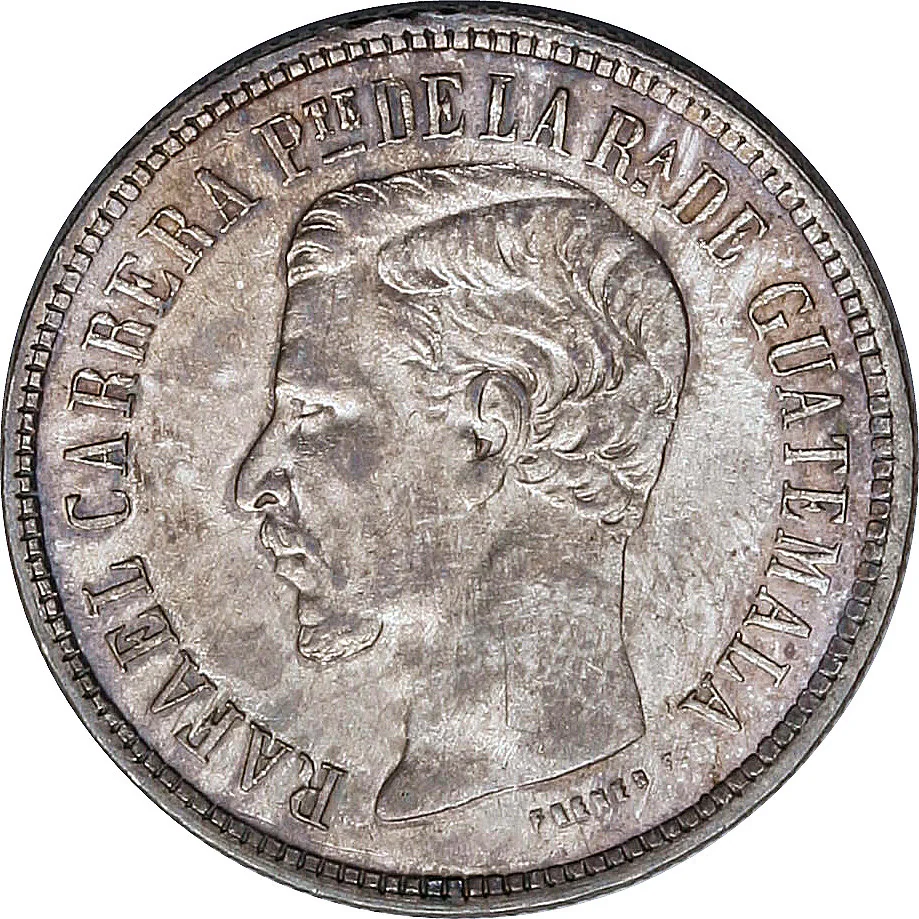
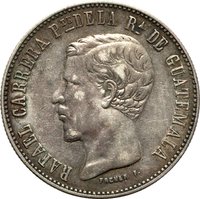
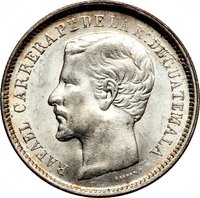
Bust left, legend encircling, engraver's name at base.
Inscription:
RAFAEL CARRERA PTE DE LA RA. DE GUATEMALA
FRENER F.
FRENER F.
Translation:
RAFAEL CARRERA PRESIDENT OF THE REPUBLIC OF GUATEMALA
F. FRENER
F. FRENER
Script: Latin
Language: Spanish
Engraver: Johann-Baptist Frener
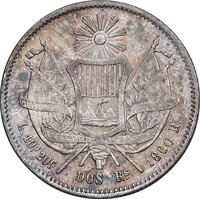
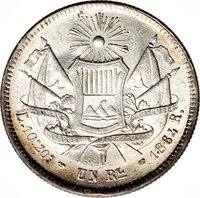
Reverse
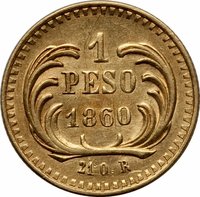
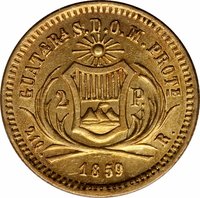
Description:
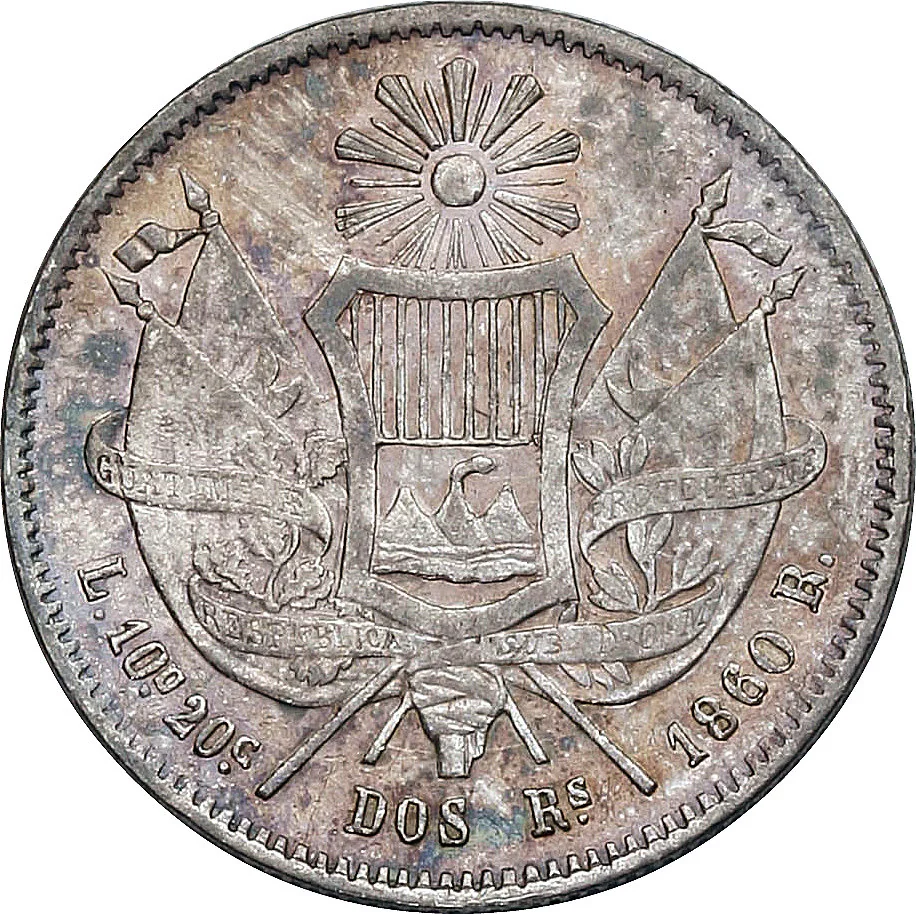
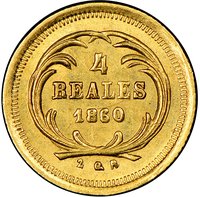
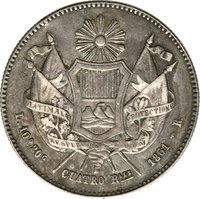
Coat of arms, with fineness, value, and date below.
Inscription:
L. 10D. 20G. DOS RS. 1860 R.
Translation:
Ten Dollars. Twenty Grams. Two Reales. 1860 R.
Script: Latin
Engraver: Johann-Baptist Frener
Edge
Categories
| Symbols> Coat of Arms |
| Person> Politician |
Mints
| Name | Mark |
|---|---|
| Casa de Moneda de Guatemala | — |
Mintings
| Year | Mint Mark | Mintage | Quality | Collection |
|---|---|---|---|---|
| 1860 | — | 78,815 | ||
| 1861 | — | 220,994 |
Historical background
In 1860, Guatemala's currency situation was characterized by a complex and fragmented monetary system, a direct legacy of its colonial past and the political instability following independence from Spain in 1821. The official currency was the Guatemalan Peso, theoretically divided into 8 Reales, but the reality was far more chaotic. The economy relied heavily on a circulation of diverse and often debased coinage, including worn Spanish colonial pieces, coins from other Central American republics, and even counterfeits. This lack of a uniform, trusted national currency hindered commerce, facilitated fraud, and reflected the broader challenges of state-building in a region plagued by civil wars and weak central institutions.
The period was one of transition under the conservative regime of President Rafael Carrera, who had brought a degree of stability after decades of conflict. While his government focused on consolidating political power and reaffirming traditional social structures, comprehensive monetary reform was not yet a primary achievement. The scarcity of small denomination coins for daily transactions was a persistent problem, often forcing the use of cut or "clipped" segments of larger silver coins. Furthermore, the global shift towards the gold standard was beginning to influence economic thinking, but Guatemala's economy remained fundamentally tied to silver, leaving it vulnerable to international fluctuations in the value of precious metals.
Consequently, the monetary landscape of 1860 was marked by inconvenience and inefficiency. The coexistence of multiple coin types required merchants and citizens to constantly assess the weight and purity of individual pieces, with values often determined by local agreement rather than national fiat. This unsatisfactory system would eventually lead to more decisive action, culminating in the decimalization reform of 1869 that introduced the Centavo and the Quetzal (though not yet as a physical unit) as a new accounting system. Therefore, 1860 represents a late chapter in Guatemala's post-colonial monetary disorder, immediately preceding a significant, if initially incomplete, step toward a modern national currency.
The period was one of transition under the conservative regime of President Rafael Carrera, who had brought a degree of stability after decades of conflict. While his government focused on consolidating political power and reaffirming traditional social structures, comprehensive monetary reform was not yet a primary achievement. The scarcity of small denomination coins for daily transactions was a persistent problem, often forcing the use of cut or "clipped" segments of larger silver coins. Furthermore, the global shift towards the gold standard was beginning to influence economic thinking, but Guatemala's economy remained fundamentally tied to silver, leaving it vulnerable to international fluctuations in the value of precious metals.
Consequently, the monetary landscape of 1860 was marked by inconvenience and inefficiency. The coexistence of multiple coin types required merchants and citizens to constantly assess the weight and purity of individual pieces, with values often determined by local agreement rather than national fiat. This unsatisfactory system would eventually lead to more decisive action, culminating in the decimalization reform of 1869 that introduced the Centavo and the Quetzal (though not yet as a physical unit) as a new accounting system. Therefore, 1860 represents a late chapter in Guatemala's post-colonial monetary disorder, immediately preceding a significant, if initially incomplete, step toward a modern national currency.
Series: System: 1859-1870
⭐ Rare