

50 centavos – Portugal
Add to wishlist
Portugal
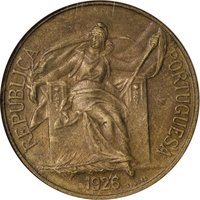
Obverse
Description:
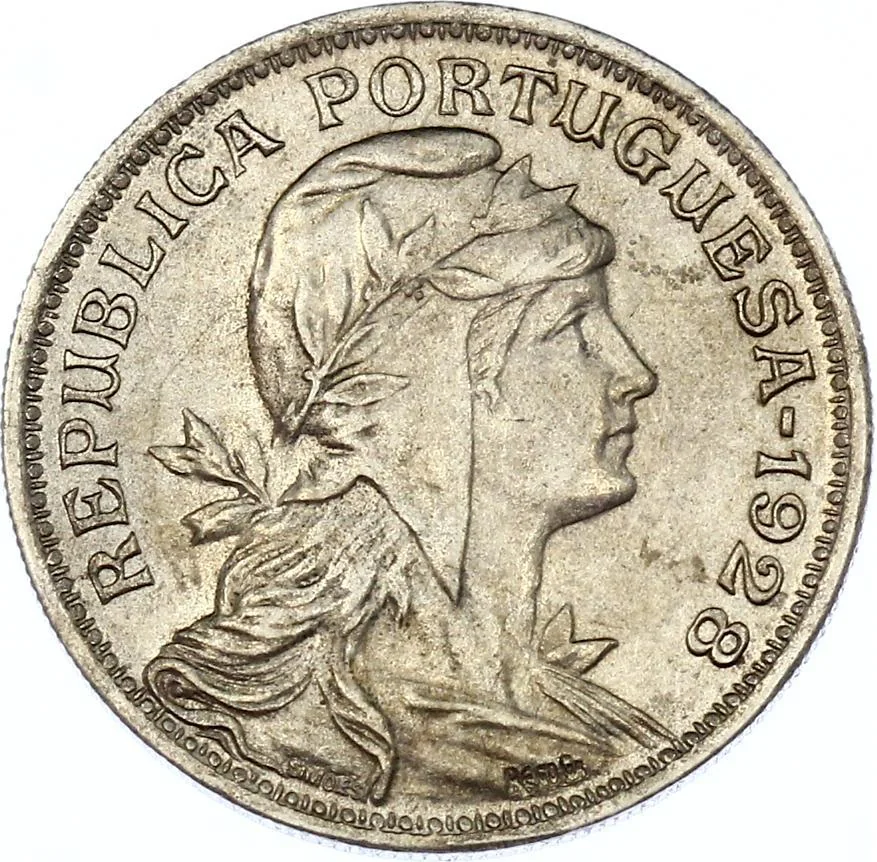
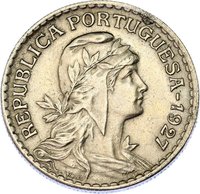
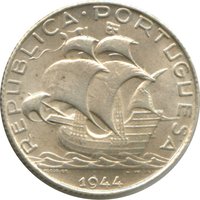
Republic allegory facing right, country name and date above.
Inscription:
REPUBLICA PORTUGUESA - 1944
SIMÕES
REGO GR
SIMÕES
REGO GR
Translation:
Portuguese Republic - 1944
Simões
Rego Gr
Simões
Rego Gr
Script: Latin
Language: Portuguese
Engravers: José Simões de Almeida, Domingos Alves do Rego
Reverse
Description:
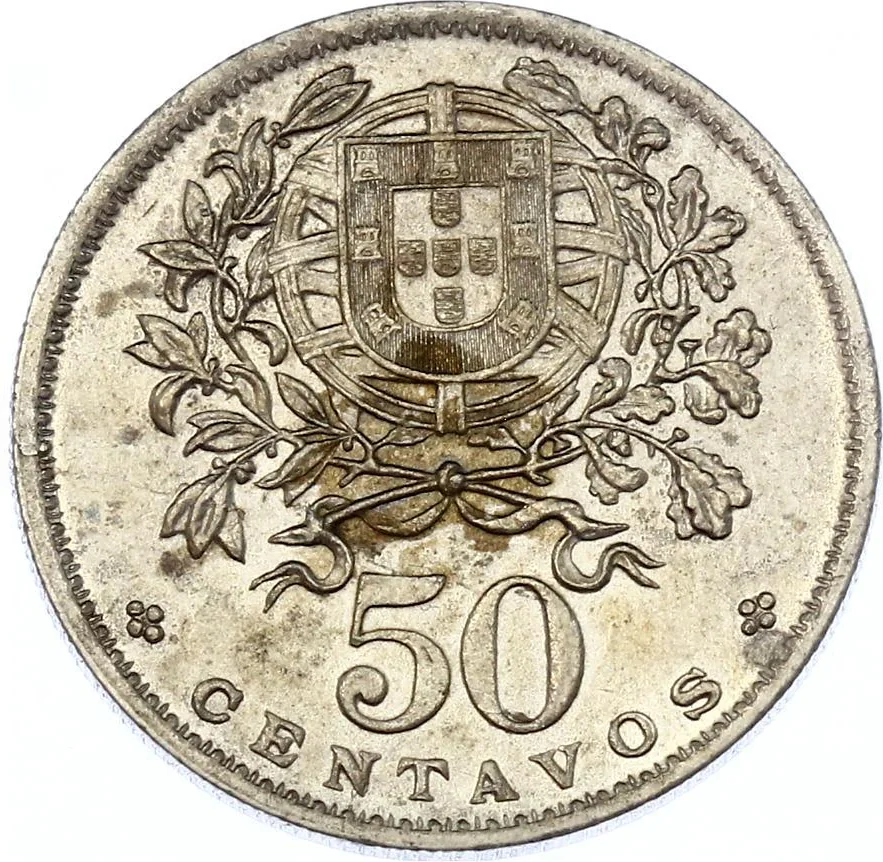
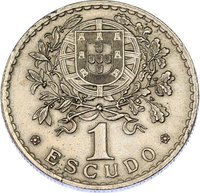
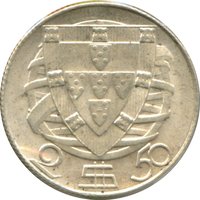
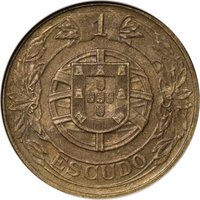
The Portuguese coat of arms with the denomination below.
Inscription:
50
* CENTAVOS *
* CENTAVOS *
Script: Latin
Engraver: José Simões de Almeida
Edge
Reeded
Categories
| Symbols> Coat of Arms |
Mints
| Name | Mark |
|---|---|
| Imprensa Nacional - Casa da Moeda | — |
Mintings
| Year | Mint Mark | Mintage | Quality | Collection |
|---|---|---|---|---|
| 1927 | — | 2,330,000 | ||
| 1928 | — | 6,823,000 | ||
| 1929 | — | 9,779,000 | ||
| 1930 | — | 1,116,000 | ||
| 1931 | — | 7,127,000 | ||
| 1935 | — | 902,000 | ||
| 1938 | — | 923,000 | ||
| 1940 | — | 2,000,000 | ||
| 1944 | — | 2,974,000 | ||
| 1945 | — | 5,700,000 | ||
| 1946 | — | 4,334,000 | ||
| 1947 | — | 6,998,000 | ||
| 1951 | — | 4,610,000 | ||
| 1952 | — | 2,421,000 | ||
| 1953 | — | 2,369,000 | ||
| 1955 | — | 3,057,000 | ||
| 1956 | — | 3,003,000 | ||
| 1957 | — | 3,940,000 | ||
| 1958 | — | 2,687,000 | ||
| 1959 | — | 4,027,000 | ||
| 1960 | — | 2,592,000 | ||
| 1961 | — | 3,324,000 | ||
| 1962 | — | 6,678,000 | ||
| 1963 | — | 2,346,000 | ||
| 1964 | — | 7,654,000 | ||
| 1965 | — | 3,366,000 | ||
| 1966 | — | 6,085,000 | ||
| 1967 | — | 19,391,000 | ||
| 1968 | — | 11,448,000 |
Historical background
In 1927, Portugal's currency situation was characterized by severe instability and devaluation, a legacy of the First Republic's financial mismanagement and political chaos. The Portuguese escudo, introduced in 1911 to replace the monarchy's real, had been severely weakened by years of budget deficits, rampant inflation, and excessive money printing to finance public spending and World War I involvement. By the mid-1920s, the currency was in free fall, losing value against major international standards like gold and the British pound, which crippled foreign trade and undermined public confidence in both the economy and the state.
This monetary crisis unfolded under the nascent authoritarian regime of the Ditadura Nacional, established by the military coup of May 1926. The new government inherited an empty treasury, a massive public debt, and a critically weak banking system. Initial attempts to stabilize the escudo through loans and austerity proved insufficient, as the fundamental lack of fiscal discipline and a coherent monetary policy persisted. The situation reached a point where the very stability of the regime was threatened by the ongoing economic distress.
Consequently, 1927 became a pivotal year that set the stage for profound reform. Faced with continued pressure, the Finance Minister, Sinel de Cordes, sought external assistance, culminating in negotiations for a stabilization loan from the League of Nations. Although these talks ultimately failed, they highlighted the severity of the crisis and paved the way for the more decisive actions that would follow under António de Oliveira Salazar, who became Finance Minister in 1928. Salazar would soon impose strict austerity, balanced budgets, and gold-pegged convertibility, ultimately using the crisis of 1927 as the justification for the radical restructuring of the Portuguese economy and the creation of the Estado Novo dictatorship.
This monetary crisis unfolded under the nascent authoritarian regime of the Ditadura Nacional, established by the military coup of May 1926. The new government inherited an empty treasury, a massive public debt, and a critically weak banking system. Initial attempts to stabilize the escudo through loans and austerity proved insufficient, as the fundamental lack of fiscal discipline and a coherent monetary policy persisted. The situation reached a point where the very stability of the regime was threatened by the ongoing economic distress.
Consequently, 1927 became a pivotal year that set the stage for profound reform. Faced with continued pressure, the Finance Minister, Sinel de Cordes, sought external assistance, culminating in negotiations for a stabilization loan from the League of Nations. Although these talks ultimately failed, they highlighted the severity of the crisis and paved the way for the more decisive actions that would follow under António de Oliveira Salazar, who became Finance Minister in 1928. Salazar would soon impose strict austerity, balanced budgets, and gold-pegged convertibility, ultimately using the crisis of 1927 as the justification for the radical restructuring of the Portuguese economy and the creation of the Estado Novo dictatorship.
Series: System 1927-1968
🌱 Very Common