

2 Euro (Austrian State Treaty) – Austria
Circulating commemorative coins
Commemoration: 50th Anniversary of the Austrian State Treaty
Austria
Context

Material
References
KM: #Click to copy to clipboard3124
Numista: #2193
Value
Exchange value: 2 EUR = $2.36
Inflation-adjusted value: 3.41 EUR
Obverse
Description:
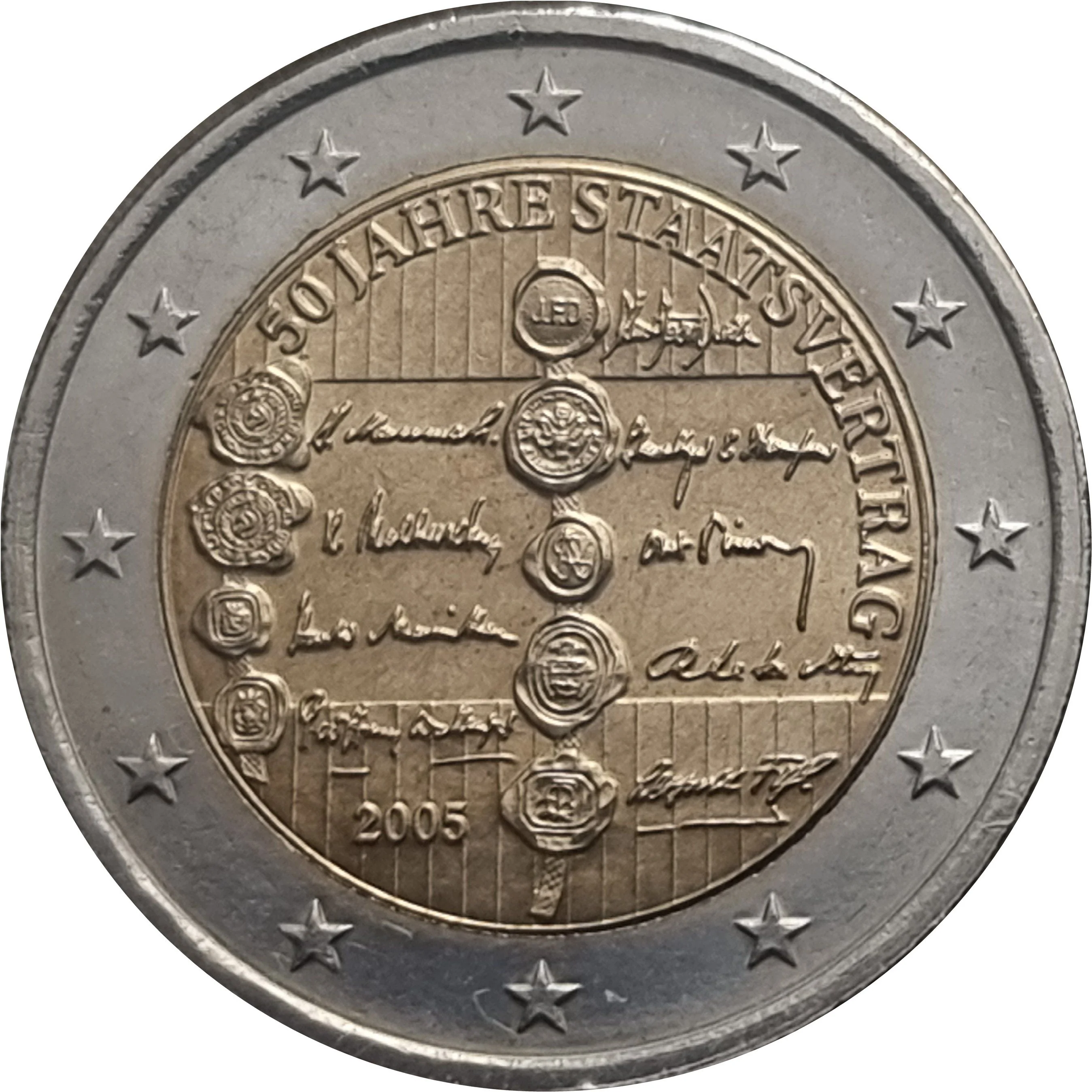
The coin's centre reproduces the signatures and seals from the Austrian State Treaty, signed in May 1955. "50 JAHRE STAATSVERTRAG" appears above the seals, with the year 2005 below. Red-white-red vertical stripes in the background represent Austria's colours. The outer ring features the 12 stars of the European Union.
Inscription:
50 JAHRE STAATSVERTRAG 2005
Translation:
50 YEARS STATE TREATY 2005
Script: Latin
Language: German
Engraver: Helmut Andexlinger
Reverse
Edge
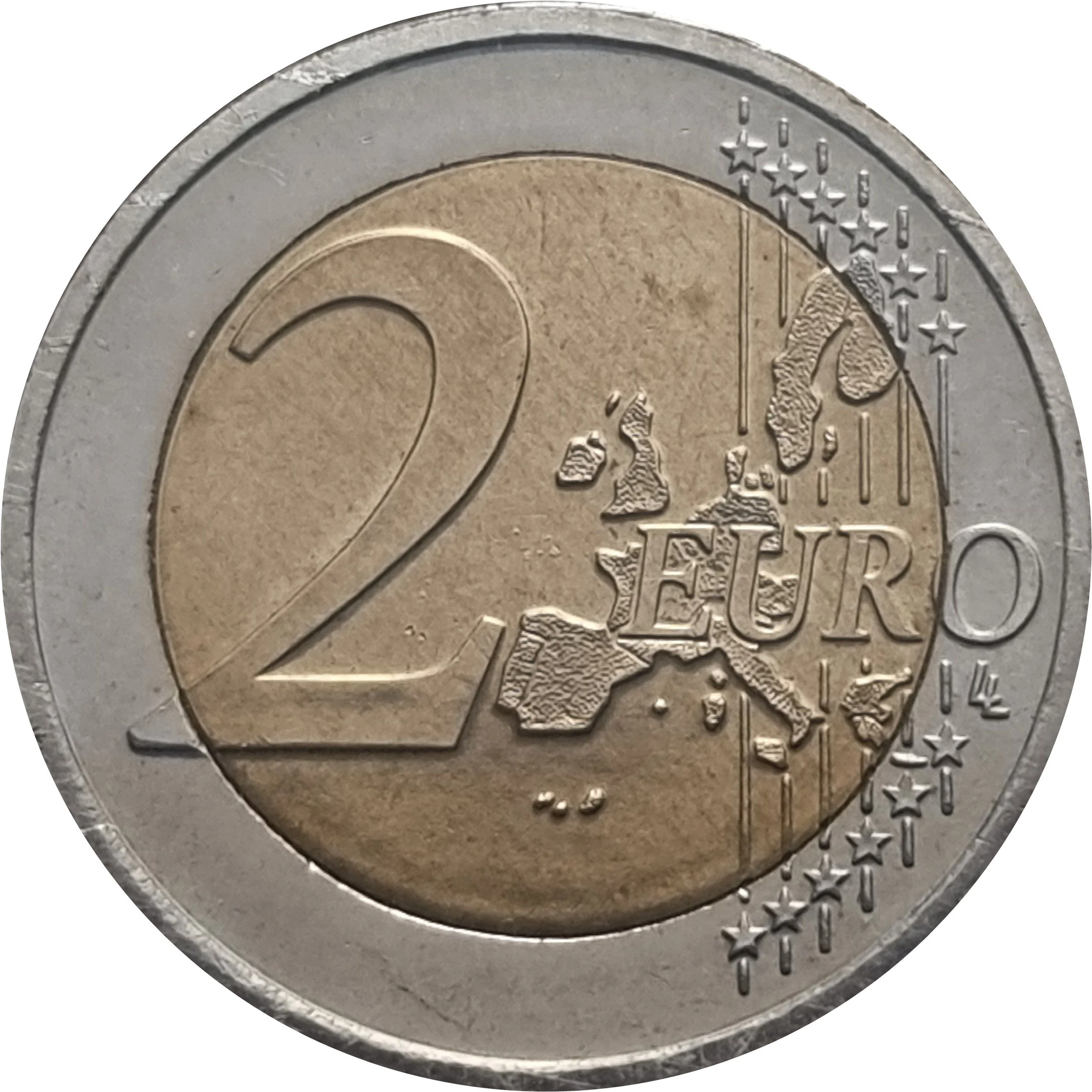
Reeded with inscription. Combination of 2 EURO and *** repeated four times.
Legend:
2 EURO *** 2 EURO *** 2 EURO *** 2 EURO ***
Mints
| Name | Mark |
|---|---|
| Münze Österreich | — |
Mintings
| Year | Mint Mark | Mintage | Quality | Collection |
|---|---|---|---|---|
| 2005 | — | 6,880,000 | ||
| 2005 | — | 100,000 | BU | |
| 2005 | — | 20,000 | Proof |
Historical background
In 2005, Austria was a well-established member of the Eurozone, having adopted the euro as its physical currency in 2002. The period was characterized by a post-transition phase where the national currency, the schilling, had been fully retired from circulation. The focus of monetary policy had shifted entirely to the European Central Bank (ECB) in Frankfurt, which set interest rates for the entire Eurozone, including Austria. Domestically, the primary economic concerns were not about currency stability but rather about broader issues like budget deficits, public debt, and maintaining competitiveness within the single currency area, especially with the recent enlargement of the European Union in 2004.
The Austrian economy in 2005 was experiencing modest growth, but faced challenges that indirectly influenced the currency environment. There was ongoing public and political debate about the perceived costs of the euro, particularly regarding price level increases since the cash changeover—a phenomenon often referred to as "teuro," a pun combining "teuer" (expensive) and "euro." Furthermore, the stability of the euro itself was a topic of discussion, as the currency had experienced significant appreciation against the US dollar in the preceding years, which impacted Austrian exporters.
Overall, the currency situation in Austria in 2005 was one of consolidated integration. The schilling was a matter of historical interest, with citizens and businesses fully accustomed to the euro. The nation's financial stability was inextricably linked to the performance and policies of the Eurozone as a whole, with domestic economic management focused on fiscal discipline to comply with the EU's Stability and Growth Pact, ensuring Austria remained a core member of the monetary union.
The Austrian economy in 2005 was experiencing modest growth, but faced challenges that indirectly influenced the currency environment. There was ongoing public and political debate about the perceived costs of the euro, particularly regarding price level increases since the cash changeover—a phenomenon often referred to as "teuro," a pun combining "teuer" (expensive) and "euro." Furthermore, the stability of the euro itself was a topic of discussion, as the currency had experienced significant appreciation against the US dollar in the preceding years, which impacted Austrian exporters.
Overall, the currency situation in Austria in 2005 was one of consolidated integration. The schilling was a matter of historical interest, with citizens and businesses fully accustomed to the euro. The nation's financial stability was inextricably linked to the performance and policies of the Eurozone as a whole, with domestic economic management focused on fiscal discipline to comply with the EU's Stability and Growth Pact, ensuring Austria remained a core member of the monetary union.
Series: Austria 2 euro commemoratives
🌱 Very Common