

50 schilling – Austria
Add to wishlist
Circulating commemorative coins
Commemoration: Last Schilling
Austria
Context
Year: 2001
Issuer: Austria
Period:
(since 1945)
Currency:
(1945—2001)
Demonetization: 28 February 2002
Total mintage: 700,000
Material
References
KM: #
Numista: #12465
Value
Exchange value: 50 ATS
Inflation-adjusted value: 92.14 ATS
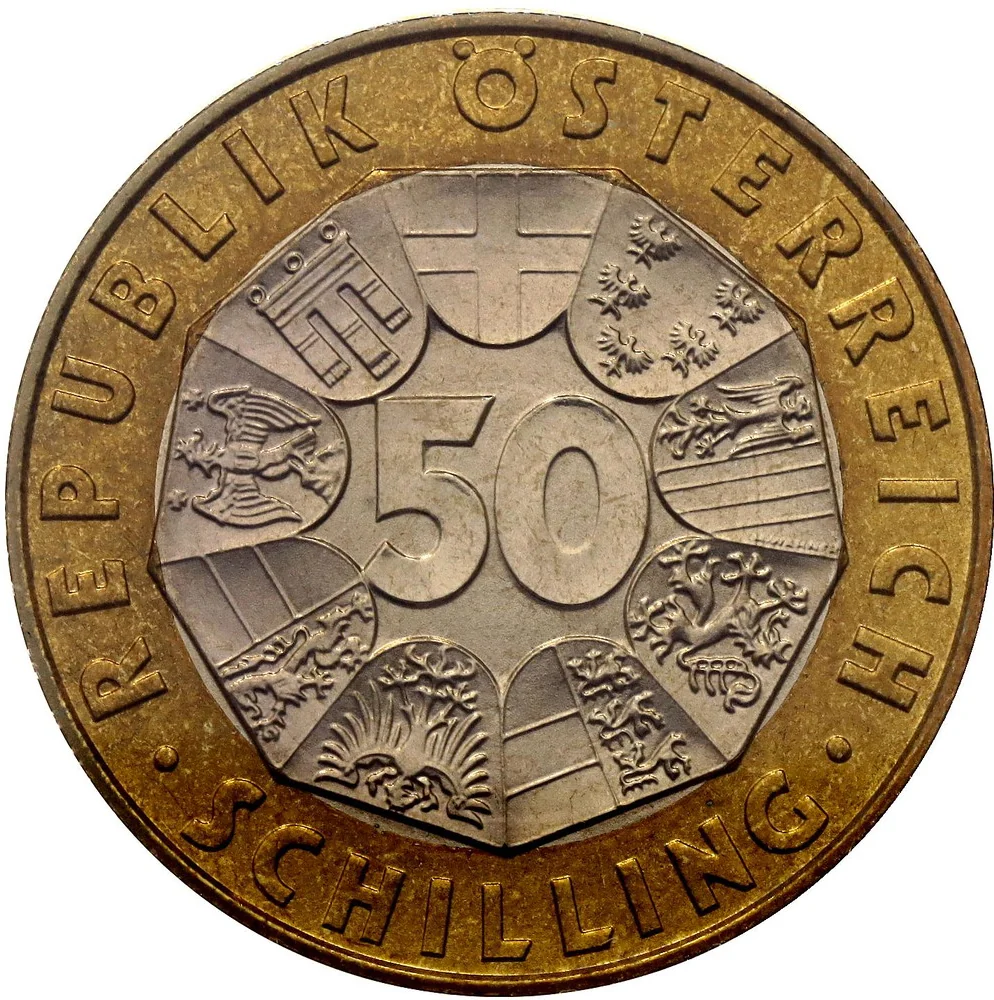
Obverse
Description:
Central number with shields, country name in outer ring.
Inscription:
REPUBLIK ÖSTERREICH
50
· SCHILLING ·
50
· SCHILLING ·
Translation:
REPUBLIC OF AUSTRIA
50
· SCHILLING ·
50
· SCHILLING ·
Script: Latin
Language: German
Engraver: Herbert Wähner
Reverse
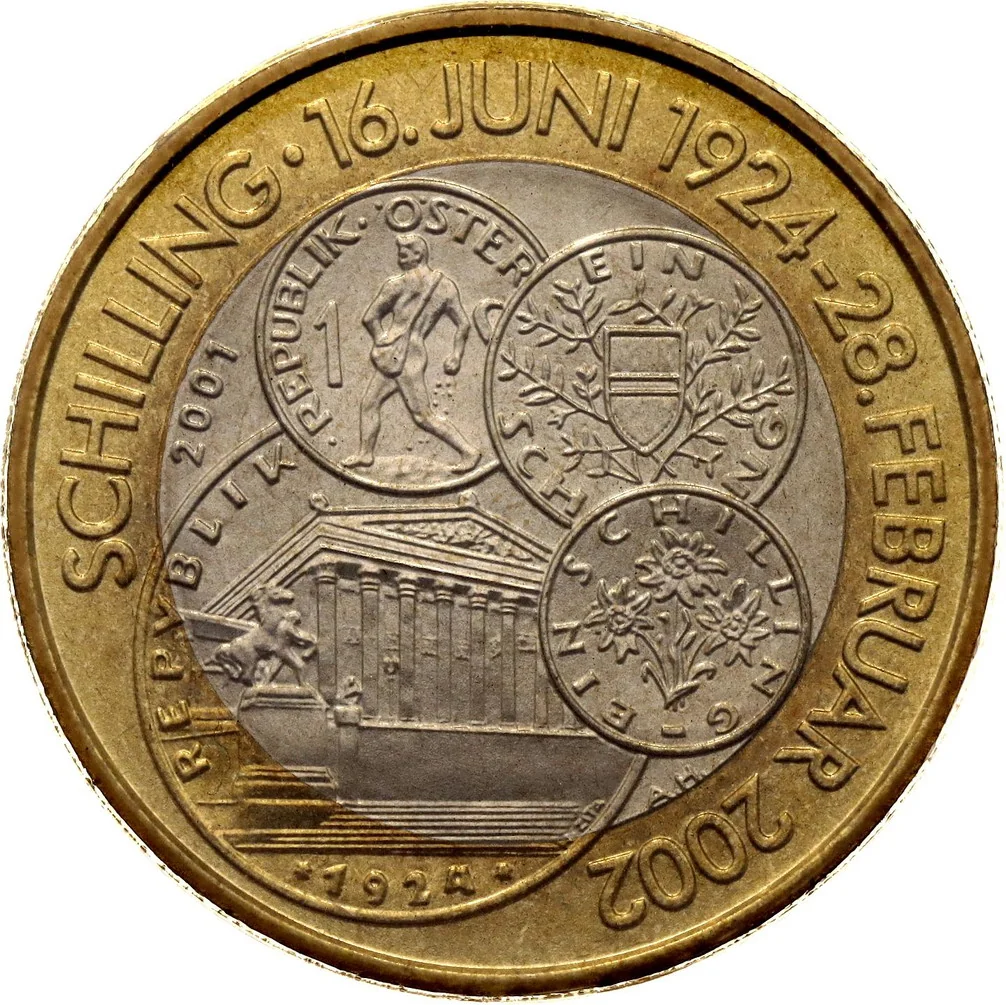
Description:
Obverse and reverse of the 1924 1 Schilling coin, and reverses of the 1947-1957 and 1959-2001 coins.
Inscription:
SCHILLING·16.JUNI 1924-28.FEBRUAR 2002
2001
2001
Translation:
Schilling. 16 June 1924 - 28 February 2002
2001
2001
Script: Latin
Language: German
Engraver: Helmut Andexlinger
Edge
Categories
| Currency> Coin depiction |
| Symbols> Coat of Arms |
Mints
| Name | Mark |
|---|---|
| Münze Österreich | — |
Mintings
| Year | Mint Mark | Mintage | Quality | Collection |
|---|---|---|---|---|
| 2001 | — | 600,000 | ||
| 2001 | — | 100,000 | Special Uncirculated |
Historical background
In 2001, Austria was in the final, operational phase of adopting the euro as its official currency, having been a founding member of the European Economic and Monetary Union (EMU) in 1999. During this three-year transition period, the euro existed only as "book money" (for electronic payments and accounting), while the Austrian schilling remained the physical currency in daily use. The country's economy and financial systems were firmly anchored within the Eurozone's framework, with the schilling's exchange rate irrevocably fixed at 13.7603 ATS to 1 EUR.
The year was characterized by extensive public preparation for the imminent "cash changeover" scheduled for 1 January 2002. A massive logistical effort was underway, involving banks, businesses, and government agencies to ensure a smooth transition. This included the production and secure distribution of euro banknotes and coins, the dual display of prices in both schillings and euros to familiarize the public, and the recalibration of countless vending machines and cash registers. The Austrian National Bank played a central role in managing this process and in educating citizens to build trust in the new currency.
Economically, the situation was stable, with Austria benefiting from the low-interest-rate environment and credibility of the European Central Bank. The fixed conversion rate eliminated exchange rate risk with other Eurozone partners, facilitating trade and investment. While some concerns about price rounding and inflation ("teuro") were publicly debated, the official policy and public sentiment were overwhelmingly geared towards a seamless integration into the single currency, marking a definitive step in Austria's post-war European identity.
The year was characterized by extensive public preparation for the imminent "cash changeover" scheduled for 1 January 2002. A massive logistical effort was underway, involving banks, businesses, and government agencies to ensure a smooth transition. This included the production and secure distribution of euro banknotes and coins, the dual display of prices in both schillings and euros to familiarize the public, and the recalibration of countless vending machines and cash registers. The Austrian National Bank played a central role in managing this process and in educating citizens to build trust in the new currency.
Economically, the situation was stable, with Austria benefiting from the low-interest-rate environment and credibility of the European Central Bank. The fixed conversion rate eliminated exchange rate risk with other Eurozone partners, facilitating trade and investment. While some concerns about price rounding and inflation ("teuro") were publicly debated, the official policy and public sentiment were overwhelmingly geared towards a seamless integration into the single currency, marking a definitive step in Austria's post-war European identity.
🌱 Fairly Common