

5 lire – Italian Eritrea
Add to wishlist
Eritrea
Context
Years: 1891–1896
Country: Eritrea
Issuer: Italian Eritrea
Ruler: Umberto I
Currency:
(1890—1921)
Demonetization: 4 September 1898
Total mintage: 395,999
Material
References
KM: #
Numista: #19047
Value
Bullion value: $57.50
Obverse
Description:
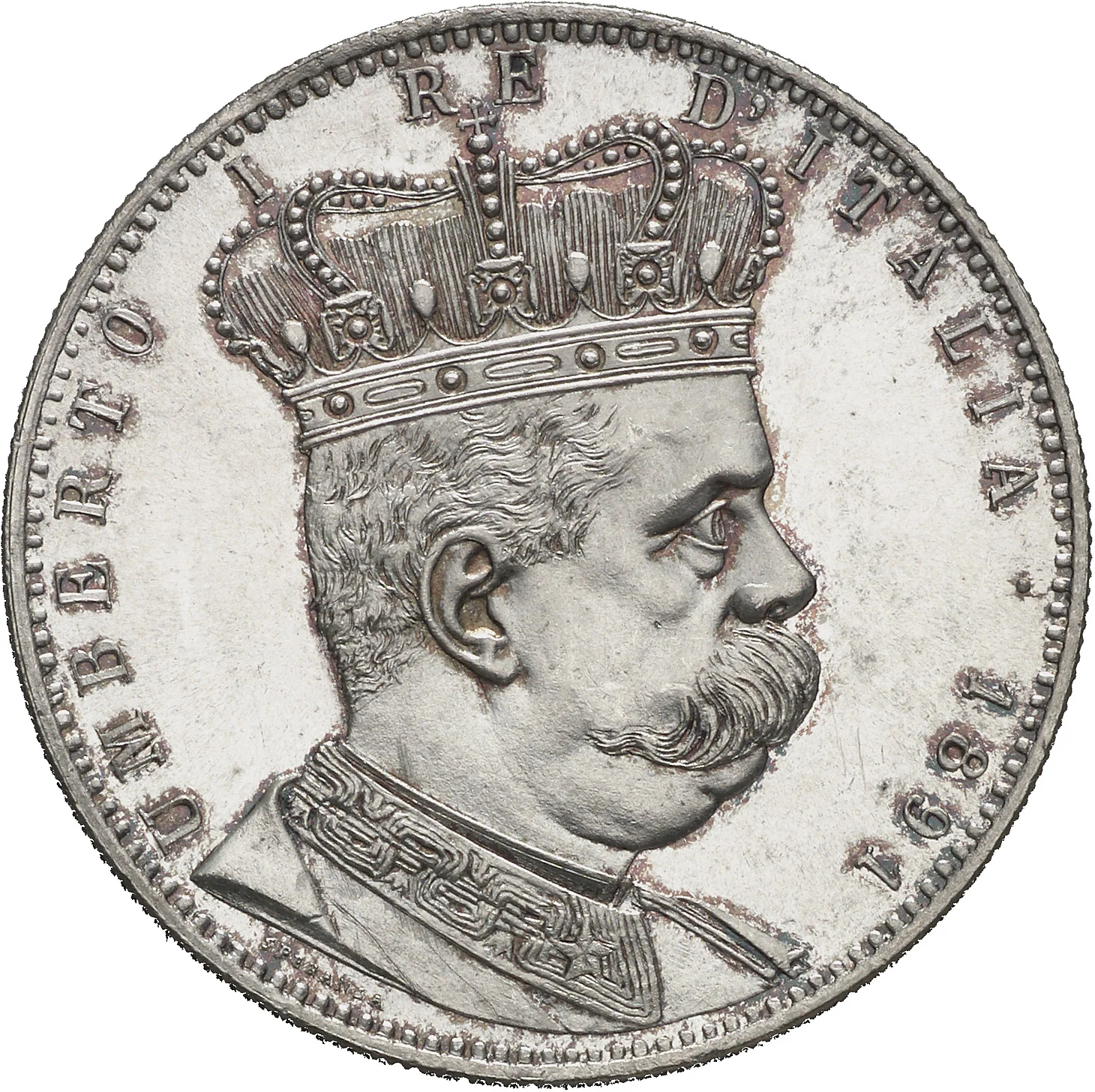
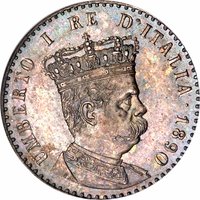
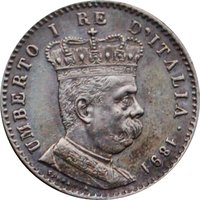
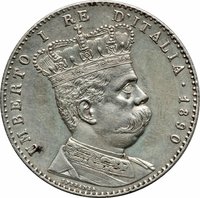
Umberto I crowned bust, right.
Inscription:
UMBERTO I RE D'ITALIA · 1896
SPERANZA
SPERANZA
Translation:
Umberto I King of Italy · 1896
Hope
Hope
Script: Latin
Language: Italian
Engraver: Filippo Speranza
Reverse
Edge
Reeded
Categories
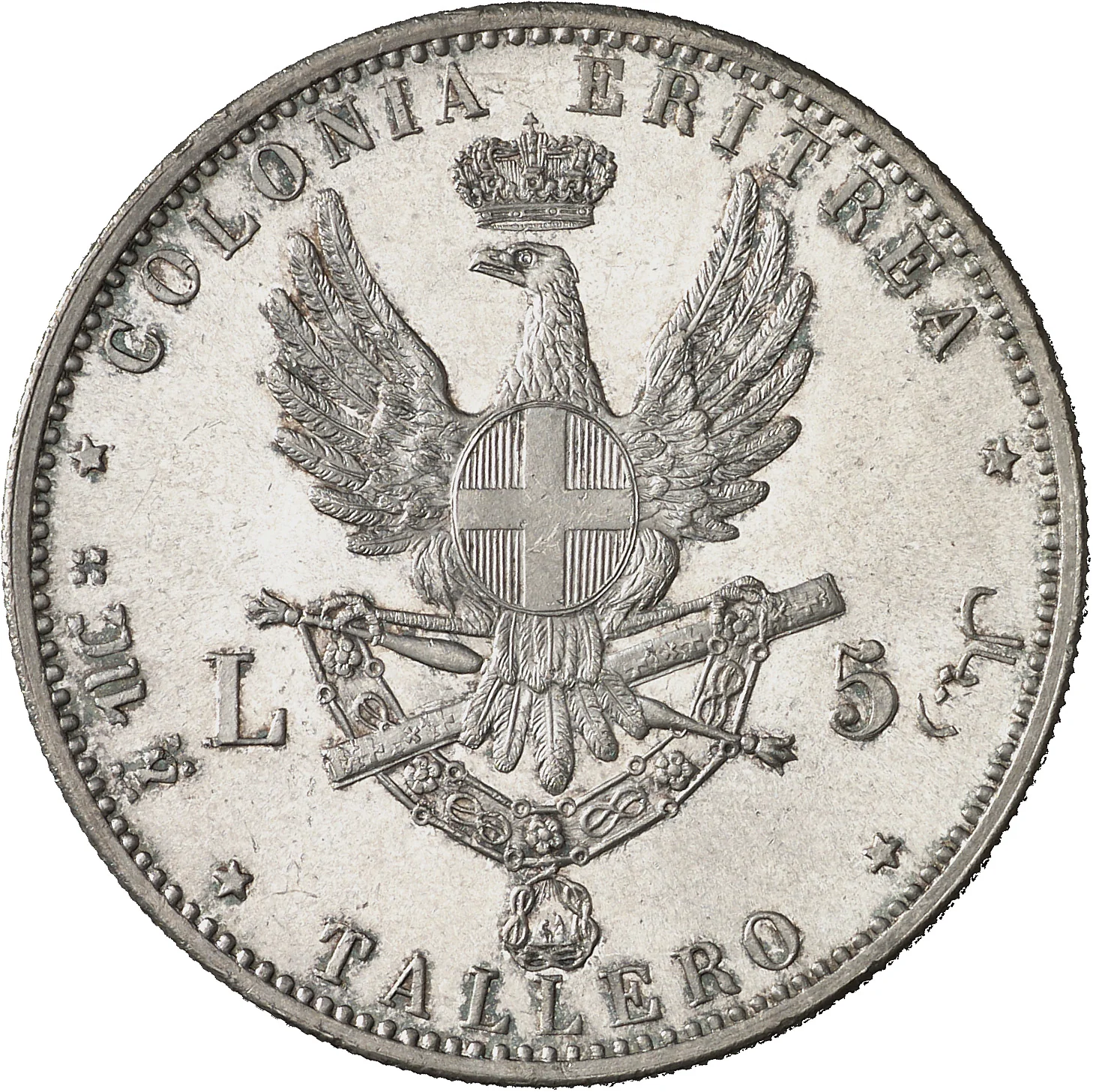
| Animal> Bird> Eagle |
| Person> Monarch |
| Mustache/Beard |
| Symbol> Crown |
| Symbols> Coat of Arms |
Mints
| Name | Mark |
|---|---|
| Rome | — |
Mintings
| Year | Mint Mark | Mintage | Quality | Collection |
|---|---|---|---|---|
| 1891 | — | 195,999 | ||
| 1896 | — | 200,000 |
Historical background
In 1891, the currency situation in Italian Eritrea was a complex and transitional one, reflecting the colony's recent establishment and Italy's broader imperial ambitions. The Italian government, having formally declared the colony in 1890, sought to impose economic order and integrate the territory into its sphere of influence. However, the practical reality on the ground was one of monetary pluralism. The Maria Theresa thaler (MTT), a large silver coin first minted in 1780, remained the dominant and most trusted medium of exchange for both local populations and regional trade. Its high silver content and consistent design made it a de facto stable currency across the Horn of Africa and the Red Sea region, stubbornly resisting immediate displacement.
Officially, Italy introduced the Italian lira as the sole legal tender, aiming to streamline administration and tie the colony's economy to the metropole. This policy was enforced for government transactions, salaries for colonial troops (Ascari), and payments to Italian officials and contractors. Despite this decree, the lira struggled to gain acceptance beyond these official circles. Its forced circulation at a fixed and often unrealistic exchange rate against the thaler led to distortions, widespread hoarding of thalers, and a thriving black market for currency exchange. The population, deeply accustomed to the thaler's tangible value, viewed the paper lire and even fractional silver coins with suspicion.
Consequently, the monetary landscape was effectively bifurcated. A dual-system emerged where the Italian lira functioned within the narrow confines of the colonial state apparatus and the growing communities of Italian settlers, while the Maria Theresa thaler continued to underpin the vast majority of local commerce, pastoral economies, and trade with neighboring Ethiopia and Sudan. This situation persisted for years, illustrating the limits of colonial power in immediately transforming deep-seated economic structures. The year 1891 thus represents a point of friction, where official Italian monetary policy clashed with the enduring practical and cultural authority of a pre-existing, regional currency.
Officially, Italy introduced the Italian lira as the sole legal tender, aiming to streamline administration and tie the colony's economy to the metropole. This policy was enforced for government transactions, salaries for colonial troops (Ascari), and payments to Italian officials and contractors. Despite this decree, the lira struggled to gain acceptance beyond these official circles. Its forced circulation at a fixed and often unrealistic exchange rate against the thaler led to distortions, widespread hoarding of thalers, and a thriving black market for currency exchange. The population, deeply accustomed to the thaler's tangible value, viewed the paper lire and even fractional silver coins with suspicion.
Consequently, the monetary landscape was effectively bifurcated. A dual-system emerged where the Italian lira functioned within the narrow confines of the colonial state apparatus and the growing communities of Italian settlers, while the Maria Theresa thaler continued to underpin the vast majority of local commerce, pastoral economies, and trade with neighboring Ethiopia and Sudan. This situation persisted for years, illustrating the limits of colonial power in immediately transforming deep-seated economic structures. The year 1891 thus represents a point of friction, where official Italian monetary policy clashed with the enduring practical and cultural authority of a pre-existing, regional currency.

🌟 Uncommon