

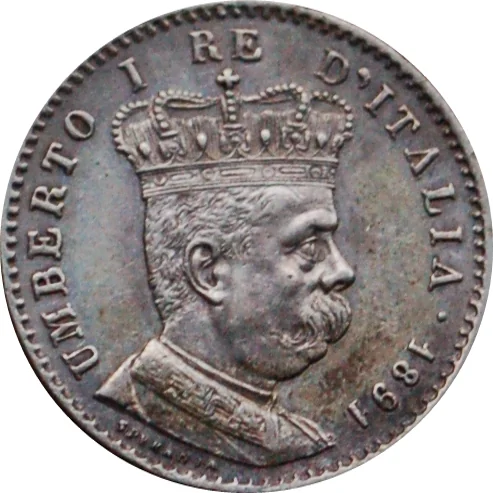
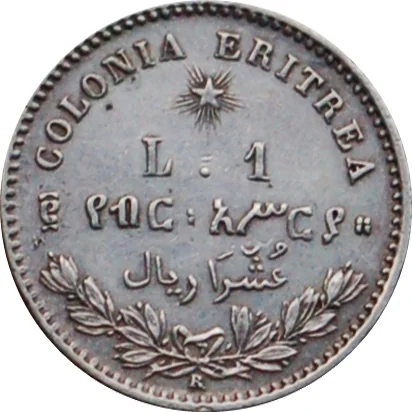
1 lira – Italian Eritrea
Add to wishlist
Eritrea
Context
Years: 1890–1896
Country: Eritrea
Issuer: Italian Eritrea
Ruler: Umberto I
Currency:
(1890—1921)
Demonetization: 4 September 1898
Total mintage: 4,500,000
Material
References
KM: #
Numista: #33271
Value
Bullion value: $10.63
Obverse
Description:
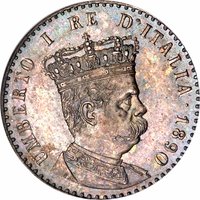
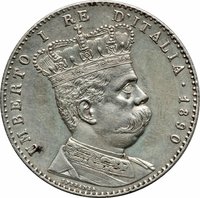
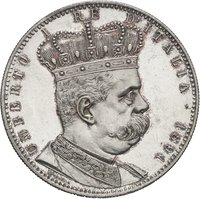
Umberto I crowned bust, right.
Inscription:
UMBERTO I RE D'ITALIA · 1891
Translation:
Umberto I King of Italy · 1891
Script: Latin
Language: Italian
Engraver: Filippo Speranza
Reverse
Edge
Reeded
Categories
| Symbol> Crown |
| Person> Monarch |
| Mustache/Beard |
Mints
| Name | Mark |
|---|---|
| Rome | R |
Historical background
Upon its official establishment as Italy’s first colony in 1890, Italian Eritrea inherited a complex monetary landscape. The region was a crossroads of trade, and its economy functioned on a multi-currency system dominated by the Austrian Maria Theresa thaler (MTT). This large silver coin, prized for its consistent silver content and recognizable image, was the de facto standard for high-value transactions and external trade. Alongside it, a variety of other silver and bronze coins circulated, including Ottoman, Egyptian, and Indian rupees, while barter remained common in rural areas.
The Italian administration faced immediate challenges in imposing monetary order. Their goal was to integrate Eritrea into Italy’s economic sphere, which required replacing the ubiquitous thaler with the Italian lira. To this end, they introduced a fixed exchange rate in 1891, decreeing that one Maria Theresa thaler would be valued at five Italian lire. However, this official rate often conflicted with the market value, leading to instability and confusion. The government also began issuing special silver talleri for the colony, stamped with the likeness of King Umberto I, but these failed to dislodge the trusted MTT from public preference.
Consequently, the early 1890s were characterized by a protracted period of dual circulation and monetary experimentation. The Italian lira was used for government salaries and payments to the state, but the Maria Theresa thaler remained entrenched in daily commerce and the minds of the local population. This unsatisfactory situation forced the colonial authorities to repeatedly adjust policies, setting the stage for a decades-long struggle to achieve a unified currency system, a goal that would remain elusive throughout much of the colonial period.
The Italian administration faced immediate challenges in imposing monetary order. Their goal was to integrate Eritrea into Italy’s economic sphere, which required replacing the ubiquitous thaler with the Italian lira. To this end, they introduced a fixed exchange rate in 1891, decreeing that one Maria Theresa thaler would be valued at five Italian lire. However, this official rate often conflicted with the market value, leading to instability and confusion. The government also began issuing special silver talleri for the colony, stamped with the likeness of King Umberto I, but these failed to dislodge the trusted MTT from public preference.
Consequently, the early 1890s were characterized by a protracted period of dual circulation and monetary experimentation. The Italian lira was used for government salaries and payments to the state, but the Maria Theresa thaler remained entrenched in daily commerce and the minds of the local population. This unsatisfactory situation forced the colonial authorities to repeatedly adjust policies, setting the stage for a decades-long struggle to achieve a unified currency system, a goal that would remain elusive throughout much of the colonial period.
🌟 Limited