

1 Franc – Switzerland
Switzerland
Context
Years: 1875–1967
Issuer: Switzerland 
Period:
(since 1848)
Currency:
(since 1850)
Demonetization: 1 April 1971
Total mintage: 134,891,028
Material
References
KM: #Click to copy to clipboard24
Numista: #184
Value
Exchange value: 1 CHF = $1.29
Bullion value: $12.11
Obverse
Description:
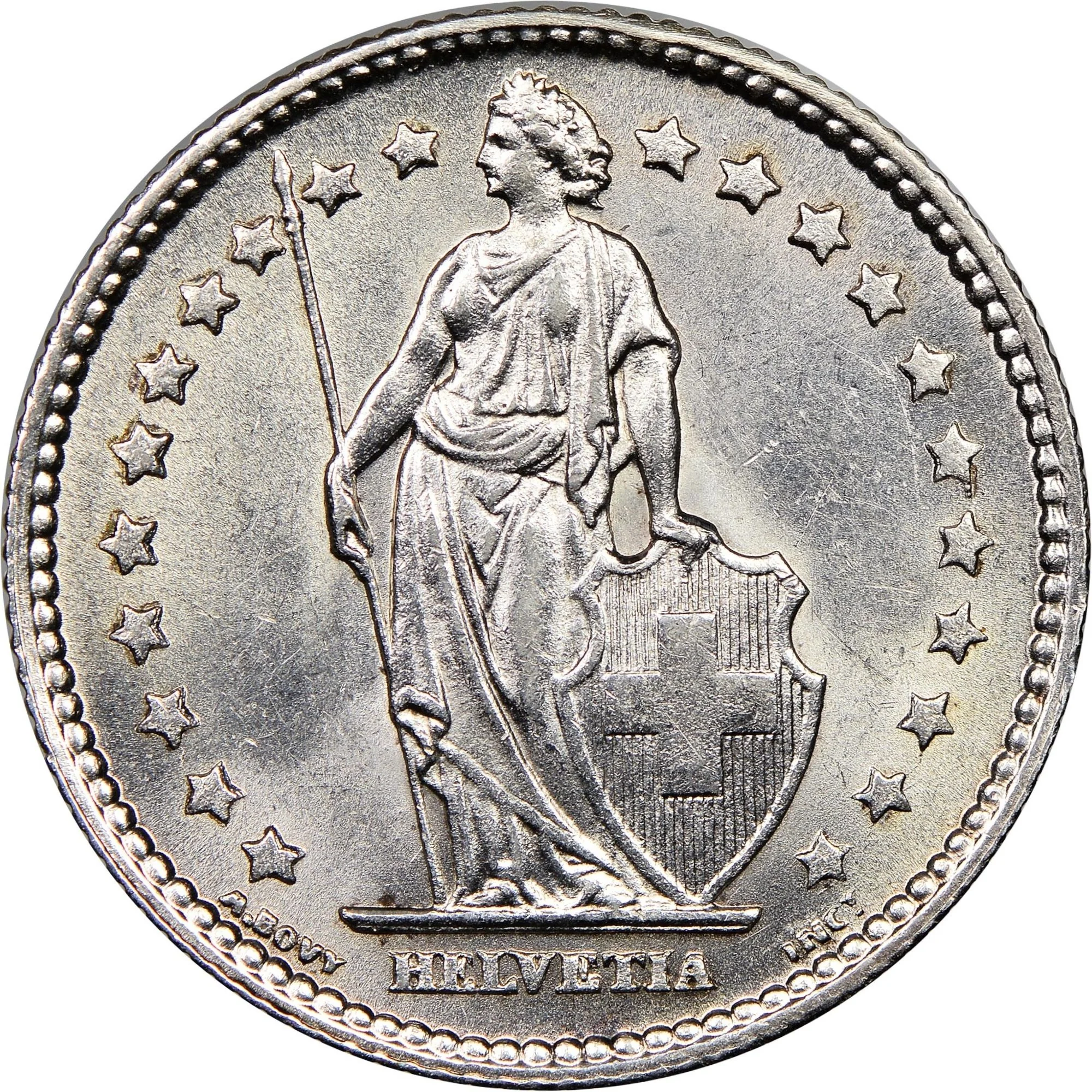
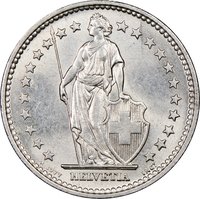
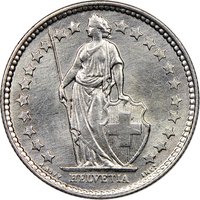
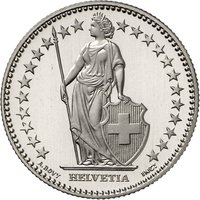
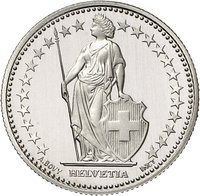
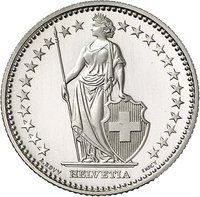
Helvetia standing left in a toga, holding a spear and a shield with the Swiss coat of arms, surrounded by 22 stars for the cantons.
Inscription:
HELVETIA
A . BOVY INCᵀ.
A . BOVY INCᵀ.
Translation:
Helvetia
A. Bovy, Engraver.
A. Bovy, Engraver.
Script: Latin
Engraver: Antoine Bovy
Designer: Albert Walch
Reverse
Description:
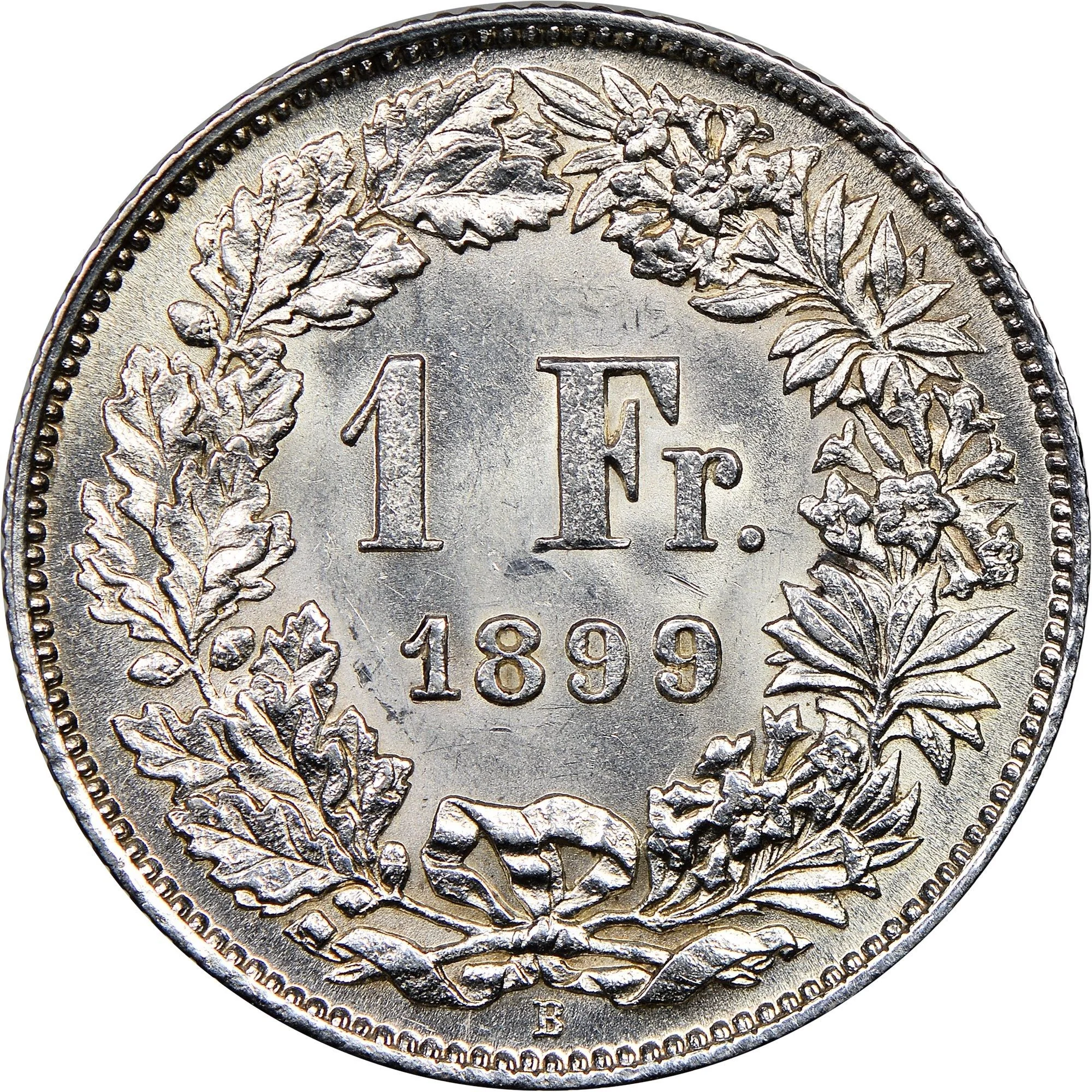
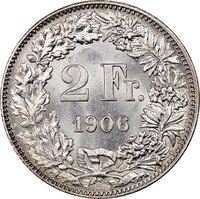
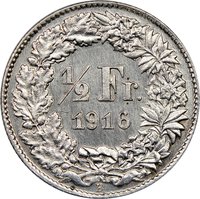
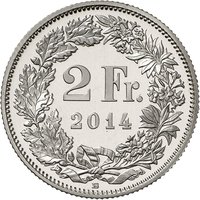
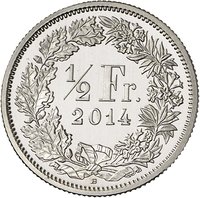
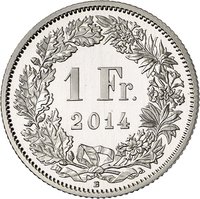
Oak and alpine rose wreath tied with a ribbon.
Inscription:
1 Fr.
1899
B
1899
B
Script: Latin
Engraver: Antoine Bovy
Designer: Friedrich Fisch
Edge
Reeded.
Mints
| Name | Mark |
|---|---|
| Bern | B |
Mintings
| Year | Mint Mark | Mintage | Quality | Collection |
|---|---|---|---|---|
| 1875 | B | 1,036,000 | ||
| 1876 | B | 2,500,000 | ||
| 1877 | B | 2,520,000 | ||
| 1880 | B | 945,000 | ||
| 1886 | B | 1,000,000 | ||
| 1887 | B | 1,000,000 | ||
| 1894 | A | 1,200,000 | ||
| 1896 | B | 28 | ||
| 1898 | B | 400,000 | ||
| 1899 | B | 400,000 | ||
| 1900 | B | 400,000 | ||
| 1901 | B | 400,000 | ||
| 1903 | B | 1,000,000 | ||
| 1904 | B | 400,000 | ||
| 1905 | B | 700,000 | ||
| 1906 | B | 700,000 | ||
| 1907 | B | 800,000 | ||
| 1908 | B | 1,200,000 | ||
| 1909 | B | 900,000 | ||
| 1910 | B | 1,000,000 | ||
| 1911 | B | 1,200,000 | ||
| 1912 | B | 1,200,000 | ||
| 1913 | B | 1,200,000 | ||
| 1914 | B | 4,200,000 | ||
| 1916 | B | 1,000,000 | ||
| 1920 | B | 3,300,000 | ||
| 1921 | B | 3,800,000 | ||
| 1928 | B | 1,500,000 | ||
| 1931 | B | 1,000,000 | ||
| 1932 | B | 500,000 | ||
| 1934 | B | 500,000 | ||
| 1936 | B | 500,000 | ||
| 1937 | B | 1,000,000 | ||
| 1939 | B | 2,106,000 | ||
| 1940 | B | 2,003,000 | ||
| 1943 | B | 3,526,000 | ||
| 1944 | B | 6,225,000 | ||
| 1945 | B | 7,794,000 | ||
| 1946 | B | 2,539,000 | ||
| 1947 | B | 624,000 | ||
| 1952 | B | 2,853,000 | ||
| 1953 | B | 786,000 | ||
| 1955 | B | 194,000 | ||
| 1956 | B | 2,500,000 | ||
| 1957 | B | 6,421,000 | ||
| 1958 | B | 3,580,000 | ||
| 1959 | B | 1,859,000 | ||
| 1960 | B | 3,523,000 | ||
| 1961 | B | 6,549,000 | ||
| 1962 | B | 6,220,000 | ||
| 1963 | B | 13,476,000 | ||
| 1964 | B | 12,560,000 | ||
| 1965 | B | 5,032,000 | ||
| 1966 | B | 3,032,000 | ||
| 1967 | B | 2,088,000 |
Historical background
In 1875, Switzerland stood at a pivotal moment of monetary unification, transitioning from a complex patchwork of cantonal and foreign currencies to a single, stable national system. For decades, the Swiss economy operated with a bewildering array of over 8,000 different coin types, primarily French francs, Italian lire, and various South German gulden, alongside local issues. This lack of uniformity created significant inefficiencies for trade and commerce, prompting the federal government, empowered by the revised Federal Constitution of 1874, to assert exclusive control over currency.
The Swiss Federal Coinage Act of 1850 had first attempted reform by introducing the Swiss franc, pegged to the French franc and based on a bimetallic (silver and gold) standard. However, the concurrent circulation of old and foreign coins persisted. The critical law of 1875, effective into 1876, mandated the withdrawal of all foreign currency and established the franc as the sole legal tender. Crucially, Switzerland joined the Latin Monetary Union (LMU), a transnational agreement with France, Belgium, and Italy that created a standardized gold and silver coinage across member states, ensuring fixed exchange rates and reciprocal acceptance.
Therefore, by the end of 1875, Switzerland had legally cemented its modern monetary foundation. The move was driven by pragmatic economic integration and the desire for stability, aligning the nation with its major trading partners through the LMU. This established the Swiss franc on a de facto gold standard, laying the institutional groundwork for the currency's future reputation for exceptional security and stability in the centuries to follow.
The Swiss Federal Coinage Act of 1850 had first attempted reform by introducing the Swiss franc, pegged to the French franc and based on a bimetallic (silver and gold) standard. However, the concurrent circulation of old and foreign coins persisted. The critical law of 1875, effective into 1876, mandated the withdrawal of all foreign currency and established the franc as the sole legal tender. Crucially, Switzerland joined the Latin Monetary Union (LMU), a transnational agreement with France, Belgium, and Italy that created a standardized gold and silver coinage across member states, ensuring fixed exchange rates and reciprocal acceptance.
Therefore, by the end of 1875, Switzerland had legally cemented its modern monetary foundation. The move was driven by pragmatic economic integration and the desire for stability, aligning the nation with its major trading partners through the LMU. This established the Swiss franc on a de facto gold standard, laying the institutional groundwork for the currency's future reputation for exceptional security and stability in the centuries to follow.
Series: Helvetia standing series
🌱 Very Common