

2 Francs – Switzerland
Switzerland
Context
Years: 1874–1967
Issuer: Switzerland 
Period:
(since 1848)
Currency:
(since 1850)
Demonetization: 1 April 1971
Total mintage: 73,550,000
Material
References
KM: #Click to copy to clipboard21
Numista: #188
Value
Exchange value: 2 CHF = $2.59
Bullion value: $23.90
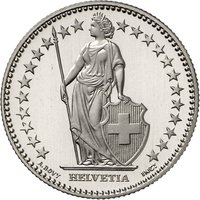
Obverse
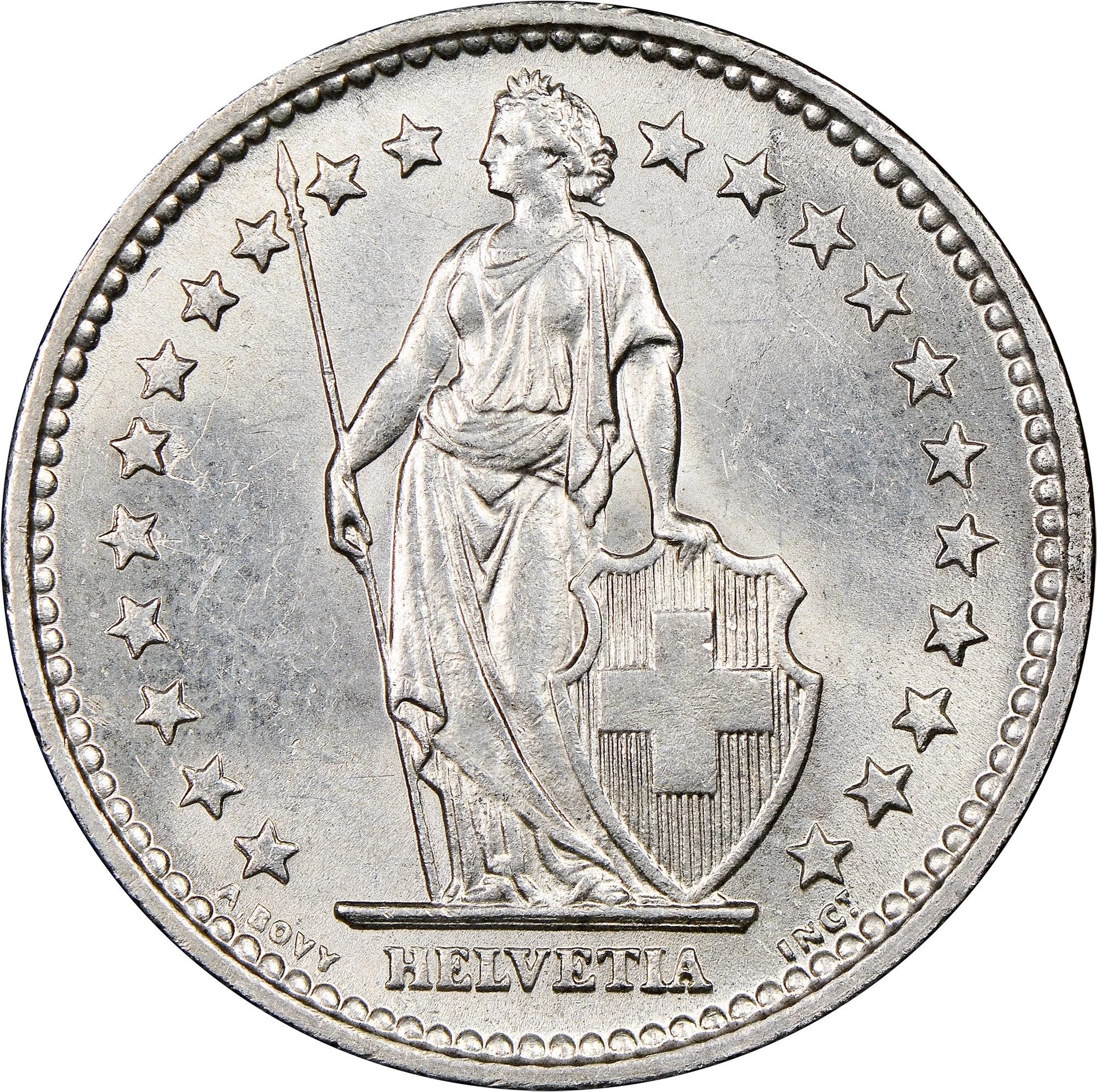
Description:
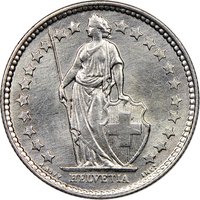
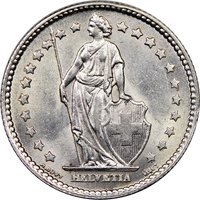
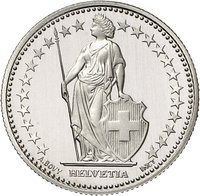
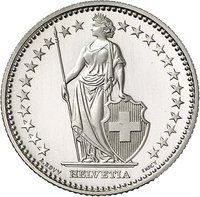
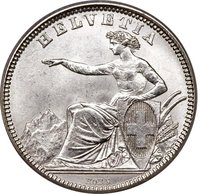
Helvetia standing left in a toga, holding a spear and a shield with the Swiss coat of arms, surrounded by 22 stars for the cantons.
Inscription:
HELVETIA
A . BOVY INCᵀ.
A . BOVY INCᵀ.
Translation:
Helvetia
A. Bovy, Engraver
A. Bovy, Engraver
Script: Latin
Engraver: Antoine Bovy
Designer: Albert Walch
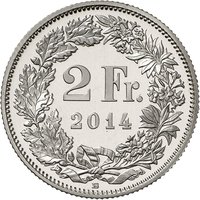
Reverse
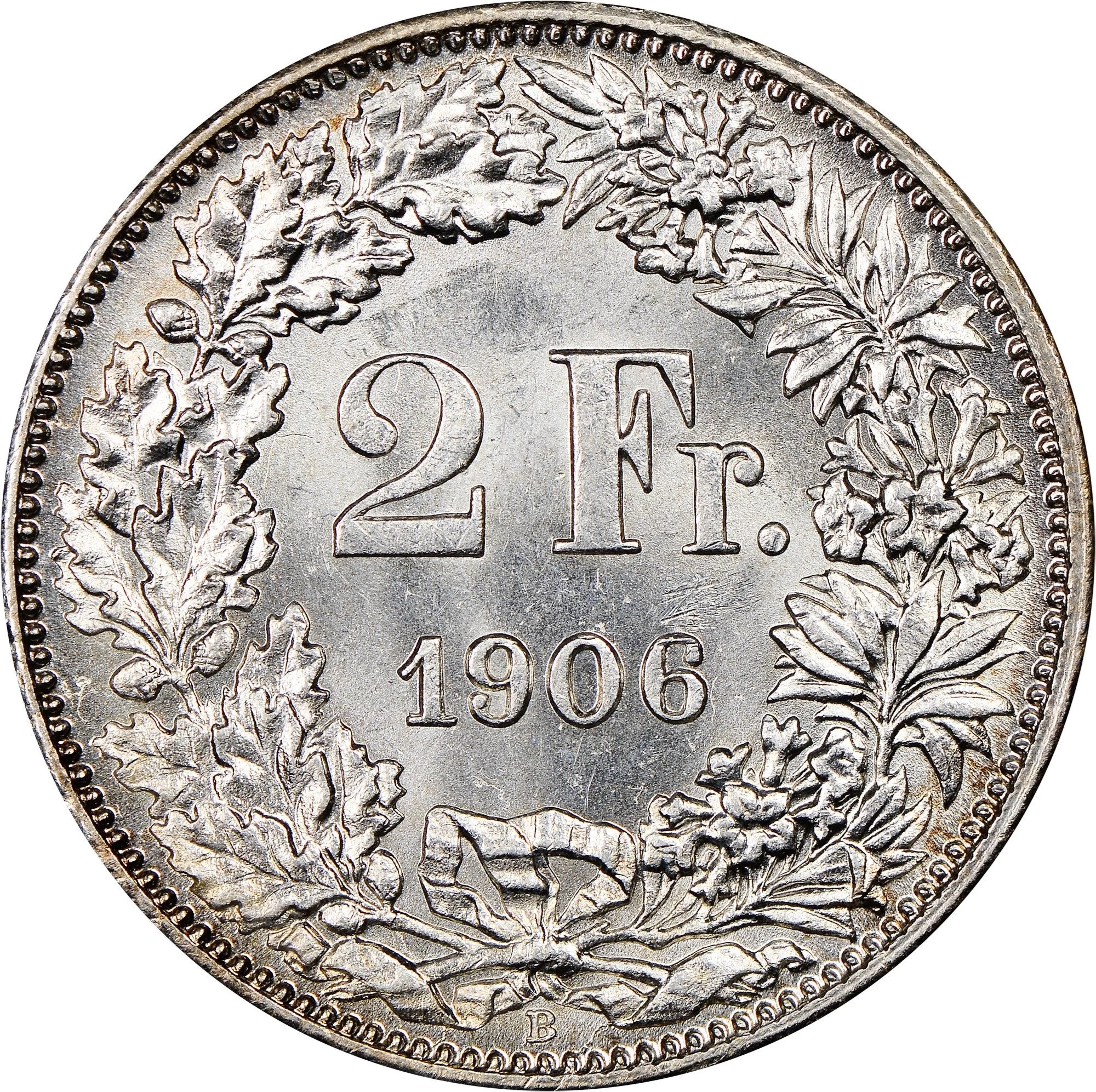
Description:
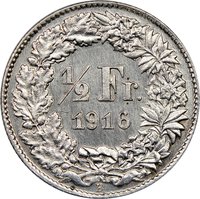
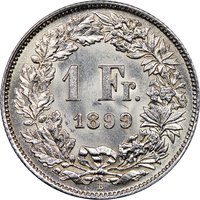
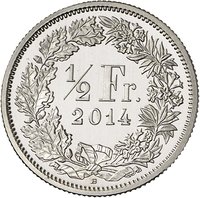
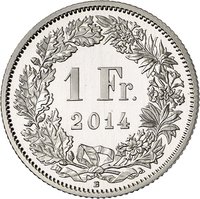
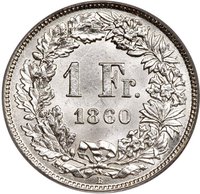
Oak and alpine rose wreath tied with a ribbon.
Inscription:
2 Fr.
1906
B
1906
B
Script: Latin
Engraver: Antoine Bovy
Designer: Friedrich Fisch
Edge
Reeded.
Mints
| Name | Mark |
|---|---|
| Bern | B |
Mintings
| Year | Mint Mark | Mintage | Quality | Collection |
|---|---|---|---|---|
| 1874 | B | 1,000,000 | ||
| 1875 | B | 982,000 | ||
| 1878 | B | 1,500,000 | ||
| 1879 | B | 518,000 | ||
| 1886 | B | 1,000,000 | ||
| 1894 | A | 700,000 | ||
| 1896 | B | — | ||
| 1901 | B | 50,000 | ||
| 1903 | B | 300,000 | ||
| 1904 | B | 200,000 | ||
| 1905 | B | 300,000 | ||
| 1906 | B | 400,000 | ||
| 1907 | B | 300,000 | ||
| 1908 | B | 200,000 | ||
| 1909 | B | 300,000 | ||
| 1910 | B | 250,000 | ||
| 1911 | B | 400,000 | ||
| 1912 | B | — | ||
| 1913 | B | 300,000 | ||
| 1914 | B | 1,000,000 | ||
| 1916 | B | 250,000 | ||
| 1920 | B | 2,300,000 | ||
| 1921 | B | 2,000,000 | ||
| 1922 | B | 400,000 | ||
| 1928 | B | 750,000 | ||
| 1931 | B | 500,000 | ||
| 1932 | B | 250,000 | ||
| 1936 | B | 250,000 | ||
| 1937 | B | 250,000 | ||
| 1939 | B | 1,455,000 | ||
| 1940 | B | 2,503,000 | ||
| 1941 | B | 1,192,000 | ||
| 1943 | B | 2,089,000 | ||
| 1944 | B | 6,276,000 | ||
| 1945 | B | 1,134,000 | ||
| 1946 | B | 1,629,000 | ||
| 1947 | B | 500,000 | ||
| 1948 | B | 920,000 | ||
| 1953 | B | 438,000 | ||
| 1955 | B | 1,032,000 | ||
| 1957 | B | 2,298,000 | ||
| 1958 | B | 650,000 | ||
| 1959 | B | 2,905,000 | ||
| 1960 | B | 1,980,000 | ||
| 1961 | B | 4,653,000 | ||
| 1963 | B | 8,030,000 | ||
| 1964 | B | 4,558,000 | ||
| 1965 | B | 8,526,000 | ||
| 1967 | B | 4,132,000 |
Historical background
In 1874, Switzerland was navigating a complex and fragmented monetary landscape, a direct legacy of its federal structure. Prior to the 1848 constitution, the right to coin money was held by the individual cantons and even some private banks, resulting in a bewildering array of over 800 different coins in circulation. While the 1848 constitution granted the exclusive right to mint coinage to the federal government, the practical implementation was slow. The first federal coinage law of 1850 introduced the Swiss franc, pegged to the French franc and based on a bimetallic (silver and gold) standard, but it did not fully eliminate foreign and old cantonal currencies from daily use.
The critical turning point arrived with the Federal Coinage Act of 1874, a landmark piece of legislation passed in the wake of the revised federal constitution of 1874, which strengthened central authority. This act went beyond coinage to decisively establish the Swiss franc as the sole legal tender throughout the Confederation, finally abolishing the remaining foreign currencies (primarily French, Italian, and Belgian coins) that still circulated. More significantly, it prepared Switzerland for participation in the Latin Monetary Union (LMU), a supranational bimetallic system it had joined in 1865 but now fully committed to through domestic law.
Therefore, the currency situation in 1874 was one of decisive federal consolidation and international alignment. The new law created a uniform, stable national currency, eliminating the last vestiges of monetary cantonalism and foreign dependence. By legally anchoring Switzerland's place in the LMU, it ensured that the Swiss franc maintained a fixed parity with the currencies of France, Belgium, Italy, and later Greece, facilitating trade and providing stability, though it also meant Switzerland's monetary policy was partly influenced by this international agreement until the Union's effective dissolution in the early 20th century.
The critical turning point arrived with the Federal Coinage Act of 1874, a landmark piece of legislation passed in the wake of the revised federal constitution of 1874, which strengthened central authority. This act went beyond coinage to decisively establish the Swiss franc as the sole legal tender throughout the Confederation, finally abolishing the remaining foreign currencies (primarily French, Italian, and Belgian coins) that still circulated. More significantly, it prepared Switzerland for participation in the Latin Monetary Union (LMU), a supranational bimetallic system it had joined in 1865 but now fully committed to through domestic law.
Therefore, the currency situation in 1874 was one of decisive federal consolidation and international alignment. The new law created a uniform, stable national currency, eliminating the last vestiges of monetary cantonalism and foreign dependence. By legally anchoring Switzerland's place in the LMU, it ensured that the Swiss franc maintained a fixed parity with the currencies of France, Belgium, Italy, and later Greece, facilitating trade and providing stability, though it also meant Switzerland's monetary policy was partly influenced by this international agreement until the Union's effective dissolution in the early 20th century.
Series: Helvetia standing series
🌱 Very Common