

8 Gute Groschen – Brunswick-Lüneburg-Celle
Standard circulation coins
Series: Thaler
Germany
Context
Years: 1694–1698
Country: Germany 
Issuer: Brunswick-Lüneburg-Celle
Ruler: George William
Currency:
Demonetized: Yes
Material
References
KM: #Click to copy to clipboard347.1
Numista: #371765
Value
Bullion value: $22.50
Obverse
Description:
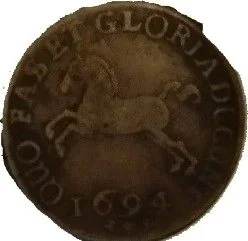
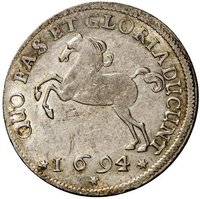
Rearing horse, date flanked by rosettes.
Inscription:
QUO FAS ET GLORIA DUCUNT
🟌 1694 🟌
🟌
🟌 1694 🟌
🟌
Script: Latin
Reverse
Description:
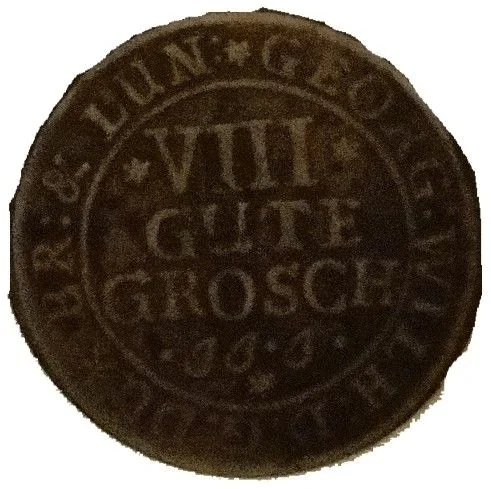
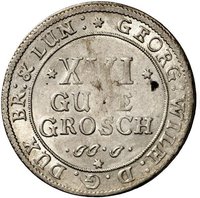
Three lines of value.
Mint mark beneath.
Mint mark beneath.
Inscription:
DUX BR:& LUN: GEORG:WILH:D.G.
🟌 VIII 🟌
GU.TE
GROSCH:
.JJ.J.
🟌
🟌 VIII 🟌
GU.TE
GROSCH:
.JJ.J.
🟌
Script: Latin
Edge
Plain
Mints
| Name | Mark |
|---|---|
| Celle | — |
Mintings
| Year | Mint Mark | Mintage | Quality | Collection |
|---|---|---|---|---|
| 1694 | — | — | ||
| 1698 | — | — |
Historical background
In 1694, the Duchy of Brunswick-Lüneburg, specifically the Principality of Celle under Duke George William, was grappling with severe monetary instability common across the Holy Roman Empire. The region was plagued by the circulation of vastly debased coinage, a legacy of the Kipper und Wipper period earlier in the century, where states competitively lowered the silver content of coins to fund expenditures, eroding public trust. This chaotic system of multiple, deteriorating currencies hampered trade, created price volatility, and complicated the ducal finances, especially as Celle maintained a relatively powerful and modern standing army that required reliable funding.
Duke George William’s administration responded with a significant monetary reform in 1694, aimed at establishing a stable and uniform currency. The cornerstone was the introduction of the Celler Taler, a new silver coin minted to a strict and reliable standard of purity and weight. This reform was not undertaken in isolation; it was carefully aligned with the currency of the neighboring Electorate of Brunswick-Lüneburg (Hanover), ruled by his brother, Duke Ernest Augustus. This coordination was a strategic move to facilitate trade and economic stability across the family's intertwined territories.
The 1694 reform was a notable success, temporarily restoring confidence in the principality's currency and simplifying fiscal transactions. It demonstrated the growing administrative capability of the state to assert control over a key economic lever. However, the underlying pressures of frequent military conflicts and the complex, fragmented monetary landscape of the Empire meant that maintaining this stability was an ongoing challenge. The reform laid important groundwork for the eventual financial integration of Celle with Hanover in 1705 upon George William's death, moving the region a step closer to the unified monetary systems of the modern era.
Duke George William’s administration responded with a significant monetary reform in 1694, aimed at establishing a stable and uniform currency. The cornerstone was the introduction of the Celler Taler, a new silver coin minted to a strict and reliable standard of purity and weight. This reform was not undertaken in isolation; it was carefully aligned with the currency of the neighboring Electorate of Brunswick-Lüneburg (Hanover), ruled by his brother, Duke Ernest Augustus. This coordination was a strategic move to facilitate trade and economic stability across the family's intertwined territories.
The 1694 reform was a notable success, temporarily restoring confidence in the principality's currency and simplifying fiscal transactions. It demonstrated the growing administrative capability of the state to assert control over a key economic lever. However, the underlying pressures of frequent military conflicts and the complex, fragmented monetary landscape of the Empire meant that maintaining this stability was an ongoing challenge. The reform laid important groundwork for the eventual financial integration of Celle with Hanover in 1705 upon George William's death, moving the region a step closer to the unified monetary systems of the modern era.
✨ Legendary