

16 gute groschen – Brunswick-Lüneburg-Celle
Add to wishlist
Standard circulation coins
Series: Thaler
Germany
Context
Years: 1693–1698
Country: Germany
Issuer: Brunswick-Lüneburg-Celle
Ruler: George William
Currency:
Demonetized: Yes
Material
References
KM: #
Numista: #337894
Value
Bullion value: $43.55
Obverse
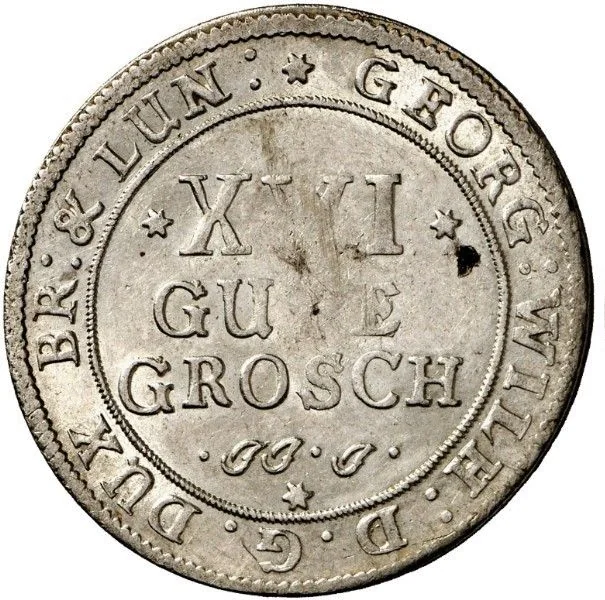
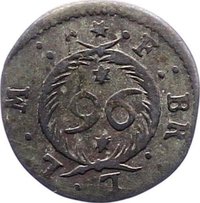
Description:
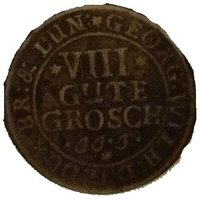
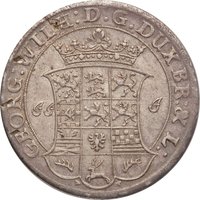
Three lines of value.
Mint mark beneath.
Mint mark beneath.
Inscription:
DUX BR : & LUN : GEORG : WILH : D . G .
🟌 XVI 🟌
GUTE
GROSCH
.JJ.J.
🟌
🟌 XVI 🟌
GUTE
GROSCH
.JJ.J.
🟌
Script: Latin
Reverse
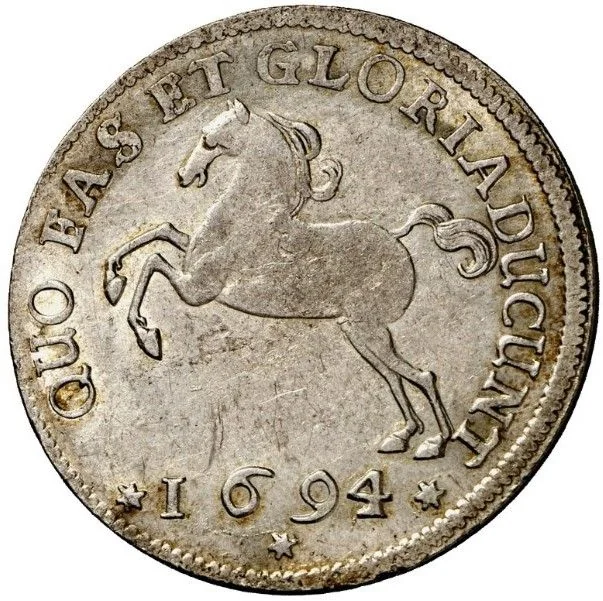
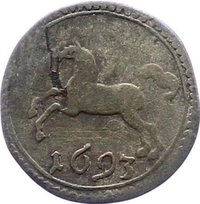
Description:
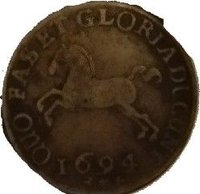
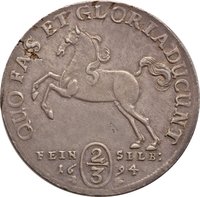
Rearing horse, date flanked by rosettes.
Inscription:
QUO FAS ET GLORIA DUCUNT
🟌 1694 🟌
🟌
🟌 1694 🟌
🟌
Script: Latin
Edge
Plain
Mints
| Name | Mark |
|---|---|
| Celle | — |
Mintings
| Year | Mint Mark | Mintage | Quality | Collection |
|---|---|---|---|---|
| 1693 | — | — | ||
| 1694 | — | — | ||
| 1698 | — | — |
Historical background
In 1693, the Duchy of Brunswick-Lüneburg, specifically the Principality of Celle under Duke George William, was entangled in the complex and debased currency landscape of the Holy Roman Empire. The period was defined by the Kipper- und Wipperzeit, an era of rampant currency manipulation where numerous states, including neighboring principalities, were debasing their coinage to fund military expenditures, particularly for the ongoing Nine Years' War (1688-1697). This created a chaotic monetary environment where bad coinage drove out the good, causing inflation, economic distrust, and severe disruption to trade.
Duke George William, however, pursued a notably responsible and stabilizing policy in this context. Recognizing the long-term economic damage caused by debasement, he resisted the temptation to drastically lower the silver content of Celle's coins. Instead, he maintained a relatively stable and high-quality thaler currency, which earned a strong reputation for reliability. This policy made Celle a monetary haven, attracting higher-value coinage into the principality and facilitating more secure commerce, even as surrounding regions suffered from monetary chaos.
Consequently, the currency situation in Brunswick-Lüneburg-Celle in 1693 was one of deliberate exception and relative stability amidst regional turmoil. While the broader empire grappled with a crisis of confidence in its money, Celle’s commitment to sound coinage strengthened its local economy and the Duke's fiscal standing. This prudent management contrasted sharply with the short-term gains sought by other rulers and laid a foundation for the economic cohesion that would later support the elevation of the Hanoverian line to the British throne.
Duke George William, however, pursued a notably responsible and stabilizing policy in this context. Recognizing the long-term economic damage caused by debasement, he resisted the temptation to drastically lower the silver content of Celle's coins. Instead, he maintained a relatively stable and high-quality thaler currency, which earned a strong reputation for reliability. This policy made Celle a monetary haven, attracting higher-value coinage into the principality and facilitating more secure commerce, even as surrounding regions suffered from monetary chaos.
Consequently, the currency situation in Brunswick-Lüneburg-Celle in 1693 was one of deliberate exception and relative stability amidst regional turmoil. While the broader empire grappled with a crisis of confidence in its money, Celle’s commitment to sound coinage strengthened its local economy and the Duke's fiscal standing. This prudent management contrasted sharply with the short-term gains sought by other rulers and laid a foundation for the economic cohesion that would later support the elevation of the Hanoverian line to the British throne.
✨ Legendary