

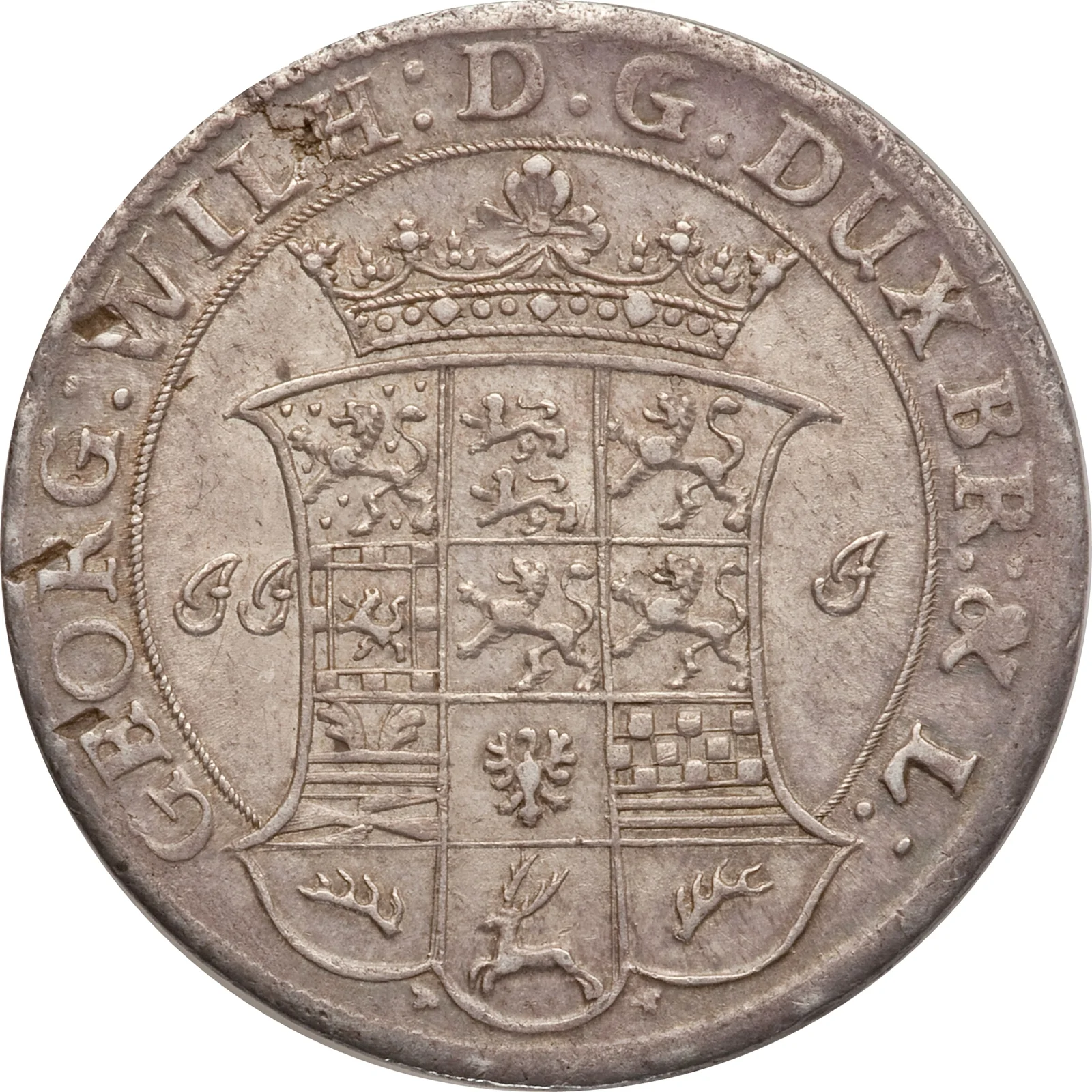
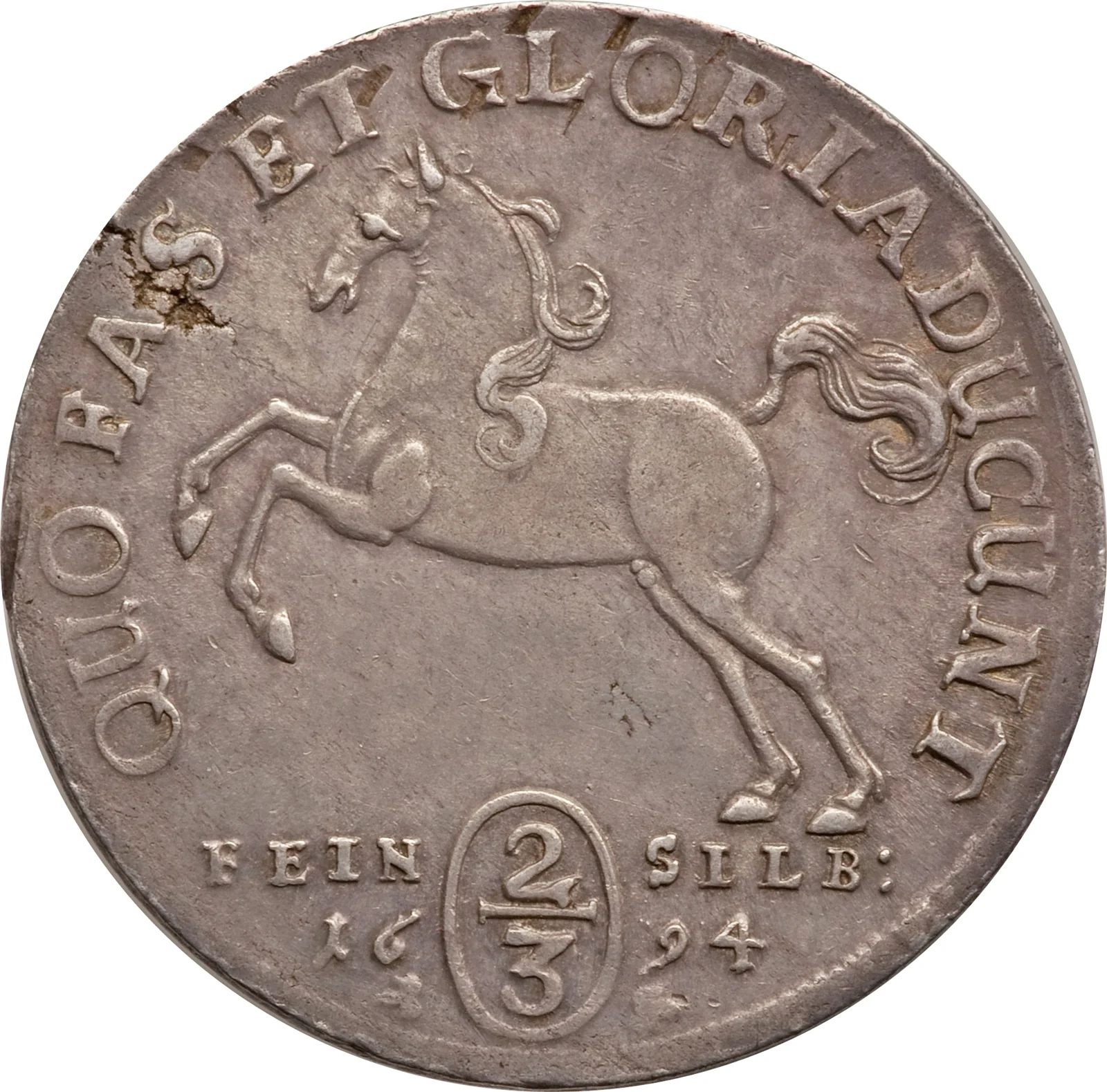
⅔ Thaler – Brunswick-Lüneburg-Celle
Germany
Context
Years: 1692–1697
Country: Germany 
Issuer: Brunswick-Lüneburg-Celle
Ruler: George William
Currency:
Demonetized: Yes
Material
References
KM: #Click to copy to clipboard346
Numista: #21166
Obverse
Description:
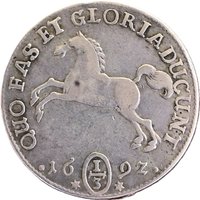
Horse rearing left above the face value, within an oval splitting the date 1692.
Inscription:
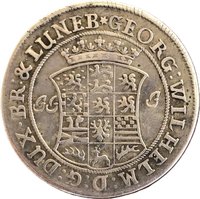
GEORG:WILHELM:D:G:DUX.BRUNS & LUNEB
Script: Latin
Reverse
Edge
Mints
| Name | Mark |
|---|---|
| Celle | — |
Mintings
| Year | Mint Mark | Mintage | Quality | Collection |
|---|---|---|---|---|
| 1692 | — | — | ||
| 1693 | — | — | ||
| 1694 | — | — | ||
| 1697 | — | — |
Historical background
In 1692, the Duchy of Brunswick-Lüneburg, specifically the sub-principality of Celle under Duke George William, operated within the complex monetary landscape of the Holy Roman Empire. The region was part of the northern German Thaler currency zone, but its economy was burdened by a proliferation of different coins from neighboring states and a legacy of debased coinage from earlier conflicts. The official unit of account was the Thaler, divided into 24 Gute Groschen or 36 Mariengroschen, but in practice, a混乱 (chaos) of Reichsthalers, Gulden, and various smaller coins circulated, their values fluctuating based on metallic content and origin.
This monetary fragmentation was exacerbated by the ongoing Nine Years' War (1688-1697), in which Duke George William, as a close ally of the Habsburg Emperor, was a committed participant. The financial strain of maintaining troops led to fiscal pressures, including the temptation to engage in Kippermünze (clipping or debasement) to generate short-term revenue, though George William was generally more restrained than some contemporaries. The need to pay soldiers and suppliers, often from abroad, forced the ducal treasury to constantly manage and exchange a multitude of foreign currencies, further complicating domestic trade and taxation.
Consequently, the currency situation in 1692 was one of precarious stability, managed through administrative effort rather than systemic soundness. The ducal mint in Celle worked to maintain standards, but the broader system suffered from a lack of uniformity. This environment highlighted the urgent need for the imperial currency reforms that would later be attempted with the Reichsmünzordnung of 1694, which aimed, with limited success, to standardize the thaler across the Empire and reduce the monetary chaos experienced by territories like Brunswick-Lüneburg-Celle.
This monetary fragmentation was exacerbated by the ongoing Nine Years' War (1688-1697), in which Duke George William, as a close ally of the Habsburg Emperor, was a committed participant. The financial strain of maintaining troops led to fiscal pressures, including the temptation to engage in Kippermünze (clipping or debasement) to generate short-term revenue, though George William was generally more restrained than some contemporaries. The need to pay soldiers and suppliers, often from abroad, forced the ducal treasury to constantly manage and exchange a multitude of foreign currencies, further complicating domestic trade and taxation.
Consequently, the currency situation in 1692 was one of precarious stability, managed through administrative effort rather than systemic soundness. The ducal mint in Celle worked to maintain standards, but the broader system suffered from a lack of uniformity. This environment highlighted the urgent need for the imperial currency reforms that would later be attempted with the Reichsmünzordnung of 1694, which aimed, with limited success, to standardize the thaler across the Empire and reduce the monetary chaos experienced by territories like Brunswick-Lüneburg-Celle.
💎 Extremely Rare